

When the market is "pouring," most participants try to reduce risk: they close positions, lock in losses, or simply go to cash. Against this backdrop, the Bitmine strategy is particularly noticeable: the company continues to build up its reserve $ETH specifically during price declines, and it does this not with one large order, but with a series of "waves" — several purchases spread over time. This approach usually solves two tasks: averaging the entry price and reducing market impact to avoid heating the price against themselves at the time of purchase.

According to public updates from the company itself, in recent days the volume of additional purchases is measured in hundreds of millions of dollars, while weekly replenishments are in the tens and hundreds of thousands of ETH. At the same time, scale benchmarks were revealed: the total treasury volume in ETH is already at the level of millions of coins, making the bet not tactical, but strategic, with a horizon of 'surviving volatility and waiting for the cycle.'
An important nuance: 'wave' buying on the dip is also a form of providing liquidity to the market. When market sales prevail during a decline, a large buyer can partially stabilize the order book, turning chaotic sell-offs into a more manageable decline. However, this coin has a flip side: the greater the concentration of an asset on the balance of one entity, the more the market begins to depend on its behavior - whether it will continue to buy, whether it will face capital constraints, whether it will change its strategy. In such situations, price support can be 'reflexive': the expectation of future purchases becomes a factor in the current price.
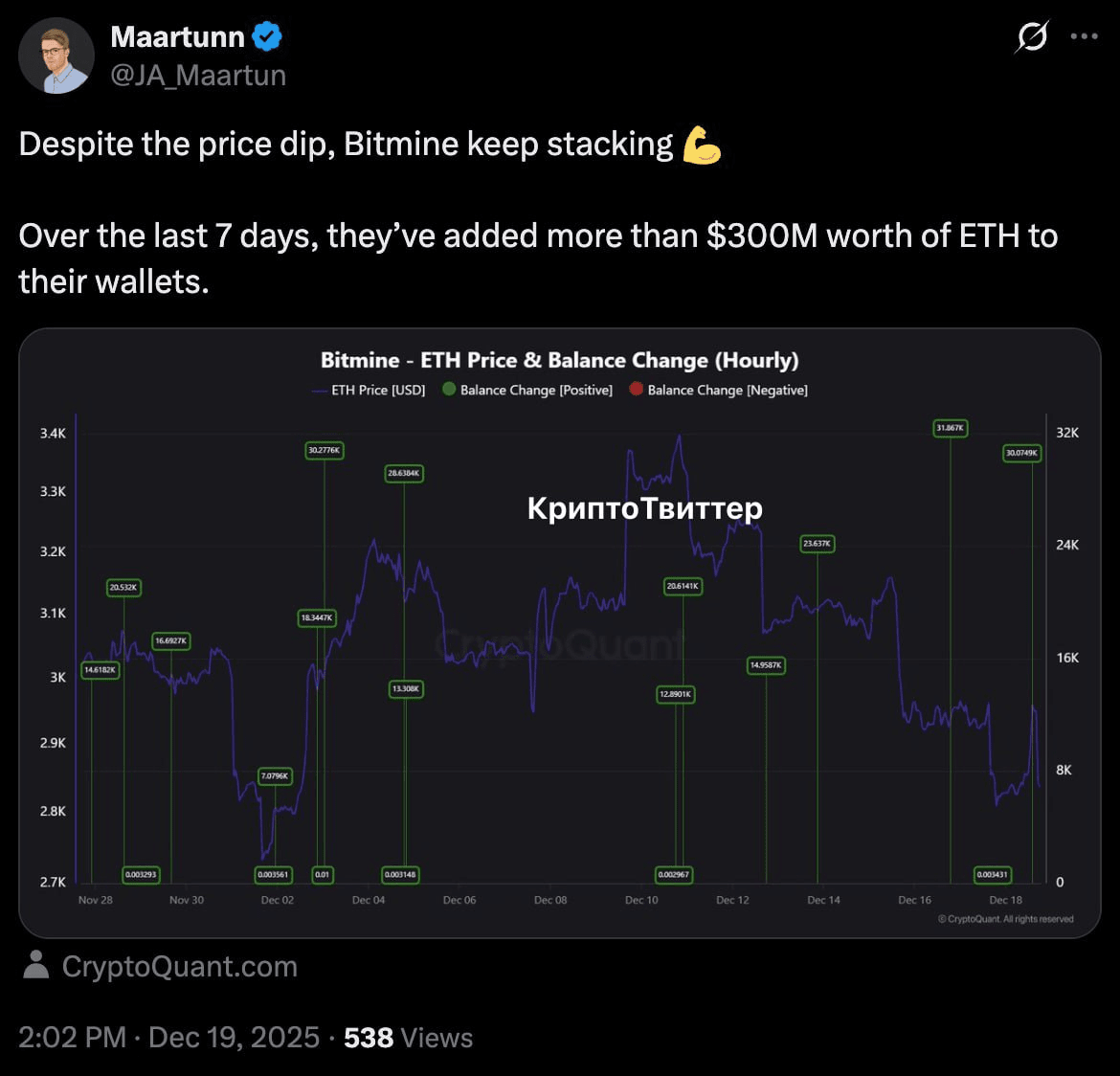
Therefore, the main question here is not even whether the buyer is right about the market direction, but about the sustainability of the model. If purchases are financed from 'long' capital and the company is willing to hold the asset through downturns, accumulation waves can look like a disciplined DCA on an institutional scale. However, if the pace of accumulation is tied to market conditions (liquidity, availability of financing, investor sentiment), then the risk shifts from 'the price of ETH will fall' to 'the strategy will become fragile precisely at the moment when the market becomes stressful again.'