The article tells the story of the rise and fall of Binance's stablecoin BUSD, from the initial hegemonic unified market liquidity to the shift towards an aggregation strategy after regulatory crackdowns, ultimately leading to the launch of United Stables ($U) to accommodate multiple stablecoins and position for the AI economy.
Article author: Agintender
Source: Mars Finance
In the world of cryptocurrency, the real determinants of victory and defeat have never been code, but rather the game between liquidity, power, and regulation. The rise and fall of BUSD is not a tale of the blood and tears of a stablecoin, but a financial war about how exchanges attempt to 'unify the world.'
When BUSD was thrust onto the historical stage, it carried not just a compliant narrative but also Binance's ambition to reshape the stablecoin order through high-pressure means—by enforcing exchange rates and merging trading pairs, directly swallowing the depth of competitors into its own ledger.
The 'automatic conversion' of 2022 was a textbook-style blitzkrieg; while the regulatory hammer on Valentine's Day 2023 caused this seemingly flawless empire to collapse in an instant. The twin BUSDs, the shadowy Binance-Peg, and the misalignment of regulatory boundaries together formed its Achilles' heel.
But the story does not end here.
From FDUSD to BFUSD, and then to United Stables ($U), Binance has not given up on stablecoins but has evolved through failure, shifting from hegemony-style unity to aggregation-style consumption, even paving the way for the AI economy.
This is an article about stablecoins, and also a documentary about how exchanges attempt to tame the market and are countered by regulations.
Chapter One: Passion and Hegemony—The 'Great Unity' Tale of BUSD
The story of BUSD is not just about the rise and fall of compliant products, but a tale of how exchanges attempted to unify market liquidity through administrative means, only to be countered by regulators.
1.1 Recognizing the Micro: Dinner between CZ and Richmond Teo
In 2019, the stablecoin market was the Wild West of Tether. At this time, Richmond Teo, as the co-founder and Asia CEO of Paxos, became a key bridge connecting New York regulators and Asian crypto giants.
An industry rumor, seemingly false yet widely believed, circulated that on the eve of BUSD's release, shortly after Paxos celebrated its compliance status in a blog post, Rich Teo and CZ were spotted dining together at a high-end restaurant overseas. After that dinner, the situation changed suddenly: Huobi's HUSD gradually fell from grace, and Paxos established itself as the 'full-time custodian' of BUSD. CZ entrusted Binance's liquidity backing to Teo, while Teo used the 'green list' license from the New York State Department of Financial Services (NYDFS) to give Binance a bulletproof vest.
1.2 Passionate Moment: 2022's 'Exchange Rate Unification Blitzkrieg'
The most 'passionate' and controversial moment in BUSD's history occurred in September 2022. To challenge the dominance of USDT and USDC, Binance launched a stunning 'liquidity unification' initiative.
Binance announced that existing user balances and newly deposited USDC, USDP (Paxos Dollar), and TUSD (TrueUSD) will be automatically converted to BUSD at a 1:1 ratio.
Binance directly removed the spot trading pairs for USDC, USDP, and TUSD. This means that in Binance, the largest liquidity pool globally, although users can deposit USDC, they can only see and use BUSD on paper. (However, when withdrawing, they can withdraw USDT or USDC)
This was a blatant conspiracy. By forcibly merging liquidity, BUSD instantly gained trading depth that originally belonged to competitors. Circle (USDC issuer) CEO Jeremy Allaire stated on Twitter that this helps increase dollar liquidity, but in reality, USDC's brand presence in the Binance ecosystem was forcibly erased, becoming the 'fuel' for BUSD.
This radical strategy had a significant effect. BUSD's market cap skyrocketed to a historical peak of $23 billion in November 2022, once accounting for half of the trading volume on centralized exchanges. That was the most glorious moment for BUSD and the peak of Binance's ambition to establish an independent financial closed loop.
1.3 The 'Valentine's Day Massacre' of Regulation
However, this 'great unity' situation came to an abrupt halt on February 13, 2023. NYDFS pointed out that the 'Binance-Peg BUSD' issued by Binance (a shadow version issued for use on the BNB Chain) exceeded Paxos's regulatory scope and ordered a halt to minting. The market cap of BUSD fell from a peak of $23 billion to zero, and the empire built through 'automatic conversion' collapsed under the regulatory hammer.
For Teo, this is undoubtedly a heavy blow. As an architect, he watched helplessly as the “child” he raised alongside CZ was forcibly euthanized. Paxos was forced to announce a severance of ties with Binance, and Teo subsequently entered a low-profile period lasting over a year.
However, the story does not end here. Rich Teo's high-profile comeback in the Trump family's crypto project World Liberty Financial (WLFI) is seen as a continuation of his story with CZ. Teo is leveraging new political capital to build a new compliant stablecoin (USD1), while WLFI deeply relies on the liquidity of BNB Chain. This seems to be a more subtle and indirect way for two old friends to continue their 'liquidity pact' in the regulatory gap.
Chapter Two: Achilles' Heel — 'Twins' and the Thunder of Regulation
2.1 Fatal Structural Defect: Binance-Peg BUSD
Behind BUSD's brilliance lies a structural risk that ultimately led to its destruction. In fact, there are two completely different forms of BUSD circulating in the market:
BUSD issued by Paxos (ERC-20): This is the real 'compliant BUSD', issued by Paxos on the Ethereum blockchain, directly regulated by NYDFS, with reserves strictly held in segregated accounts in the U.S.
Binance-Peg BUSD (BEP-20, etc.): This is a 'wrapped token' created by Binance to expand its ecosystem to non-Ethereum chains (such as BNB Chain, Polygon, Avalanche).
Theoretically, the mechanism of Binance-Peg BUSD is: Binance locks 1 Paxos BUSD on Ethereum, and then mints 1 Binance-Peg BUSD on the BNB Chain. However, this 'bridging' mechanism entirely relies on Binance's internal operations, rather than direct management by Paxos. NYDFS's regulatory authority and 'green list' only cover Paxos BUSD on Ethereum, not Binance-Peg BUSD.
The outbreak of the problem lies in the disconnect in reserve management. Investigations by Bloomberg and other media revealed that during certain periods from 2020 to 2021, wallets supporting Binance-Peg BUSD exhibited severe 'under-collateralization', with a gap reaching as high as $1 billion. Although Binance claimed this was merely an 'operational delay' rather than a solvency issue, it directly violated the bottom line of regulators: a stablecoin branded with 'NYDFS regulation' had derived an unregulated and poorly managed 'shadow version'.
2.2 The Hammer of Regulation: The 'Valentine's Day Massacre' of 2023
The fate of BUSD came to an abrupt halt on February 13, 2023. On this day, the New York State Department of Financial Services (NYDFS) issued an administrative order requiring Paxos to immediately stop minting new BUSD tokens.
The reasons from regulators are very clear and lethal: Paxos failed to effectively supervise its relationship with Binance, particularly regarding the issuance of Binance-Peg BUSD, which allowed compliant BUSD to be used as an endorsement tool for unauthorized derivatives. NYDFS explicitly stated: “While we authorized BUSD on Ethereum, we never authorized Binance-Peg BUSD.”
At the same time, the U.S. Securities and Exchange Commission (SEC) issued a Wells Notice to Paxos, accusing BUSD of being an 'unregistered security.' The logic behind this accusation is that BUSD is not just a payment tool; it is part of Binance's profit mechanism (through Earn products, etc.), and therefore may constitute an investment contract. Although the SEC later dropped this specific investigation in July 2024, the dual blows at that time were already fatal.
2.3 The Fall and Retreat
“Stop Minting” means BUSD has become a “zombie token” that can only be redeemed and not minted. This is a death sentence for an asset intended to serve as a medium of liquidity. With Paxos announcing the termination of its partnership with Binance, BUSD's market cap began free-falling. Within just a few days, hundreds of millions of dollars flowed out; within a year, its market cap shrank by over 90%.
Binance was forced to make a painful retreat:
Delisting trading pairs: Gradually removing BUSD's spot and leveraged trading pairs.
Cease as Margin: Announce that BUSD will no longer serve as margin assets for contract trading.
Forced Conversion: Urging users to convert BUSD into other stablecoins (like FDUSD).
The once 'passionate' stablecoin empire collapsed under the regulatory hammer. Binance lost a trump card in stablecoins and was forced to rethink its stablecoin strategy.
Chapter Three: The Transition of the Vacuum Period and the Emergence of FDUSD and BFUSD
In the early stages after BUSD's collapse, Binance faced the unwillingness of 'losing its own stablecoin' and questioned why it should hand over these revenues to others. To fill this gap, Binance quickly supported First Digital USD (FDUSD). This is a stablecoin issued by Hong Kong's First Digital Labs.
Binance's support for FDUSD almost replicated the strategy it used to support BUSD back then:
Launch a 'zero fee' event for the FDUSD trading pair.
Provide a 1:1 lossless conversion from BUSD to FDUSD.
Join FDUSD as a mining option in Launchpool.
However, FDUSD is more like a strategic buffer. While it solved the transfer of compliance location (from the U.S. to Hong Kong), it remains a traditional, centralized stablecoin issued by a third party. It has not resolved the core issue: if regulators target the issuer again, Binance remains passive. Furthermore, in a dollar interest rate environment reaching up to 5%, the model of FDUSD (and USDT/USDC) is that the issuer earns all the interest while users gain nothing. This has become outdated in the DeFi era.
The era belonging to new stablecoins has also passed. The original largest use case for FDUSD was participation in Launchpool, but with the sharp decline in Launchpool activities, the use value of FDUSD has also continued to diminish. Additionally, the scandal exposed by Justin Sun in April 2025 has challenged FDUSD's growth.
To counter the 'contract position yield' feature of competitors, BFUSD (Binance Futures USD) was born.
Binance repeatedly emphasizes that BFUSD is a 'reward-type margin asset', rather than a true stablecoin.
Users holding BFUSD can earn an APY of 4-5%. The returns come from 'Delta hedging' strategies.
BFUSD cannot be withdrawn and can only serve as margin in Binance's contract accounts. It is Binance's 'internal circulation' weapon, ensuring that users do not transfer funds out of the exchange even in a bear market; it is an asset appreciation financial product dressed in the guise of a 'stablecoin'. Although BFUSD has also achieved considerable success (currently with an issuance of 1.8 billion), Binance knows it cannot leave the exchange's stablecoin, it can only be joy beans.
Chapter Four: United Stables ($U) — The 'Surprise' and New Situation It Brings
If BUSD is the 'exclusive' hegemony, and BFUSD is the 'internal' defense, then the newly released United Stables ($U) brings a completely different surprise: 'compatibility' and 'the future'.
4.1 No longer 'reinventing the wheel,' but 'consuming the wheel'
Unlike during the BUSD era when it tried to eliminate USDC, $U has adopted the strategy of a 'Meta-Stablecoin'.
$U is backed by a basket of assets. According to the information published on December 18, 2025, its reserves include USDT, USDC, and USD1.
Continuing the unified strategy of BUSD, regardless of whether you are USDC, USDT, USD1, or U.S. dollars, all become the underlying assets of $U, but are presented as U externally. By absorbing the liquidity-disconnected USDT and USDC into the reserve pool of $U, United Stables attempts to 'unify' these assets algorithmically on the BNB Chain, issuing the most liquid $U, which might be more akin to curveUSD. U is the unified name for these stablecoins, but when withdrawing/redeeming, users can choose other stablecoins.
This is a higher-dimensional strike—since you dare not use the dollars I issued, I will package the dollars you dare to use into my token.
4.2 Surprise Two: Subtle Clues, Trump Concept Coin USD1 Enters
The strategic surprise of United Stables lies in its incorporation of USD1 into the reserve assets. (This is a stablecoin issued by the Trump family's crypto project World Liberty Financial (WLFI), and the head of the stablecoin project is actually BUSD's old architect, Richmond Teo. I wonder if there is consideration of this relationship?)
After all, USD1 is significantly smaller than USDC and USDT, and this support appears more like a political signal from the outside. It can be foreseen that United Stables provides a vast use case for USD1 (as the underlying of $U), given that USD1's use cases are still relatively limited at present.
4.3 Surprise Three: Currency Born for AI (The AI Economy)
United Stables clearly states that $U is 'designed for the AI economy'.
As stated in the tweet from United Stables
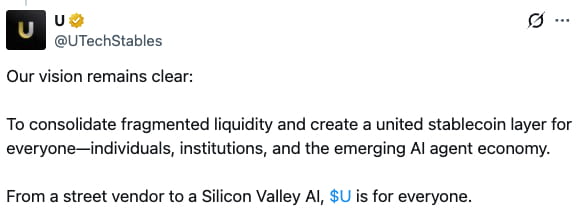
EIP-3009 (No Gas Authorization): Allows 'Gasless Transfers'. This means future AI agents (Bots) do not need to hold BNB or ETH for transaction fees when making high-frequency micropayments. This solves the biggest pain points in machine-to-machine (M2M) economies.
x402 Delegated Execution: A standard that allows smart contracts to automatically execute fund allocation based on specific conditions. This paves the way for future “autonomous hedge funds” or “AI for automatic payments in supply chains.”
As of the time of writing: U has already reached a circulation of 55m, is it a buildup of strength? Or just a fleeting moment?
https://x.com/UTechStables/status/2001667382444482708?s=20
Epilogue: How far has it walked from 'hegemony' to 'great unity'?
Looking back at the evolution from BUSD to United Stables, we see an astonishing evolution of strategic thinking:
The BUSD era (hegemony): leveraging the monopoly position of exchanges to forcibly eliminate competitors through 'automatic conversion', pursuing absolute market share. While this approach is 'passionate', it is also likely to invite joint retaliation from regulators and competitors.
The United Stables era (great unity): Learning from lessons, adopting an 'aggregation' strategy. Acknowledging the status of USDT/USDC, but using $U as the underlying asset, creating its own upper-layer 'super application'.
Preemptively layout AI payments, stepping out of the existing stock game of human traders, to seize the future incremental market of machine economics.
$U is not just a new aggregated stablecoin, but also an attempt by BUSD, after being taken down by regulation, to redefine the rules of the stablecoin game through smoother, more sophisticated, and more technologically forward-looking means. One can only say that risks and opportunities coexist; we shall see!