

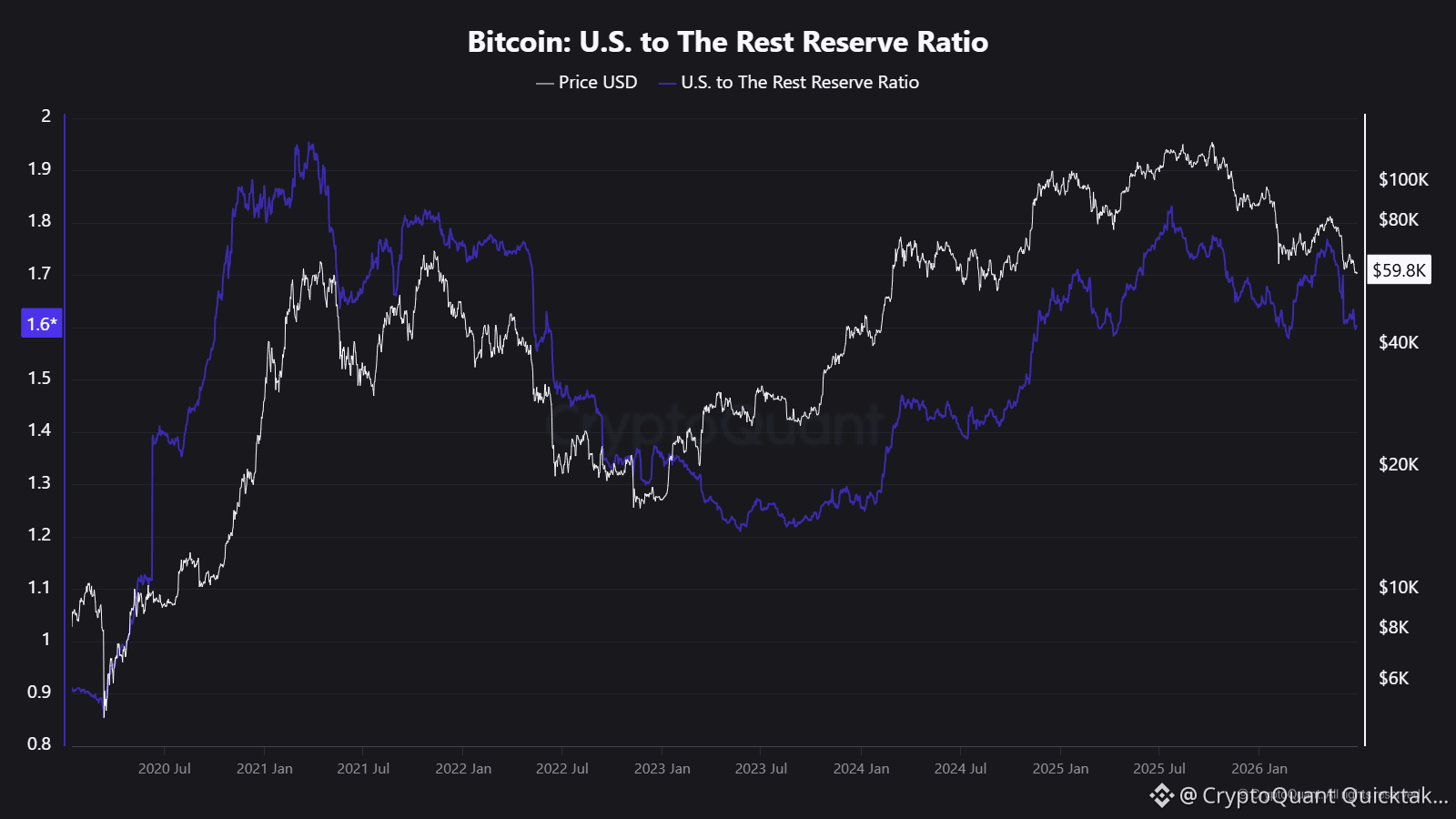
The U.S. to The Rest Reserve Ratio has dropped to around 1.5, down from a peak near 1.8 in July 2025. In under a year, the relative share of bitcoin held by U.S. institutions has fallen sharply.
This metric divides bitcoin held by U.S. exchanges, banks, and funds by the supply held outside the U.S. It tracks relative share of global supply, not absolute holdings. A falling ratio means non-U.S. entities are accumulating faster, or U.S. entities are reducing exposure faster, relative to each other.
Looking at past cycles, this ratio has repeatedly moved before price did. After the April 2021 peak near $64K, the ratio also turned down from the 1.9 zone, and bitcoin lost nearly half its value within weeks. Around the FTX collapse in November 2022, the ratio kept bleeding lower through that stretch. The opposite happened after the January 2024 U.S. spot ETF approval: the ratio turned up, and price rallied hard alongside it. When demand flowing through U.S. channels rises or falls, it has tended to lead price.
The current move fits that pattern. The ratio started breaking down from 1.8 before price even hit its October all-time high near $125K, and price has since rolled over too.
The bear case matters here. In 2022-2023, the ratio fell as low as 1.2-1.3, kept grinding lower for a while, then bottomed and climbed back to 1.8. So this decline doesn't automatically confirm a deeper downturn is locked in. It could still take more time to find a floor.
The takeaway: a falling U.S. share of bitcoin reserves has historically led price weakness, and the current drop from 1.8 to 1.5 looks like a continuation of that pattern.
This reflects my own views. Not financial advice.
Written by Rich_dady