
Bitwise submits a spot SUI ETF, institutional narratives begin to surface
Bitwise officially submits the S-1 document for the spot #sui ETF, bringing SUI back into the view of institutional investors. This move signifies more than just an ordinary product declaration; it releases a clearer signal at the structural level, indicating that the asset is being incorporated into a more long-term, compliant, and configurable framework.
From the declaration content, the #etf adopts a fully spot-supported approach, integrating staking and physical subscription and redemption mechanisms. This means that funds are not just gaining price exposure but can directly participate in the supply and demand and circulation structure of SUI. This design itself already distinguishes it from typical speculative products.
For this reason, SUI's positioning is changing; it is no longer just a highly volatile, high-beta altcoin, but is gradually aligning itself with regulated instruments that may be included in institutional allocation systems. This narrative upgrade is often more attractive to medium- and long-term funds than short-term price stimuli.

Technical signals are beginning to change, but the market still needs confirmation.
From a technical perspective, the parabolic turning indicator has already moved below the current price, which is usually seen as one of the early signals that a trend may change. However, it should be emphasized that a single technical indicator or single event rarely drives a sustained trend; the true direction still needs joint confirmation from price structures and derivatives behavior.
The importance of this ETF application largely comes from the timing of its occurrence, as SUI is currently in a clear price compression phase. Whether it is position distribution, leverage changes, or market structure, all are hinting that the market is approaching a key position that requires a choice.
The price structure indicates compression rather than trend control loss.
Currently, SUI is still operating within a descending wedge structure, with prices repeatedly touching the lower edge around 1.32 to 1.38 USD and gaining support. Since early December, this area has repeatedly absorbed selling pressure, yet has not seen effective breaches, which itself reflects that selling momentum is gradually weakening.
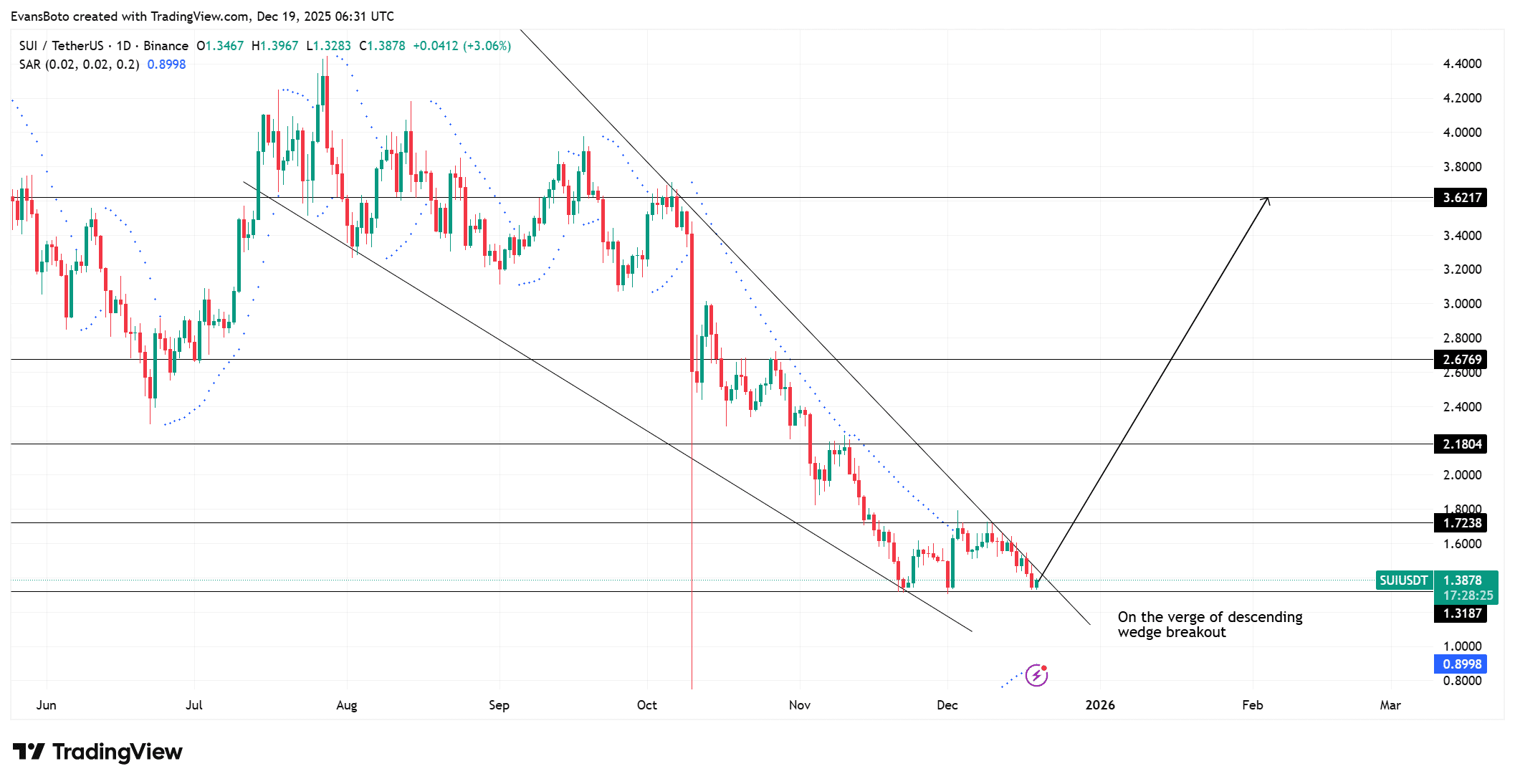
It is worth noting that the rebound rhythm after each dip is accelerating, which means it is becoming increasingly difficult for bears to expand their advantage, rather than the market is accelerating to weaken.
If prices eventually break below this support area, the more critical support level is around 1.18 USD. However, from previous trends, prices have not managed to form sustained trading below this area, which also somewhat weakens the probability of deep downward movement.
Looking upwards, short-term resistance is concentrated around 1.72 USD, while a larger supply zone is located around 2.18 USD. Multiple rebounds have been blocked in that area, so the current wedge structure looks more like an energy compression pattern rather than a reflection of trend strength. Once a direction is chosen, volatility tends to be quickly amplified.
The liquidation structure shows that short pressure is rising.
From the liquidation data, in the recent phase of increased volatility, the amount of short liquidations was significantly higher than that of long liquidations, indicating that under the circumstance where prices failed to continue to decline, the seller positions actually bore greater passive liquidation pressure.
This situation usually occurs near structural support levels. When bears continue to add positions in that area but find that prices are not cooperating, liquidation pressure will begin to act in reverse on the sellers themselves.
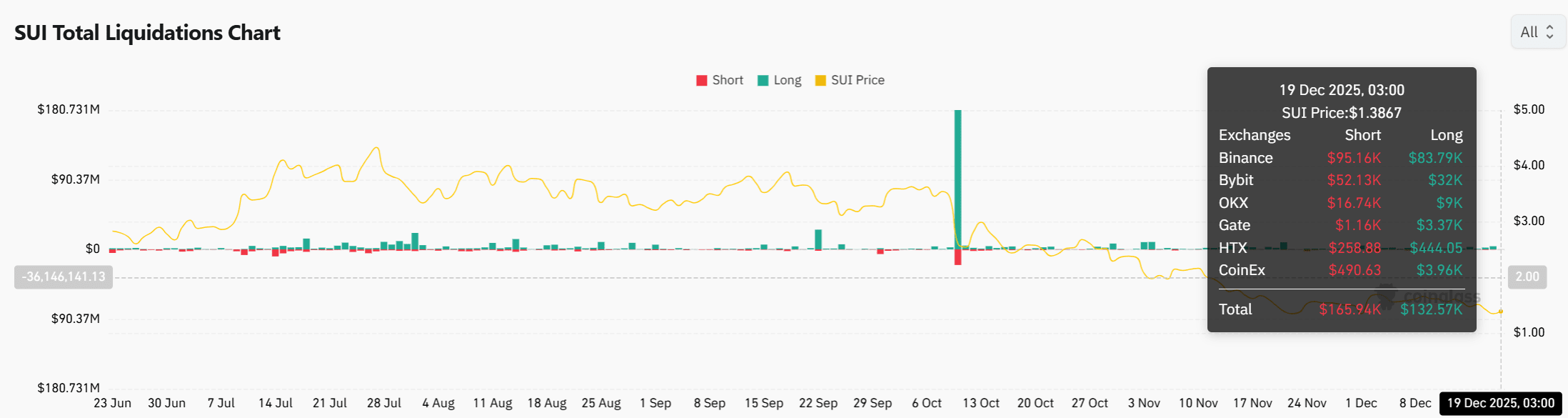
Of course, this phenomenon cannot be viewed in isolation as a confirmation signal for trend reversal, but it at least indicates that the market is gradually transitioning from a unilateral downward phase to a repricing phase, rather than continuing to expand downwards indiscriminately.
The rebound in open contracts indicates that funds have not left.
As of now, the open contract size of SUI has rebounded to 658.5 million USD and is showing moderate growth. In the context of continuous price compression, an increase in open contracts usually indicates that new positions are being established rather than old positions being forced out.
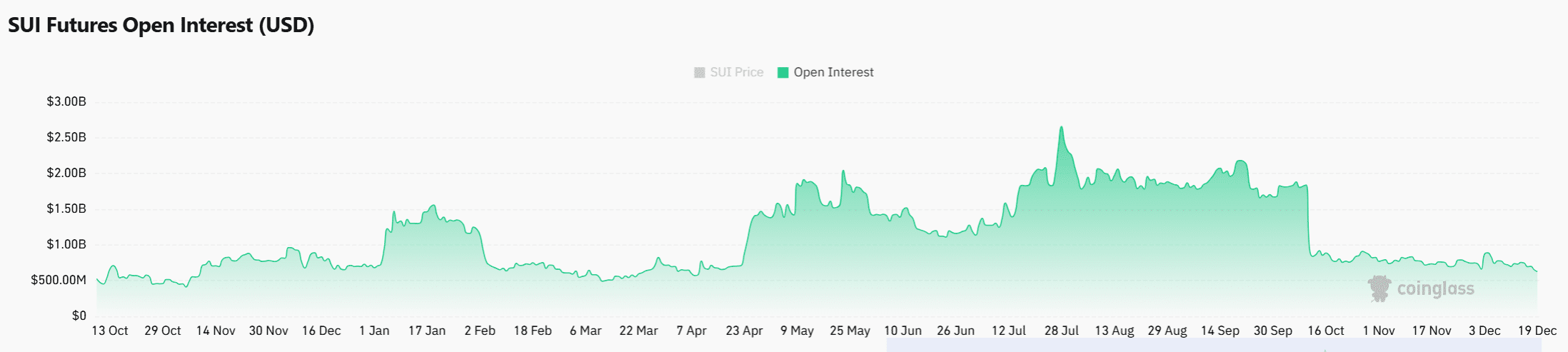
More importantly, this new leverage is formed near structural support rather than being piled up during periods of high market sentiment. This difference in positioning significantly reduces the risk of a chain reaction of downward movements in the short term.
When the increase in open contracts coincides with an increase in short liquidations, it often means that directional rotation is happening internally in the market, rather than pure speculative overheating. This also increases the probability of a one-way fluctuation being amplified once prices break through the current compression range.
Top traders maintain a bullish tendency, acting in advance rather than following.
From the data of top traders on Binance, the ratio of long accounts continues to be higher than that of short accounts, and the long-short ratio remains in a relatively positive range. This structure usually reflects the judgments of experienced funds rather than short-term fluctuations of retail sentiment.
It is particularly noteworthy that this bullish tendency existed before the price broke through the wedge structure, rather than appearing concentrated after the market confirmation. This difference often reflects a behavior pattern of professional traders who prefer to lay out positions in advance.
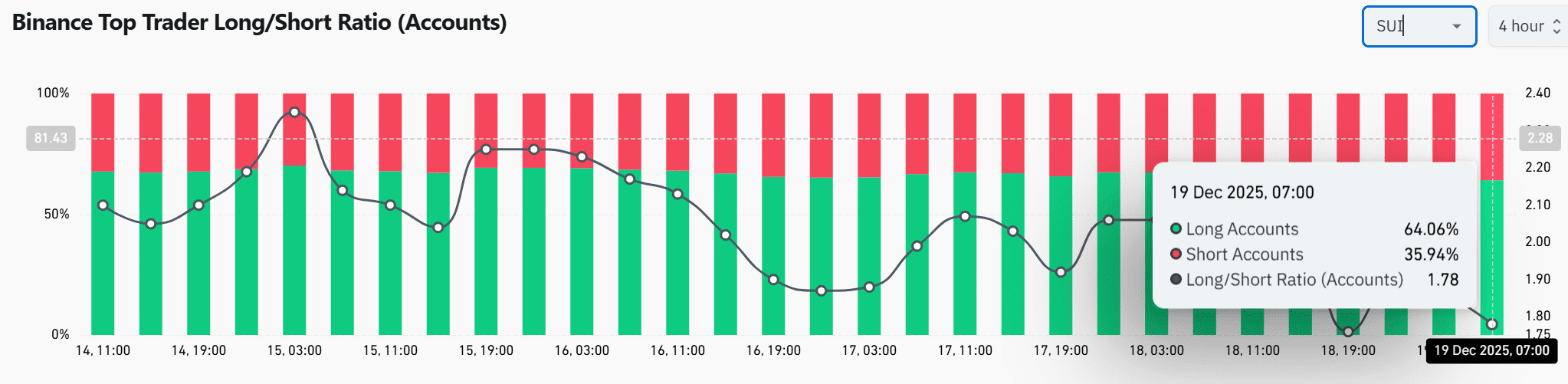
When long positions dominate, open contracts continue to rise, and short liquidation pressure increases simultaneously, the market often approaches a stage that requires a directional choice.
Summary: The key is whether the structure has completed the breakout.
In summary, Bitwise's spot SUI ETF application coincides with a backdrop of prices approaching key structural support, evident weakening of downward momentum, renewed accumulation of leverage, and a bullish bias among professional funds. This combination of multiple factors is weakening the logic of the market continuing to move downwards unilaterally.
If prices can effectively break away from the descending wedge structure, then the resonance between institutional narratives, position structures, and technical patterns will significantly increase the probability of expanding toward higher resistance areas, compared to continuing to maintain the compressed state.
From this perspective, the current SUI seems more like it is waiting for a final confirmation signal rather than preparing for further declines.#巨鲸动向
