

@Lorenzo Protocol For most of Bitcoin’s life, “doing nothing” has been a feature, not a bug. You buy, you hold, and you try not to get clever. That posture still makes sense when the alternatives are bridges you don’t trust, custodians you can’t audit, or “yield” that turns out to be someone else’s token incentives wearing a nice suit. But late 2025 has nudged even committed holders into a different question: if bitcoin is sitting there anyway, can it do something useful without turning into something else?
The timing isn’t accidental. Bitcoin is now big enough that small behavioral shifts matter. DefiLlama shows BTC around $88,000 with a market cap roughly $1.76 trillion. At this scale, tiny changes in how holders behave become entire markets. The umbrella term for the latest version is BTCFi: borrowing, lending, and yield products that treat Bitcoin as the center of gravity rather than something that must be wrapped and shipped elsewhere. Chainlink’s BTCFi explainer puts the motivation plainly: most bitcoin has historically remained idle, and there’s growing interest in unlocking that dormant liquidity.
Babylon is one reason this trend feels more real than the earlier “wrap it and pray” era. The pitch is simple enough to explain without a whitepaper: lock BTC in a self-custodial way, help secure proof-of-stake networks, and earn rewards without bridging your bitcoin to another chain. DefiLlama currently lists Babylon at about $5.4 billion in total value locked, which is far beyond a hobbyist number. Babylon’s staking dashboard shows over 61,000 BTC staked and displays an APR range from 0.03% to 1.09%, which is a sober reminder that “real yield” here is modest and variable, not a magic faucet. Binance Research also notes that since Phase 1 launched in August 2024, more than 57,000 BTC had been staked through Babylon’s protocol, giving the whole idea a sense of traction rather than theory. Babylon Labs has additionally framed Genesis (launched April 10, 2025) as a milestone in making native Bitcoin staking a foundation for a broader ecosystem.
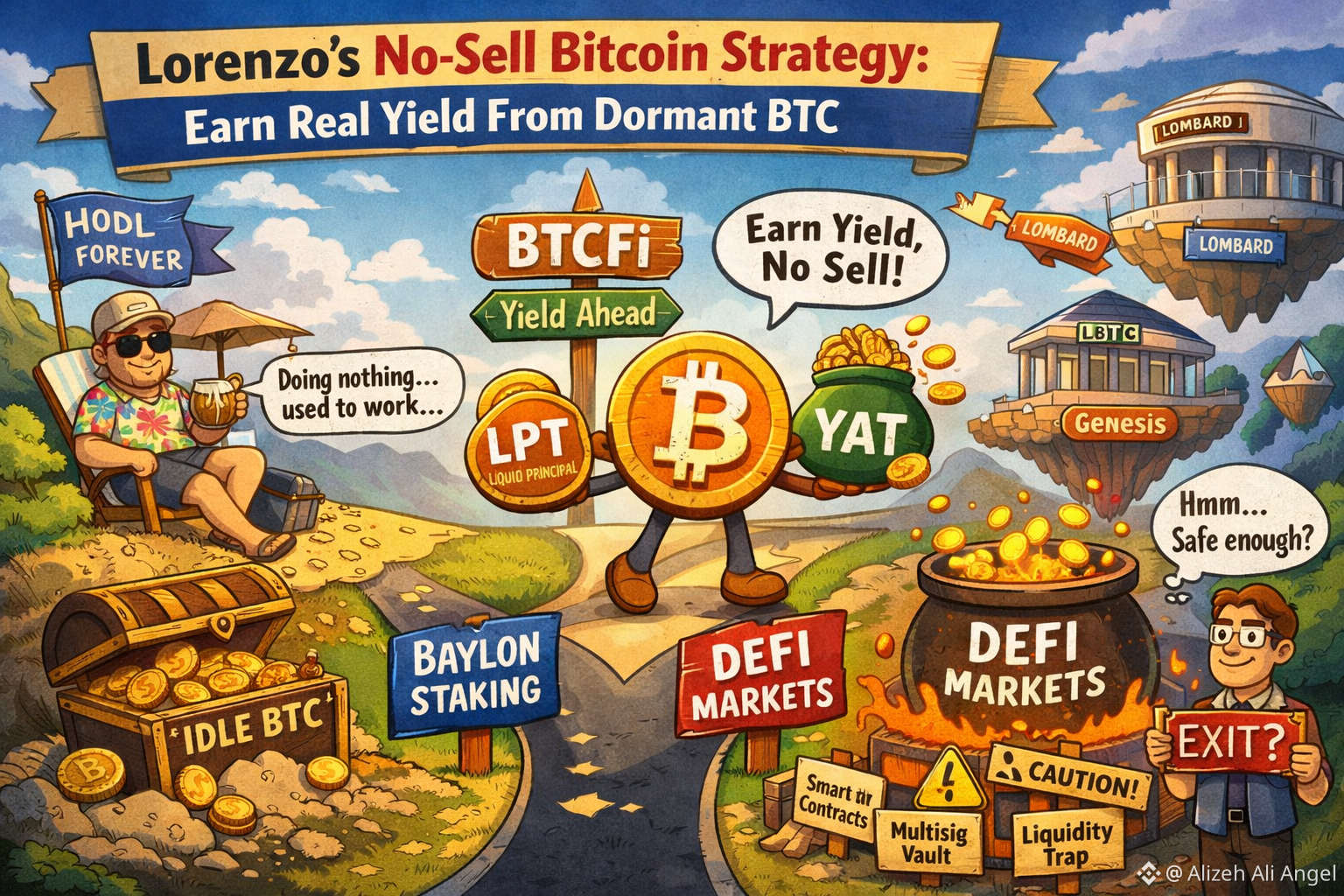
Lorenzo’s “no-sell” strategy sits neatly on top of that shift. It’s not asking holders to become yield tourists. It’s trying to let people keep BTC exposure while drawing a yield stream from staking activity. Lorenzo describes a straightforward cycle: deposit BTC into a staking plan, receive tokens that represent your position, and later burn those tokens to withdraw principal and accrued rewards. The point is behavioral more than philosophical. A lot of people don’t sell BTC because selling is a final decision: taxes, timing regret, and the feeling that you’ve converted a long-term belief into a short-term trade. A no-sell yield strategy is basically a compromise with reality: keep the exposure, but stop pretending a trillion-dollar asset has to sit perfectly still forever.
The design choice that matters most is how Lorenzo splits the position in two. Its materials describe Liquid Principal Tokens (LPTs), representing the right to claim the staked bitcoin, and Yield-Accruing Tokens (YATs), representing the right to the reward stream for a staking period. In human terms, it separates “what you own” from “what you earn.” That doesn’t delete risk, but it forces clarity. When yield products fail, it’s often because principal, yield, leverage, and liquidity all blur into one tidy token that looks stable until it doesn’t. Splitting principal from rewards makes it harder to hide what’s really going on. It also creates a calmer set of choices: hold the principal claim and ignore yield, trade the yield claim for income, or simply wait out the staking period.
None of this is a free lunch, and it’s healthier to say that out loud. Lorenzo’s own technical write-up describes a vault wallet controlled by a multi-signature setup where vault partners hold keys on separate hardware, and it notes that Bitcoin’s limited base-layer programmability constrains how decentralized this system can be today. In plain language, there is still trust somewhere. There is also operational risk, in addition to smart-contract and liquidity risk. “No sell” does not mean “no risk,” and anyone pitching it that way is either confused or selling something.
Zooming out helps keep expectations grounded, too. In DefiLlama’s competitor list for restaked BTC products, some liquid BTC derivatives are far larger—Lombard’s LBTC and GTBTC are listed in the hundreds of millions, while Lorenzo stBTC is listed around $9.5 million. That doesn’t prove anything by itself, but it does show the market is still sorting out which designs earn durable confidence and which remain niche tools for power users. Sometimes smaller size is just “early.” Sometimes it’s “not yet trusted.” You can’t tell which one it is by vibes; you tell by how systems behave under stress.
So why is this trending now, specifically? One answer is that the policy environment looks less frozen. Grayscale’s 2026 outlook argues that 2025 brought meaningful steps toward U.S. crypto regulatory clarity, including stablecoin legislation and custody-related shifts, with market-structure rules potentially next. When institutions feel they can explain a strategy to a compliance team without sweating, experimentation tends to follow. Another answer is simpler: people are tired. After years when “yield” often meant emissions and incentives, a small, boring, variable rate that’s tied to providing security can look strangely appealing—especially when the alternative is selling the asset you refuse to sell.
The most grounded way to think about Lorenzo’s no-sell strategy is as optionality, not a promise. It won’t fit everyone, and it shouldn’t. Plenty of Bitcoin holders will always prefer zero complexity, and that’s a defensible choice. But the existence of multi-billion-dollar BTC staking systems, plus frameworks like Lorenzo’s principal-and-yield split, is changing what “hold” can mean. The honest takeaway isn’t “earn big.” It’s “earn something, carefully,” while staying as close as possible to the original reason you owned BTC in the first place.
