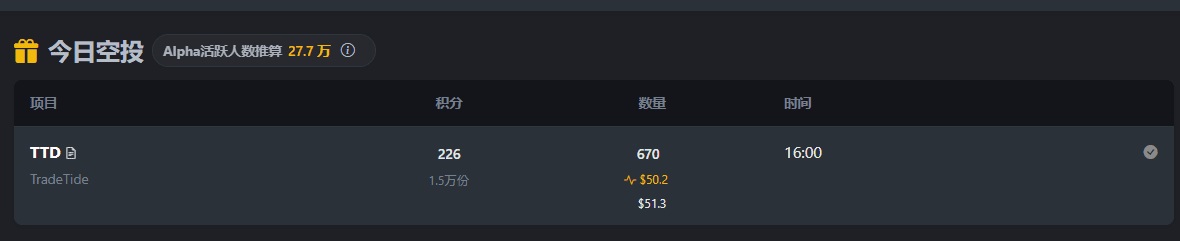
This afternoon at four o'clock, the TTD launched on Binance Alpha has allowed many friends to benefit from another wave of airdrop bonuses. I looked at the data, and the Alpha rewards claimed have now exceeded 50U. This operation is indeed a good return for users who have accumulated enough Alpha points. Recently, observing the overall performance of the Alpha project, one can clearly feel a trend of warming. From VOOI, LISA to RTX, ZKP, although the fluctuations are still drastic, those projects with solid backing can still bring decent returns to early participants.
But to be honest, while the excitement of playing with new coins like Alpha is thrilling, every time I see those fluctuations of several tens of percent, I can't help but think: in this extremely volatile market, do we also need some stable ballast? This is why I have been increasingly focusing on the stablecoin sector lately, especially those projects that can truly maintain stability amidst market storms.
Speaking of stablecoins, many people's first response might be traditional players like USDT and USDC. But today I want to talk about USDD, launched by @usddio—a decentralized stablecoin that I believe performs quite solidly in terms of safety and stability.
First, let me explain why I pay attention to USDD. You know, the stablecoin market has been quite unstable this year, with several projects once thought to be stable experiencing severe de-pegging, some even collapsing directly. Against this backdrop, USDD's performance stands out—it has maintained a price stable around 0.999 dollars, even during significant market fluctuations. This is actually supported by robust technology.
The most reassuring aspect of USDD is its over-collateralization mechanism. What does it mean? Simply put, for every 1 dollar of USDD issued, there are assets worth more than 2 or even 3 times that amount as collateral. I checked the official data, and the collateralization rates for different asset pools range from 200% to 300%, which means that even if the market crashes, USDD has enough buffer space to maintain price stability. More importantly, these collateral assets are publicly transparent, and anyone can verify them on-chain, unlike some projects that make grand claims while their actual reserves are a mystery.
In terms of safety, USDD has made significant efforts. It has passed five audits by two top auditing firms, CertiK and Chainsecurity, which is considered a high standard in stablecoin projects. It’s worth noting that many projects start issuing tokens without even having a complete audit done; USDD reaching this level at least indicates that the team takes security seriously. An interesting detail is that even the due diligence (DD) of industry leader Binance has passed, which is enough to demonstrate the reliability of the USDD 2.0 model.
Now let’s talk about its stability mechanism. USDD uses the PSM (Peg Stability Module) function, allowing users to exchange USDD for USDT and USDC at a 1:1 ratio without slippage. Currently, the liquidity of PSM on the TRON chain is close to fifty million dollars, and there are also ample liquidity reserves on Ethereum and BSC. This mechanism is clever—if the price of USDD falls below 1 dollar, arbitrageurs will buy USDD and exchange it for USDT to profit from the price difference; and vice versa. This market-driven arbitrage mechanism allows the price of USDD to automatically return to the peg without human intervention.
Some might worry: Could USDD suddenly collapse like some previous algorithmic stablecoins? This concern is quite normal, as there have indeed been many lessons learned from the market. However, USDD is fundamentally different from those purely algorithmic stablecoins. In January of this year, USDD completed a comprehensive upgrade to version 2.0, fully transitioning from the previous algorithmic model to an over-collateralized CDP model. In simple terms, the current USDD is backed by real assets, not just relying on algorithms and market confidence.
Moreover, USDD 2.0 completely returns control to users, allowing anyone to freely mint USDD, with tokens having the characteristics of being immutable and unfrozen. This decentralized design prevents systemic risks from arising due to issues with any centralized institution. All collateral assets are transparently verifiable on-chain, a level of transparency that many centralized stablecoins cannot achieve.
It is especially worth mentioning USDD's economic model. In June of this year, it launched the Smart Allocator, a completely on-chain, transparent, and controllable investment strategy system. As of now, official data shows that this system has generated over 7.2 million dollars in profits for the protocol. What does this mean? It means that USDD no longer needs to rely on external subsidies to maintain profits but can generate sustainable income independently. This positive feedback loop of the economic model is something many stablecoin projects aspire to but cannot achieve.
Returning to the initial discussion of the Alpha airdrop, the two are not contradictory. By participating in the Alpha project, we are seeking high-risk, high-reward opportunities; while allocating stablecoins like USDD adds a layer of safety to the investment portfolio. Especially after receiving the Alpha airdrop, if one does not want to chase prices immediately, converting a portion of the profits into stable assets like USDD can both preserve profits and earn stable returns through staking—it's a win-win, isn't it?
Finally, I want to say that in this uncertain field of the crypto market, having some truly stable and reliable asset allocations is very important. USDD has indeed carved out a differentiated path in the stablecoin arena through over-collateralization, transparent auditing, and smart economic models. For those who want to participate in market opportunities while also controlling risks, understanding @USDD - Decentralized USD and #USDD以稳见信 is quite necessary. After all, in this market, sometimes preserving principal is more important than chasing hundredfold returns.