
While Satoshi Nakamoto’s 2008 white paper famously introduced Bitcoin as a “peer-to-peer electronic cash system,” the asset’s most prominent corporate evangelist, Michael Saylor, is pitching a radically different vision.
Saylor, the Executive Chairman of MicroStrategy, has spent the last five years transforming his software firm into what many now call a “Bitcoin central bank.” During a recent keynote at Bitcoin MENA in Abu Dhabi, Saylor doubled down on a thesis that prioritizes Bitcoin’s role as an institutional reserve asset over its utility as a medium of exchange.
The "Standard Oil" of Crypto
Economist Saifedean Ammous, author of The Bitcoin Standard and a close associate of Saylor, joined Cointelegraph’s Chain Reaction to parse this distinction. According to Ammous, Saylor doesn't view Bitcoin through the traditional lens of "money."
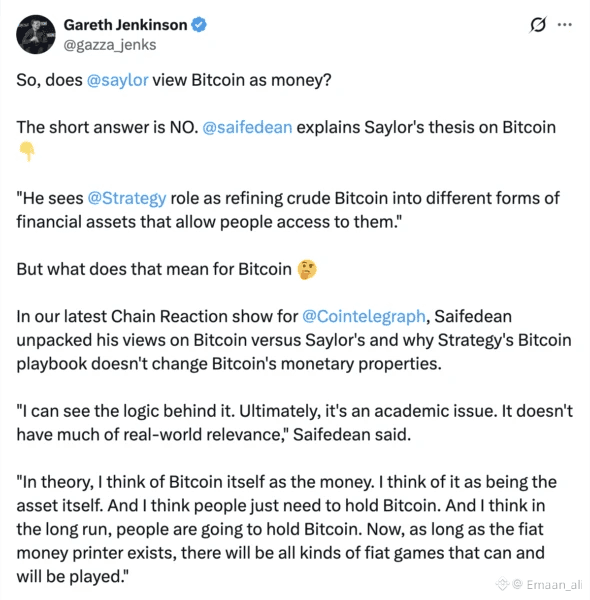
"He sees Bitcoin more as an asset—specifically, like crude oil," Ammous explained. "Just as Standard Oil refined crude into kerosene and gasoline for the masses, Saylor sees MicroStrategy’s role as 'refining' raw Bitcoin into sophisticated financial instruments."
To date, MicroStrategy has used aggressive corporate maneuvers to do just that. By issuing convertible senior notes and various classes of perpetual preferred stock (such as STRK and STRC), Saylor has created a "leveraged play" on Bitcoin. As of December 15, the company’s "refinery" holds a staggering 671,268 BTC.
The Counter-Argument: Bitcoin is Still Money
Despite Saylor’s focus on institutional "financialization," Ammous maintains that Bitcoin’s primary identity remains monetary. While he acknowledges the logic of Saylor’s "digital oil" metaphor, Ammous views the distinction as largely academic.
“In the long run, people are going to hold Bitcoin directly,” Ammous argued. He suggests that as long as fiat currencies continue to devalue through annual supply increases of 7% to 15%, the world will remain addicted to debt-based "fiat games."
However, Ammous believes these financial products—including Saylor’s—all lead to the same destination. Whether Bitcoin is used as "pristine capital" to back affordable debt or held as a direct cash balance, the end result is mass accumulation.
"One way or the other, it means more people buying Bitcoin," Ammous noted. "In my mind, that inevitably means Bitcoin becomes the money itself."
From Theory to the Streets
The debate takes on a practical dimension as Ammous moves into a new advisory role with Africa Bitcoin Corporation (ABC). While Saylor builds institutional "refineries" in the U.S., ABC President Stafford Masie says Ammous is focusing on the opposite end of the spectrum: the circular Bitcoin economies and retail adoption currently flourishing across South Africa.
Whether Bitcoin’s future is as a refined institutional bond or a retail payment tool, the race to hoard the world’s scarcest digital commodity is only accelerating.#bitcoin #BTC #Binance #MichaelSaylor #CryptoNewss
