
In the volatile world of crypto, a single spark can set off a wildfire of FUD (Fear, Uncertainty, and Doubt). We saw it in October when Donald Trump’s tariff talk triggered a brutal $19 billion liquidation. Now, the market is bracing for a sequel: rumors of a massive Bitcoin mining purge in China.
But is the "Great Firewall" actually closing in on miners again, or is this just another case of the market jumping at shadows?
The Spark: 400,000 Miners Go Dark?
The panic started with a post from Jack Jianping Kong on X. The claim? Bitcoin mining in Xinjiang was under the microscope. Within 48 hours, the narrative exploded: 400,000 miners were allegedly forced to unplug.
On the surface, the data seemed to back the panic. Bitcoin’s total hashrate—the heartbeat of the network—stumbled by 8%. In a "risk-off" market where investors are already looking for an excuse to sell, this looked like the smoking gun.
The Twist: Who Actually Unplugged?
When you stop looking at the headlines and start looking at the mining pools, the "China Crackdown" story begins to fall apart. Here is what the on-chain data actually shows:
The Global Dip: Yes, the hashrate dropped, but it wasn't just a China story.
North American Exit: Surprisingly, the biggest losses came from Foundry USA (a massive North American pool), which saw a combined drop of 200 EH/s.
The China Component: China-centric pools like Antpool and F2Pool were down by only about 100 EH/s.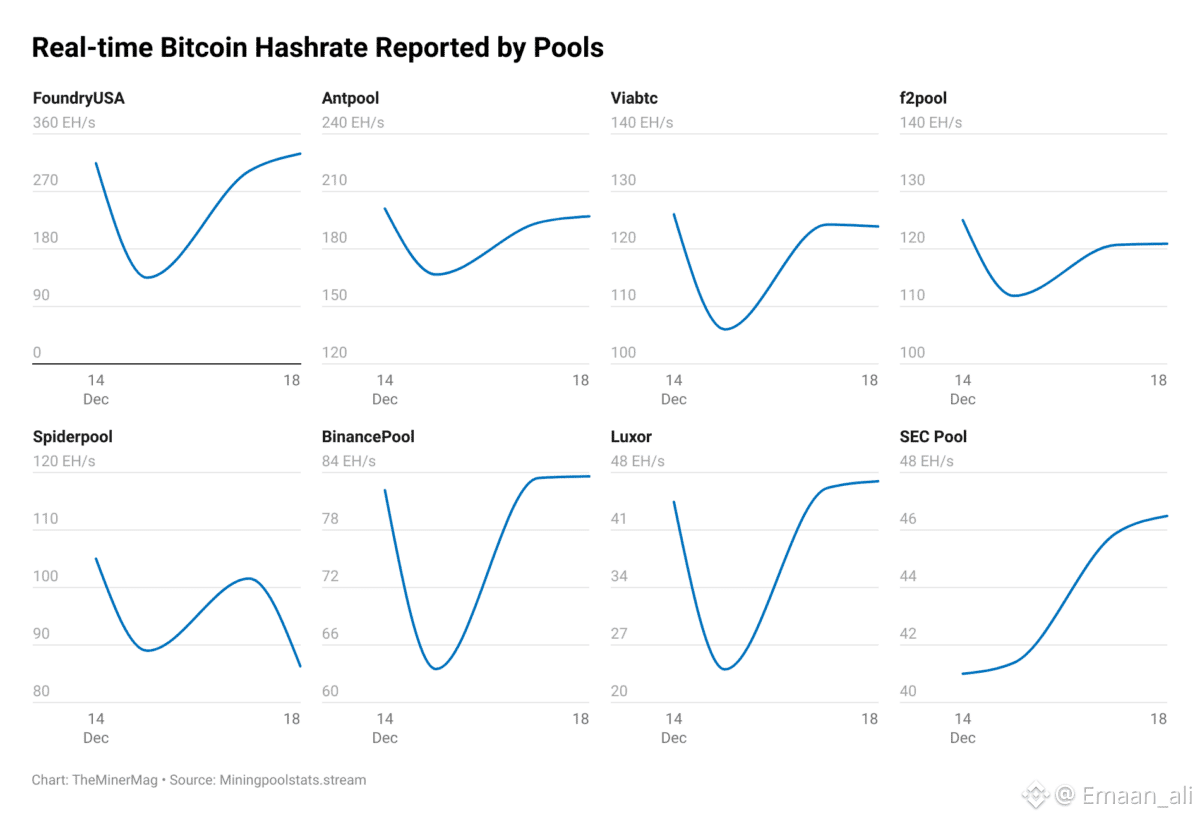
If this were a targeted regional crackdown in Xinjiang, we would expect the Chinese pools to bleed while others stayed steady. Instead, the dip was felt globally.
Verdict: Tactical Retreat, Not Total Collapse
By December 18th, the "crisis" was already fading. Hashrates across most pools bounced back to near-normal levels almost as quickly as they fell.
What actually happened?
It’s likely that some miners in China did power down briefly—a common "hide and seek" tactic to avoid routine inspections or regulatory scrutiny—but it was far from the industry-ending event the FUD suggested.
The Lesson: In crypto, the "hype" often travels faster than the truth. While the 8% dip was real, the narrative of a total Chinese shutdown was largely an exaggeration.
Why this matters for you
This cycle proves that in a jittery market, even a temporary maintenance window or a localized inspection can be spun into a "market-moving event." Before you hit the sell button based on a tweet, follow the hash. The data usually tells a much calmer story than the headlines#FUD #ChinaCrackdown #CryptoNewss #Write2Earn
