
Blockchain technology has successfully solved one of the hardest problems in computing: creating trustless, decentralized networks that can securely transfer value without intermediaries.
Yet as digital assets, tokenized real-world assets (RWAs), AI agents, and institutional capital continue moving onchain, a different challenge is becoming impossible to ignore.
The question is no longer whether a transaction can be executed.
The question is whether that transaction should be executed.
Today, most blockchains verify cryptographic signatures and execute smart contracts exactly as programmed. While this model has powered the growth of DeFi, it often lacks a native mechanism to evaluate organizational policies before transactions are finalized.
For institutions, DAOs, treasury managers, AI agents, and regulated financial applications, execution alone is no longer enough.
They need authorization.
Why Authorization Matters
Traditional finance operates through multiple layers of authorization.
Payments have spending limits.
Treasuries require multiple approvals.
Compliance rules determine who can access assets.
Risk engines monitor exposure before funds move.
Onchain finance, however, generally assumes that possession of private keys is sufficient authorization.
This creates challenges that become more significant as larger amounts of capital enter decentralized ecosystems.
Organizations increasingly need programmable rules that define:
• Who can execute transactions
• Under what conditions transactions are allowed
• Maximum risk exposure
• Compliance requirements
• Identity verification
• Treasury governance
Without these controls, security depends heavily on operational processes rather than enforceable infrastructure.
Newton Protocol's Approach
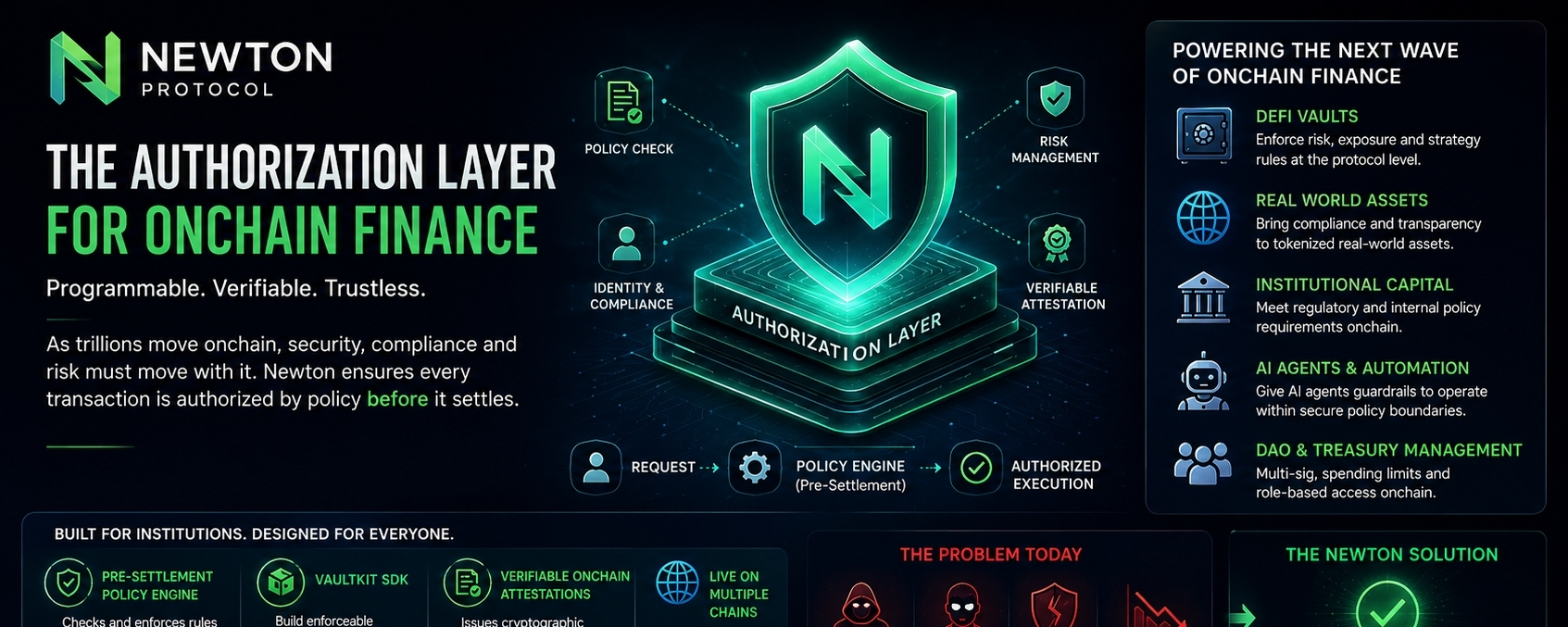
Newton Protocol introduces an authorization layer designed to evaluate transactions before settlement.
Instead of relying solely on signatures, predefined policies can be checked prior to execution.
Its architecture is built around several core components.
Pre Settlement Policy Engine
Transactions are evaluated against programmable rules before they settle.
Rather than discovering policy violations after assets have moved, organizations can define conditions that must be satisfied before execution is allowed.
VaultKit SDK
VaultKit enables developers to build programmable controls directly into vaults and financial applications.
Policies may include:
• Identity verification
• Compliance requirements
• Spending permissions
• Risk management rules
• Security constraints
Instead of relying on offchain procedures, these policies become enforceable within onchain workflows.
Verifiable Onchain Attestations
Every authorization decision can generate cryptographic attestations that provide transparent proof of policy compliance.
Rather than asking users or institutions to trust internal processes, anyone can independently verify that required conditions were satisfied.
This improves transparency while maintaining decentralization.
Why This Matters for AI
Artificial intelligence is becoming increasingly capable of making financial decisions.
AI agents can analyze markets, rebalance portfolios, execute strategies, and coordinate complex workflows at machine speed.
However, greater intelligence also increases operational risk.
An autonomous system capable of moving capital requires clear boundaries.
Authorization provides those boundaries.
Instead of allowing unrestricted execution, AI agents can operate within predefined security and governance policies.
This enables automation without sacrificing accountability.
Applications Across Onchain Finance
Newton's infrastructure extends beyond a single use case.
Potential applications include:
• DeFi vault management
• DAO treasury operations
• Institutional digital asset custody
• Real-world asset platforms
• Stablecoin infrastructure
• Autonomous AI agents
• Cross-chain financial systems
As these sectors continue expanding, programmable authorization becomes increasingly valuable.
From Trust to Verification
Crypto has always promoted the principle of "Don't trust. Verify."
Newton extends this philosophy beyond consensus.
It applies verification to authorization itself.
Rather than trusting that organizations followed internal policies, participants can verify that predefined rules were enforced before execution occurred.
This creates stronger security while preserving transparency.
Looking Ahead
The next generation of blockchain infrastructure will likely require more than scalability and lower transaction costs.
As institutional adoption accelerates and AI becomes an active participant in financial markets, execution must become more intelligent, auditable, and policy-aware.
Authorization may become as fundamental as consensus itself.
Newton Protocol is building infrastructure around that vision.
Not by replacing decentralization.
But by making onchain finance more secure, programmable, verifiable, and ready for real-world scale.
The future of blockchain isn't only about executing transactions.
It's about ensuring every transaction is executed under transparent, programmable, and verifiable rules.