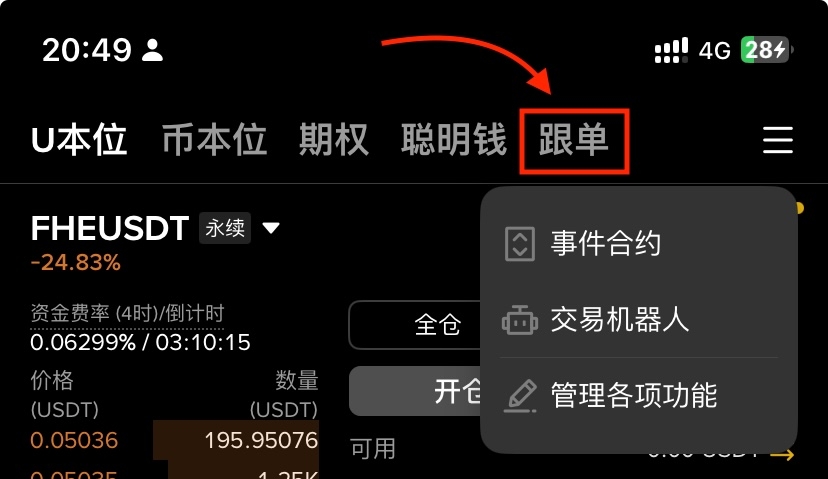
I believe that whether you start the software from the mobile end or the web end to prepare for trading, you will find the words 'copy trading'. I wonder if you have ever used this module? Without further ado, here is the entry image below:

If not found in this position, you can click below the battery on the right: three horizontal lines
So what is copy trading?
Copy trading: It means assisting users in trading by real-time copying of cryptocurrency traders with investment and judgment experience. When they increase or decrease their positions, the system will execute trades for users in the same proportion or fixed amount.
How can followers profit, and what is the profit ratio?
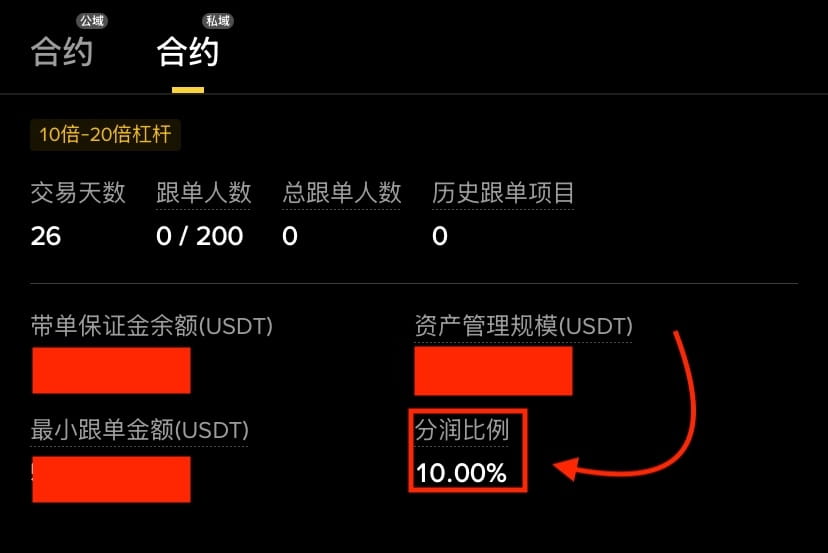
Followers will automatically copy traders' actions through the copy trading system. When continuously following and each cycle shows positive profits, the system will allocate 10% of the follower's earnings (as illustrated below) to the trader as a profit commission every Monday, while the follower receives 90% of the profits, which constitutes the actual profit.
Here we focus on 'profit in each cycle'. Binance copy traders' profits are settled every Monday at 8:30 AM Beijing time.
Example 1: If the previous settlement cycle's profit was positive (+100USDT), and the current week's profit records a negative value (-50USDT), but the total profit is positive (+50USDT), this behavior will not generate profit sharing.
Example 2: If the weekly profit records a negative value (-100USDT), and the next week's profit records a positive value (+50USDT), but cannot compensate for last week's loss (cumulative -50USDT), this behavior will not generate profit sharing.
Both examples 1 and 2 must meet the prerequisite of continuous copy trading without withdrawal midway; losses or profits after withdrawal will lead to a recalculation of all data, regardless of gain or loss.
Who are the suitable groups for copy trading?
1. New traders entering the market for the first time (somewhat knowledgeable but pretending to understand, new to cryptocurrency; they can observe the investment behavior of experienced traders through 'copy trading' to improve their trading skills).
2. Users without sufficient monitoring and trading time (successful individuals busy with their careers during the day and taking care of their families at night can choose to follow traders with styles similar to their investment approach through 'copy trading')
3. Traders with an impatient and extreme personality (trading leads to losses, and losses cause emotional turmoil; they can reduce the risk of emotional distortion in trading through 'copy trading').
4. Trading users with a certain foundation but lacking strategy (those who understand technical analysis yet cannot grasp entry points, gradually forming their own trading strategy through copy trading and reviewing).

Who are the prohibited groups for copy trading?
1. 'Wishful thinkers' pursuing overnight wealth (those who hope to replicate high-yield traders in a short time to double their assets quickly).
2. Users with a fragile mindset, referred to as 'glass hearts' (those who collapse emotionally when they see their copy trading accounts frequently stopping losses and their balance continuously decreasing).
3. 'Debtors' under financial pressure (speculators with debts or relying on loans, hoping to turn their fortunes, support their families, or change their destinies, often do not end well).

What are the risks involved in copy trading?
1. All investment products carry risks. The greatest risk of copy trading is the trader's choice of investment products and the influence of macro market trends and information. If the trader's investment strategy fails, the following users will also incur a certain degree of loss.
2. Copy trading ≠ guaranteed profit; the rate of return has non-replicability under extreme market conditions. When trading is significantly affected by market volatility, it can easily lead to insufficient liquidity, and followers may be impacted by factors such as 'slippage', 'delay', and 'position', resulting in actual gains and losses deviating slightly from expectations.
3. The ethical risk of traders; some traders, in order to attract followers, will deliberately create 'high win rates' and 'high returns' in the short term, but this type of trader often operates very unstably. Once the market reverses rapidly, there may be a risk of the account going to zero.
4. Other unclear trading risks.
Copy trading is not the end, but a new starting point!
New users can learn analysis and review the entry, exit, take profit, stop loss, and other trading points by following renowned traders, understanding the trader's entry logic and style, and after gaining experience in the market, explore a trading strategy that suits the market and themselves. Once this is achieved, it means you will gradually transition from 'passive following' to 'active thinking'; no longer mechanically copying operations, but being able to adapt to changes in the market environment, questioning the underlying logic behind the trading strategy, transforming the thought from 'why increase the position at this point' to 'this position should be increased'. As experience in copy trading accumulates, even novice users can start trying to independently formulate trading plans and have the opportunity to grow into mature traders responsible for their own trading decisions.