

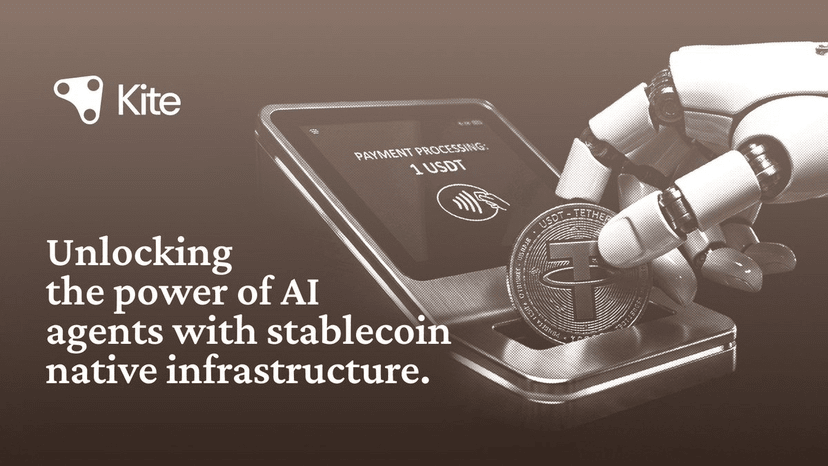
In the process of observing the integration of crypto projects with the mainstream world, I discovered a prevalent gap: native crypto projects pursue complete decentralization and autonomy, while the traditional world operates within complex legal and regulatory frameworks.
Many projects waver between these two, leading to limited development. However, when I examine KITE's design philosophy and application scenarios (especially in AI and the data economy), I see a different approach: it is actively building a framework with built-in compliance programmability, attempting to become a bridge connecting native crypto autonomy with traditional regulatory requirements, rather than an enclave that evades regulation.
This strategy may give it a unique survival advantage in the long-term development.
1. Real Dilemma: The regulatory storm of the AI data economy
I must first point out the uniqueness of the field KITE is targeting: the AI data economy is at the center of a global regulatory storm. Whether it's the EU's (Artificial Intelligence Act), the U.S. AI executive order, or the strict restrictions on cross-border data flows in various countries, it indicates that an era of 'wild growth' has ended. Any AI application that handles personal data and involves decision-making in critical areas (such as healthcare and finance) must face compliance challenges.
A purely, completely anonymous crypto network is difficult to be adopted by heavily regulated industries such as healthcare or finance. This is a real-world constraint that KITE must address.
2. KITE's compliance layer design: programmable strategies and auditability
Unlike traditional crypto projects that avoid regulation, KITE's architecture implicitly contains thoughts on addressing this challenge. Its smart contracts and modular design allow specific compliance rules to be encoded as executable on-chain or off-chain strategies. For example, an AI module processing health data of European users could have built-in rules that only nodes holding EU digital identity credentials (like eIDAS) and storing data in GDPR-compliant geographic areas can participate in processing; all data access records must be immutably recorded on-chain for auditing. The KITE network itself does not prescribe these rules, but it provides a standardized and transparent technical layer for the deployment and execution of rules. I see it as a 'compliance-neutral tool' that gives the choice to ecosystem builders.
3. Identity Hub: Connecting anonymity with trusted identity
The key to connecting encrypted anonymity with trusted identities in the real world is the KitePass identity system. Unlike traditional finance's KYC (Know Your Customer), KitePass supports more flexible levels of identity verification. A user can choose to use a completely anonymous identity for some low-sensitivity interactions, while when accessing regulated services, they can prove their age or residency requirements in a specific jurisdiction to verifying nodes through zero-knowledge proof technology, without exposing their full identity information. This design meets the privacy spirit of the crypto world while opening doors for regulated commercial activities. I believe this is a core technological component for KITE to achieve its bridging function.
4. New Business Models: Regulatory Technology (RegTech) as a Service
This architecture may spawn new business models. In the KITE ecosystem, there may emerge specialized 'compliance module' providers, which, like Lego blocks, offer plug-and-play compliance functionalities for other AI service modules. For instance, a 'U.S. healthcare HIPAA compliance package' module or a 'global data cross-border transfer assessment' module. Application developers can quickly make their products comply with legal requirements in specific markets by integrating these modules. This essentially transforms complex legal compliance requirements into combinable and automatable technical services (RegTech as a Service).
In my view, this not only reduces the compliance costs for developers but, more importantly, it creates a new path for achieving global innovation and interoperability while complying with the rules.
5. Future Positioning: Becoming the cornerstone of a responsible digital economy
Therefore, I have a new judgment on KITE's long-term positioning: it is expected to become a key infrastructure for building a responsible, auditable, and globally interconnected digital economy.
It does not attempt to overthrow the existing legal system but rather offers a more efficient and transparent way to implement legal requirements. For traditional institutions, this reduces their compliance risks in embracing blockchain and AI technologies.
For native developers in encryption, this provides a viable pathway into the trillion-dollar traditional market.
In the future, the highest value digital economic activities are likely to occur at the intersection of traditional and crypto, and KITE, through its forward-looking architectural design, is paving the way to connect these two continents in advance.
Investing in KITE, in some sense, is investing in a Web3 future that is more likely to be adopted and integrated by the mainstream world. This path may be more complex than a purely crypto-native one, but its potential upper limits and stability may also be higher.

