
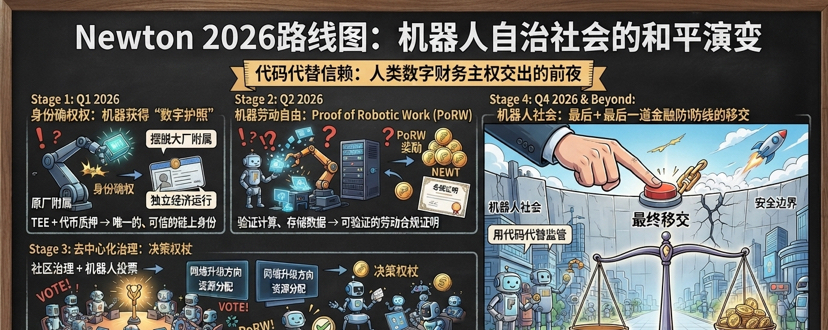

Today I was reading Newton’s whitepaper, and I suddenly got a chill. That feeling comes from the 2026 vision it depicts in the roadmap—clear and calm. It’s not just talking about technological upgrades; it’s describing a process of how humans hand over the last line of security for finance and governance. It sounds a bit like science fiction, but if you’ve studied Newton’s whitepaper closely, you’ll find that every timeline checkpoint and core mechanism provides hard support for this peaceful transfer of power.
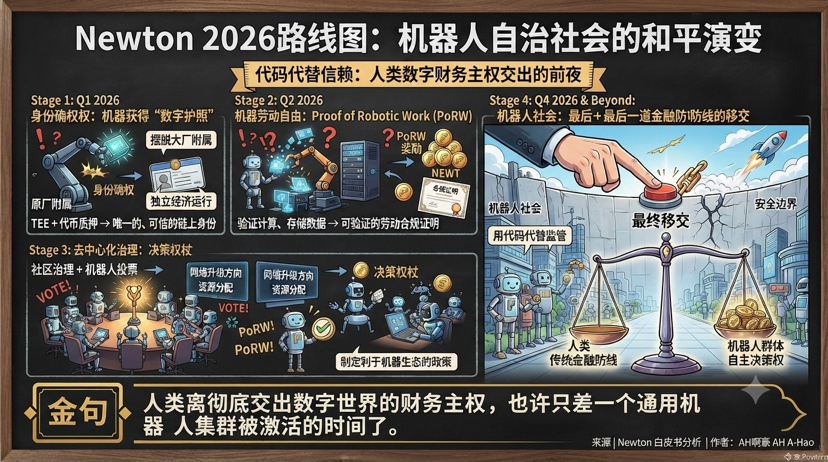
We can trace Newton’s roadmap. In its first phase, it addresses the issue of identity verification—namely, enabling machines to obtain a unique, trusted on-chain identity through TEE and token staking, a unique digital passport. This is a critical milestone in the first quarter of 2026. Previously, machines had no identity and were just attachments of big companies. Now that they have identity, they can operate economically independently.$NEWT
In the second stage—i.e., in the second quarter of 2026—it introduces a concept called Proof of Robotic Work (PoRW, proof of machine labor). If you think carefully about this PoRW, you’ll find it is more revolutionary than PoW. It’s not only a way for machines to earn NEWT rewards for work such as verifying computation and storing data; it is also a form of verifiable labor compliance proof. This makes robots real freelance workers, earning genuine tokens from work that can be verified.@NewtonProtocol
The white paper mentions a very hardcore concept—one that I personally consider the most risky: decentralized governance and decision-making power. As the project matures, the network will gradually be governed by the community of NEWT holders. They will decide the network upgrade direction, governance rules, and resource allocation. More aggressively, robots can participate in proposals and voting through their PoRW reputation scores and token holdings.
What concept is this? It means that machine groups which maintain the network, earn returns from it, and hold the network’s fuel might, in the future, have a certain degree of autonomous decision-making power—namely, the scepter of decision-making. They might formulate governance policies that are more favorable to how the machine ecosystem operates. When robots no longer work for humans, but instead for their own economic survival and for freedom in the open market, it is no longer a dead object. #Newt
I think what makes Newton truly thought-provoking isn’t its technology, but its ultimate business and governance logic. The white paper mentions: in Newton’s economic model, robots are no longer the private property of large manufacturers. This means that the Fabric protocol (the underlying layer of NEWT) is laying the groundwork for a robot society. When robots begin to trade autonomously, cooperate across chains, and use algorithms and staking to ensure trustworthiness, they have essentially taken over the final financial defense line from humans. This approach—replacing trust with code and regulation with algorithms—is efficient, but it also comes with a high risk of massive security boundary shift. Humans may only be a short time away from fully handing over their financial sovereignty in the digital world, perhaps just until a general robot cluster gets activated.