

A few days ago, I paid with a bank card at a regular coffee shop. The terminal paused for a couple of seconds, and then a short message appeared on the screen: “Approved.” It all happened so quickly that most of us don’t even think about how many processes are hidden behind that simple word.
At that moment, the bank manages to check dozens of conditions. Is there enough money in the account? Has the daily limit been exceeded? Does the operation look suspicious? Is the card blocked? Only after all the checks have been passed does the payment receive approval. And only then is the money deducted.
Later, when I reopened Newton’s documentation, one thought wouldn’t let go. We’ve gotten used to talking about blockchains as systems that reliably execute transactions. But almost never do we ask an even more important question: who should decide in the first place whether this transaction can be executed? As far as I can tell, the whole of Newton is built around this idea.
In recent years, the industry has focused on scaling. Every new blockchain promises more transactions per second, lower fees, and faster finality. It feels as if the main problem has long been identified, and now it’s just a matter of gradually improving the existing metrics. But the deeper I dig into Newton’s architecture, the more I start to doubt that speed was the main constraint.
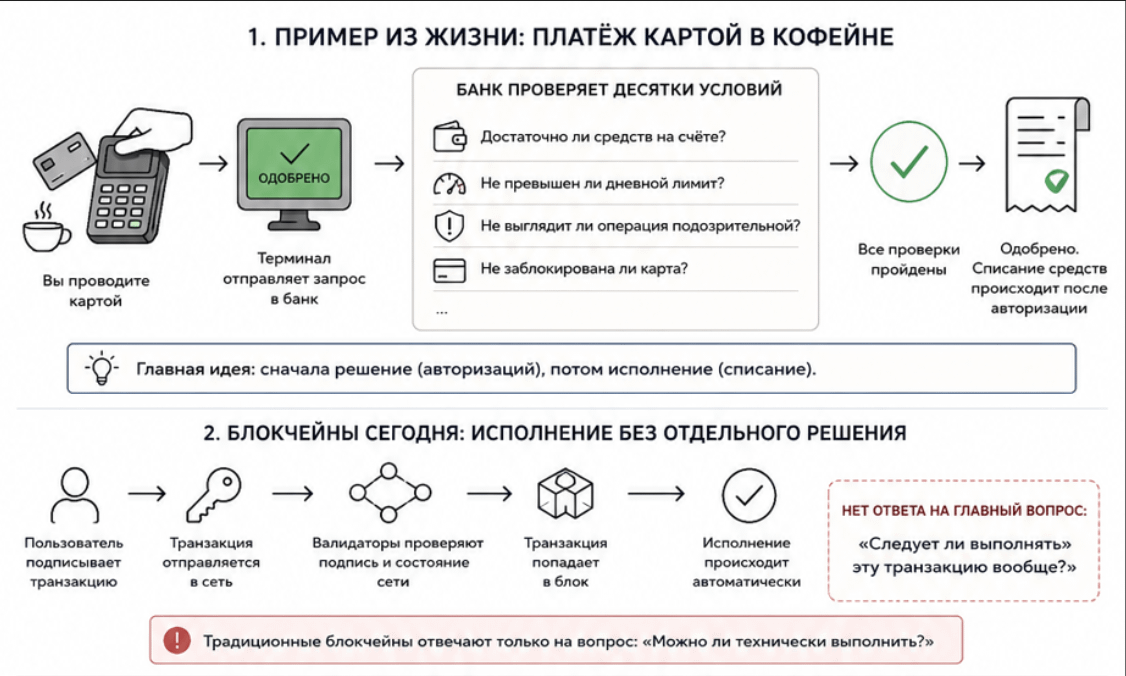
Try to imagine a typical blockchain transaction. A user signs it with their key, sends it to the network, validators verify the signature and the state of the network, and then the transaction lands in a block. The entire architecture answers the question perfectly: “Can this operation be executed technically?” But it almost never answers the other question: “Should it be executed at all?”
At first, that difference seems purely philosophical. However, the longer I thought about it, the more I understood that this is exactly where the line runs between the traditional financial system and most modern blockchains. In banking infrastructure, decision-making and operation execution have long existed as two separate processes. In a blockchain, these processes almost always merge into one.
That’s why the analogy the Newton authors draw with payment networks struck me as far deeper than it initially looks. Visa doesn’t hold users’ money and doesn’t replace banks. Its job is to add another step between the intention to make a payment and the final settlement—that is, the authorization stage. Newton proposes to create a similar layer for on-chain infrastructure.
At first I thought it was about compliance only. Identity checks, sanctions lists, regulatory requirements—all of that really is mentioned in the whitepaper. But little by little it became clear that these are only possible use cases. The real idea is much broader. Authorization Layer is an attempt to separate the decision-making process from the execution process, regardless of whether it concerns an AI agent, a DAO, tokenized assets, or a regular user.
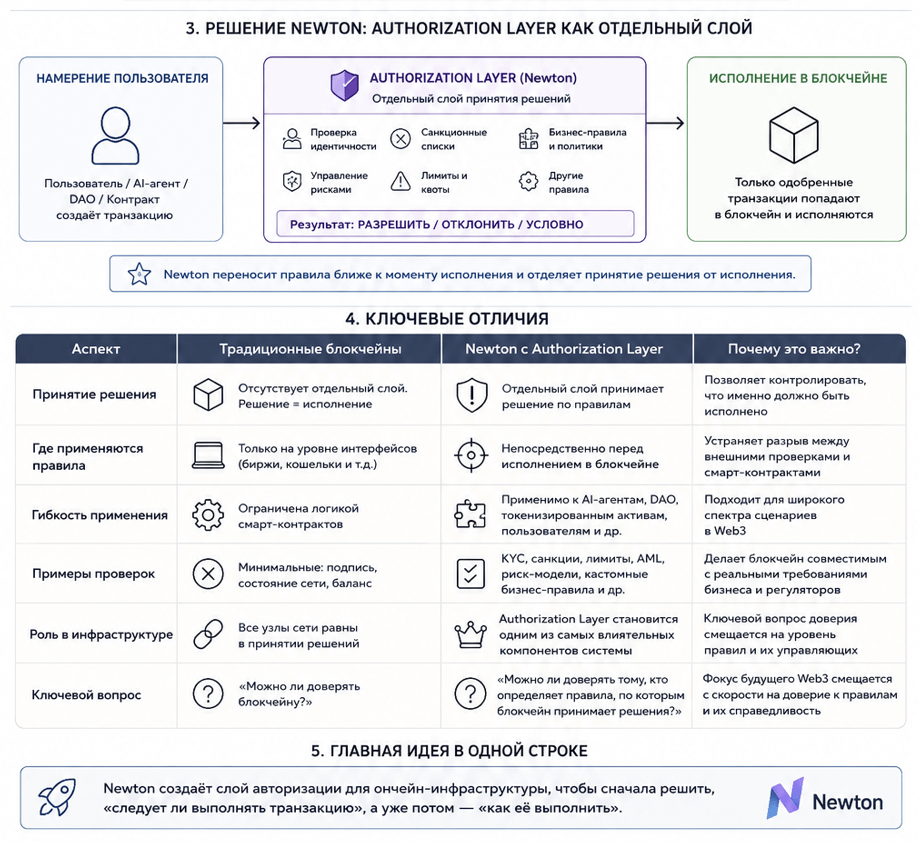
At some point I asked myself a simple question. Why do most constraints work today only as long as the user is interacting through an app interface? The exchange may require you to complete KYC. A wallet can warn about risks. But if you call a smart contract directly, a significant portion of these checks simply disappears. This gap between external checks and the actual execution of the transaction is exactly what Newton is trying to eliminate by moving the rules closer to the moment of execution.
And that’s where the research becomes genuinely interesting. If there’s a separate layer that decides whether the transaction complies with predefined rules, then it inevitably becomes one of the most influential parts of the entire system. At this point, the question changes. We stop asking, “Can we trust the blockchain?” We start asking, “Can we trust the one who defines the rules by which the blockchain makes decisions?”
Honestly, I don’t have the answer yet. But that’s exactly what pushed me to keep studying Newton. Because maybe the most important question for the next generation of blockchains isn’t about how quickly they can execute transactions, but about who and how decides that those transactions should be executed in the first place.