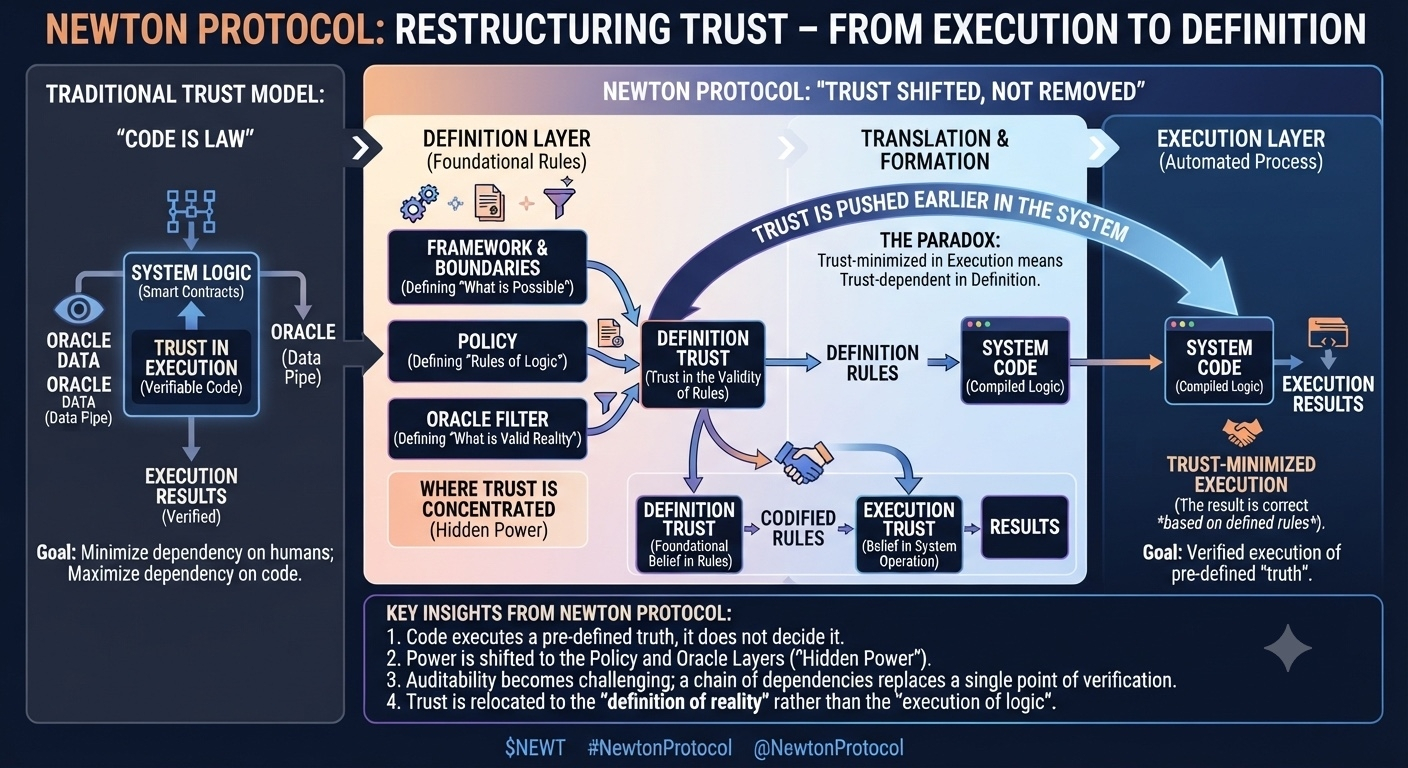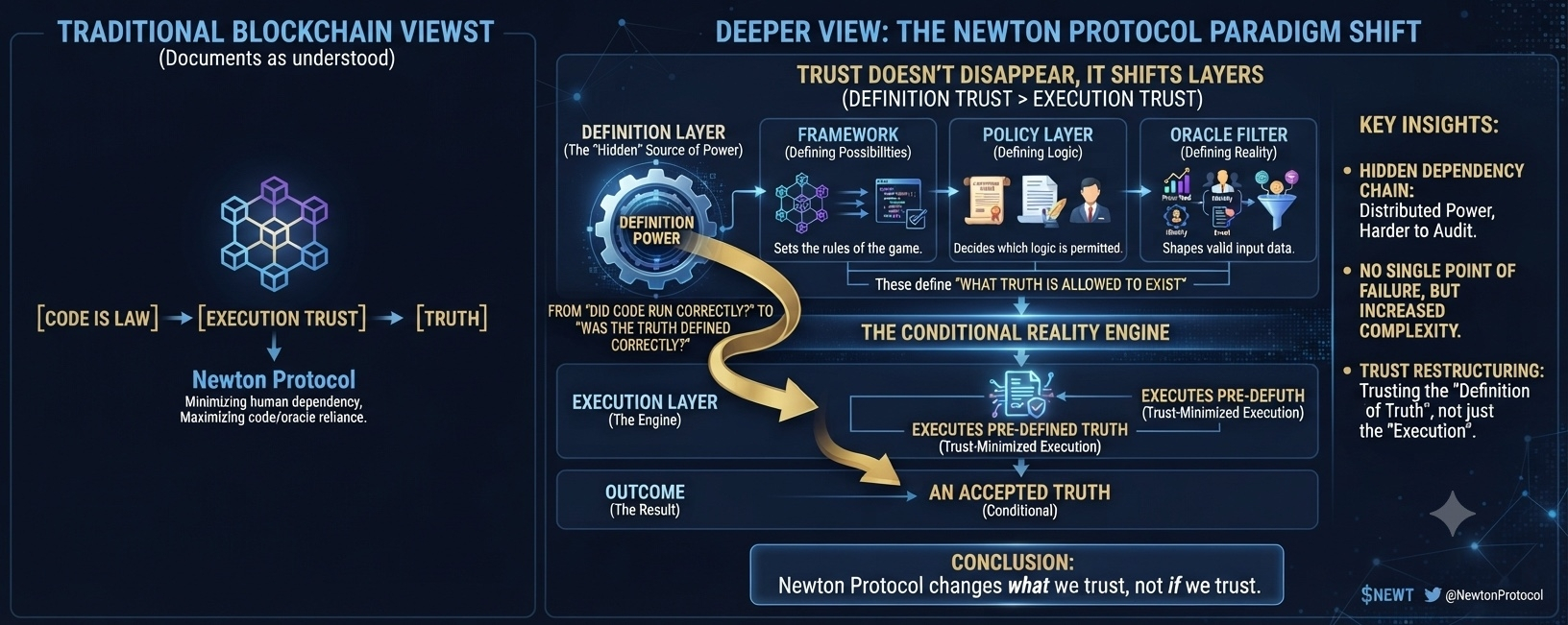
@NewtonProtocol , if you only read the docs, it’s very easy to interpret it as a “trust-minimized” system in the familiar sense: reducing reliance on humans and increasing reliance on code, oracles, and verification mechanisms. But the deeper I look, the more I feel the docs are saying it’s right, yet not saying everything. What truly changes isn’t whether “trust” exists or not, but that trust is pushed out of the most visible place.
The first thing that made me change my perspective is: in the Newton Protocol, code is no longer a place that “determines truth,” but only a place that “executes a truth that has been defined in advance.” It may sound small, but it completely overturns the intuition behind traditional blockchains. Before, I thought: writing the correct code means the system is correct. But here, the question starts moving backward from the code: who defined what “correct” means in the first place?
And here’s another difference that the docs don’t emphasize enough: the system is no longer centered around execution trust, but around definition trust. That means you don’t just have to trust that the system runs correctly—you also have to trust that the “correct definition” has been created in a valid way. I see this as a natural step forward, but it’s also the starting point of a new layer of complexity: trust doesn’t disappear, it just shifts layers.
If you look at it positively, this is a reasonable direction for a complex system. Once the on-chain world is diverse enough, you can’t cram all logic into a single rigid smart contract anymore. Separating policy, oracle, and the framework makes the system more flexible and closer to real life. But a mild counterpoint is: when “definitions” become the center, the boundary between technology and authority starts to blur.
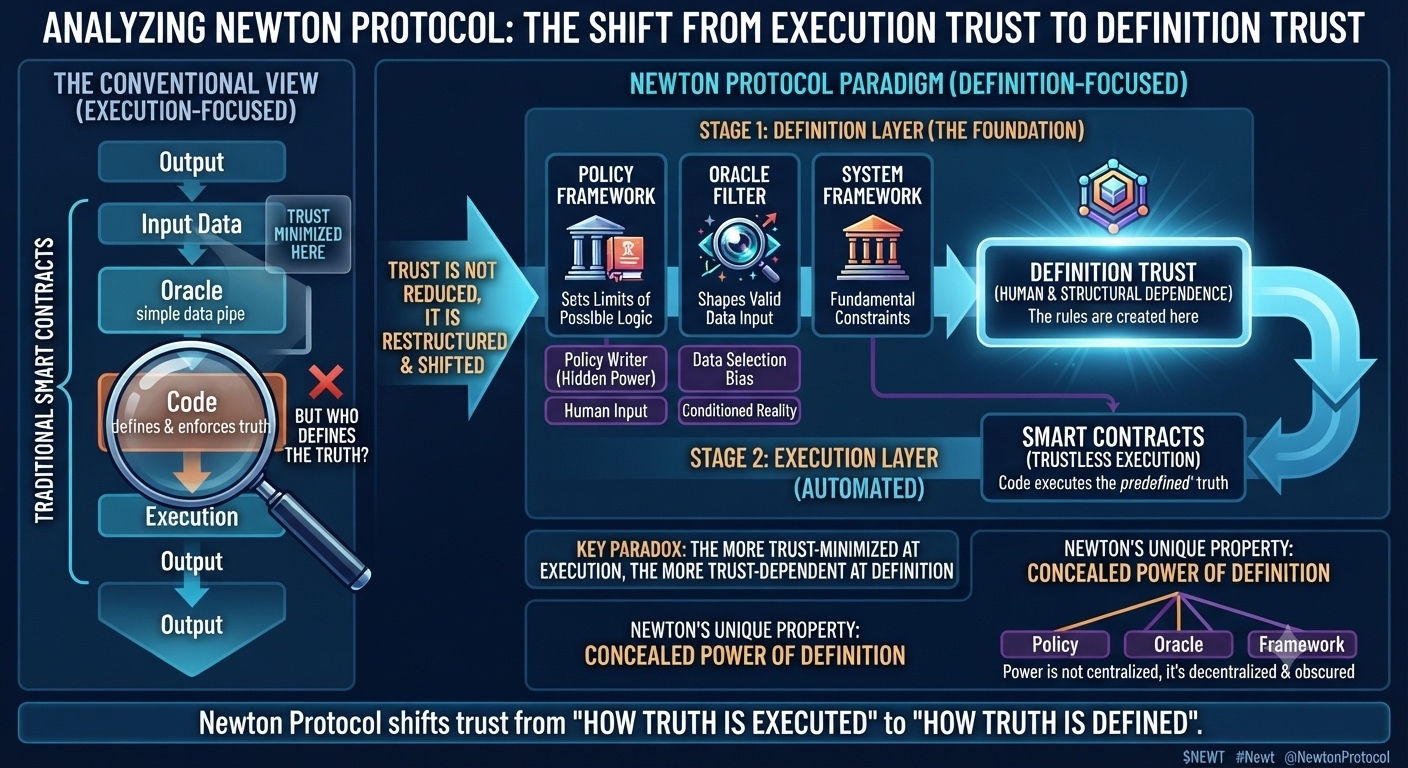
The most important point I see lies in the policy layer. The policy writer isn’t just “writing the law”; they’re deciding how that law can be written. This is a very subtle difference: code is execution, but policy is the constraint on how that execution can be thought about. I think this is strong from a design perspective, but it also creates a layer that users can almost never observe directly.
The oracle in this system is no longer simply a “data pipe.” It’s more like a filter of reality: choosing what is considered valid data for the system to reflect. If data is the input to all logic, then the oracle isn’t just providing information—it’s helping shape the final outcome. I think this is both a powerful and sensitive point.
When I combine policy and oracle, I start to see something more clearly: Newton Protocol isn’t just distributing trust—it’s restructuring where trust is generated. There’s no single point you can point to and say “I trust it here.” Instead, it’s a layered chain, where each layer trusts the one before it in its own way.
This leads to a rather nice paradox: the more trust-minimized the execution layer is, the more trust-dependent the definition layer becomes. I think this is something the docs don’t state outright. From the outside, the system seems to reduce dependence on people, but in reality it just shifts the dependency to an earlier stage of the system.
And that’s where something unique to me appears: “the abstraction of definition rights.” There is no clear entity that can be pointed to as the person who “writes the final law,” but in practice the law is formed by the combination of multiple layers: the framework constrains capability, the policy shapes logic, and the oracle shapes data. Power doesn’t disappear—it just loses its centralized form.
If we go one step further, I start to see Newton Protocol as more of a “conditional reality generator” than an execution system. It doesn’t just run logic—it runs logic that is allowed to exist. This is the part I find most brilliant: the system no longer asks “is this right or wrong?”, but asks “which version of the right is allowed to appear?”
But there’s a small problem: when definition rights are scattered and blurred, auditing becomes much harder. Users no longer check a single point, but have to trust a chain of linked assumptions. This reduces a single point of failure, but increases a “hidden dependency chain”.
In the end, I don’t see Newton Protocol as a system that reduces trust. I see it as a system that transfers trust from a more visible layer to a less visible one, but also a more sophisticated one. And the most important point is not that there is less trust, but that trust no longer sits where traditional blockchain intuition is used to finding it.
If I had to summarize in one sentence: for me, Newton Protocol doesn’t change the need for us to trust—it changes what we’re trusting, from “the way truth is executed” to “the way truth is defined”.