I keep coming back to the same practical question whenever I read about AI, blockchain, or digital infrastructure.
What is a regulated institution actually supposed to do when innovation moves faster than accountability?
That question sounds abstract until it becomes someone's daily job. A compliance officer signs off on systems they did not build. An engineer integrates services that each have different assumptions about data handling. A regulator asks for evidence months after an event took place. Meanwhile, customers simply expect everything to work without exposing information they never intended to share.
Everyone involved wants the same outcome, yet they often work from different definitions of success.
That disconnect seems to explain why so many modern systems feel awkward. They promise efficiency, automation, or intelligence, but privacy is frequently treated as something that gets added later through policies, audits, and exceptions. It works well enough until it doesn't.
The more I think about it, the less convinced I become that this is a technical problem.
It feels like a design problem.
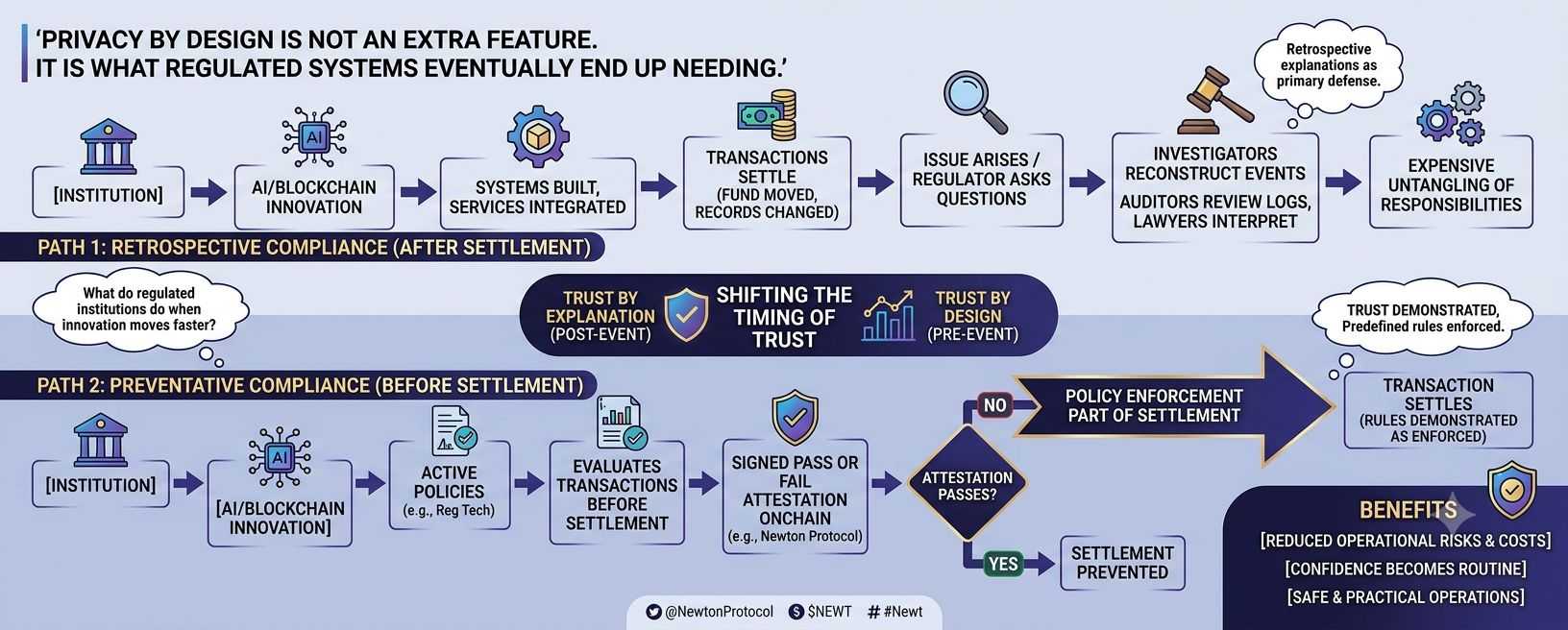
Many existing systems assume that transactions should happen first and explanations should come afterward. If something goes wrong, investigators reconstruct events, auditors review logs, lawyers interpret responsibilities, and organizations try to demonstrate that reasonable controls existed.
There is obvious value in that process. Accountability matters.
But there is also something unsatisfying about relying on retrospective explanations as the primary line of defense. By the time everyone agrees on what happened, the transaction has already settled, funds have moved, records have changed, and responsibilities have become expensive to untangle.
That is where I think regulated industries face a different reality from consumer software.
If a social application makes an incorrect recommendation, the consequences might be limited. If a regulated financial system settles a transaction that should never have been approved, the discussion quickly becomes legal rather than technical.
That changes how infrastructure should probably be designed.
The interesting question is not whether we can prove what happened after settlement.
The more useful question may be whether certain actions should have been allowed to settle in the first place.
Those are different philosophies.
One documents history.
The other attempts to shape it before irreversible actions occur.
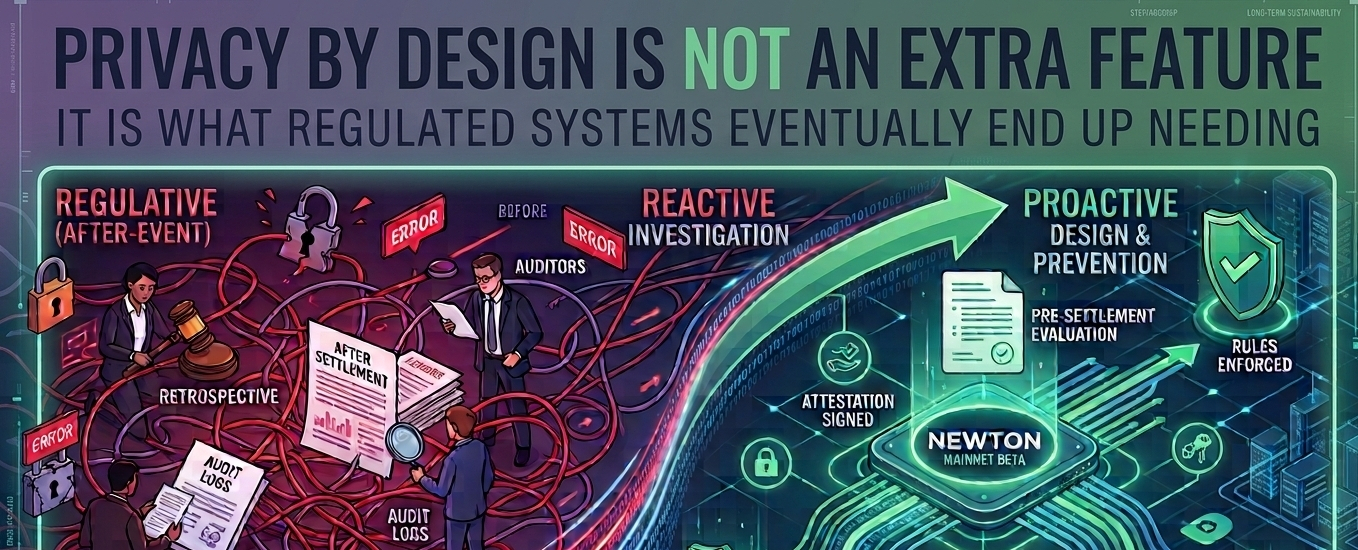
That distinction is one reason I have been paying attention to @NewtonProtocol and the direction of Newton Mainnet Beta.
Not because I assume it solves every compliance challenge, but because it approaches the problem from a point that feels closer to how regulated organizations already think.
Instead of asking systems to justify completed actions, Newton evaluates transactions against active policies before settlement and returns a signed pass or fail attestation onchain. That sounds like a small architectural difference at first, yet it changes the timing of trust.
Trust is no longer based only on later explanations.
Part of it comes from demonstrating that predefined rules were actually enforced before the transaction became final.
I think timing matters more than people sometimes acknowledge.
Most operational failures do not begin with malicious intent. They begin with ordinary exceptions.
Someone bypasses a process because a customer is waiting.
Another department introduces a temporary workaround.
A third-party integration behaves differently than expected.
None of those decisions necessarily look dangerous in isolation. Over time, however, enough exceptions accumulate that the documented process and the real process quietly become different systems.
Eventually everyone is surprised when regulators ask difficult questions.
The organization insists policies existed.
The regulator asks whether those policies were consistently enforced.
Those are not identical claims.
That difference explains why privacy by design seems more sustainable than privacy by exception.
An exception is usually justified by immediate pressure.
Design reflects long-term priorities.
Of course, building around prevention instead of reaction introduces trade-offs.
Policies that are too rigid can slow legitimate activity.
Policies that are too flexible become symbolic rather than protective.
Finding that balance is probably much harder than simply publishing technical documentation.
This is where I become cautious.
Infrastructure projects often describe ideal outcomes without discussing operational complexity.
Real institutions rarely replace existing systems overnight. They integrate gradually. Legacy databases continue running. Different jurisdictions interpret regulations differently. Internal risk teams have their own approval processes. Vendors maintain separate compliance standards.
Technology alone cannot eliminate those realities.
It has to fit inside them.
That may ultimately determine whether projects like Newton become meaningful infrastructure or remain interesting concepts.
The technical architecture could be excellent and still struggle if integration requires organizations to redesign every existing workflow.
On the other hand, if policy enforcement before settlement can fit naturally into systems that institutions already operate, the value proposition becomes easier to understand.
Not because it eliminates compliance.
Because it changes where compliance happens.
Instead of becoming a large investigation after settlement, some responsibilities move closer to the decision itself.
That could reduce operational costs over time, although I would hesitate to assume those savings automatically appear. Every additional layer of verification has implementation costs, maintenance requirements, governance questions, and organizational learning curves.
There is no free efficiency.
Someone always pays somewhere.
The goal is making sure those costs are smaller than the risks they prevent.
I also think there is an important human element that technical discussions sometimes overlook.
People rarely trust infrastructure because they understand every implementation detail.
They trust it because repeated experience gives them fewer reasons to worry.
Most internet users cannot explain payment networks.
Most drivers cannot explain anti-lock braking systems.
Most patients cannot explain medical imaging equipment.
Those technologies became trusted because they behaved consistently under pressure.
Perhaps privacy infrastructure follows the same path.
If people stop asking whether policies were enforced because reliable evidence already exists before settlement, confidence may gradually become routine rather than exceptional.
That outcome would probably matter more than any marketing campaign.
Still, skepticism seems healthy.
Many infrastructure projects promise institutional adoption.
Far fewer actually become part of institutional operations.
The difference usually depends on reliability, interoperability, governance, cost, legal clarity, and years of uneventful performance.
That is a demanding standard.
It should be.
Critical infrastructure deserves demanding standards.
My current view is fairly simple.
I do not think regulated industries need more dashboards explaining yesterday's problems.
They probably need systems that reduce the chance of creating those problems in the first place.
Whether Newton Mainnet Beta ultimately delivers that vision remains something only real deployment can answer.
But I do think it is asking a better question than many projects ask.
Instead of focusing only on how to document completed transactions, it asks whether policy enforcement itself should become part of settlement.
If that approach proves practical across different institutions, jurisdictions, and operational environments, I can imagine banks, payment providers, custodians, insurers, and public-sector organizations finding real value in it.
If it creates excessive complexity, slows business operations, or proves difficult to integrate with existing infrastructure, adoption will naturally remain limited regardless of technical merit.
Infrastructure rarely succeeds because it sounds impressive.
It succeeds when people gradually stop thinking about it because it quietly becomes the safest and most practical way to operate.
For me, that is the real test worth watching.