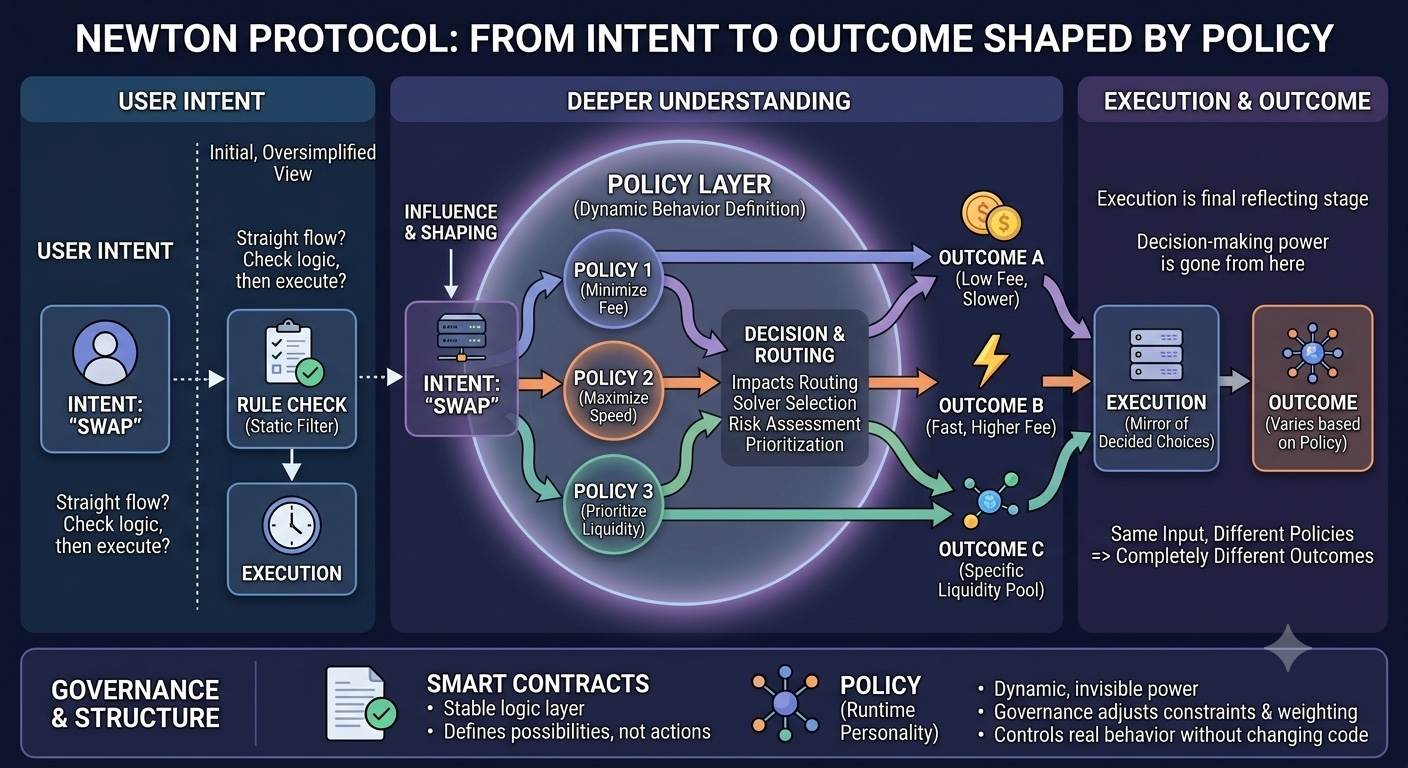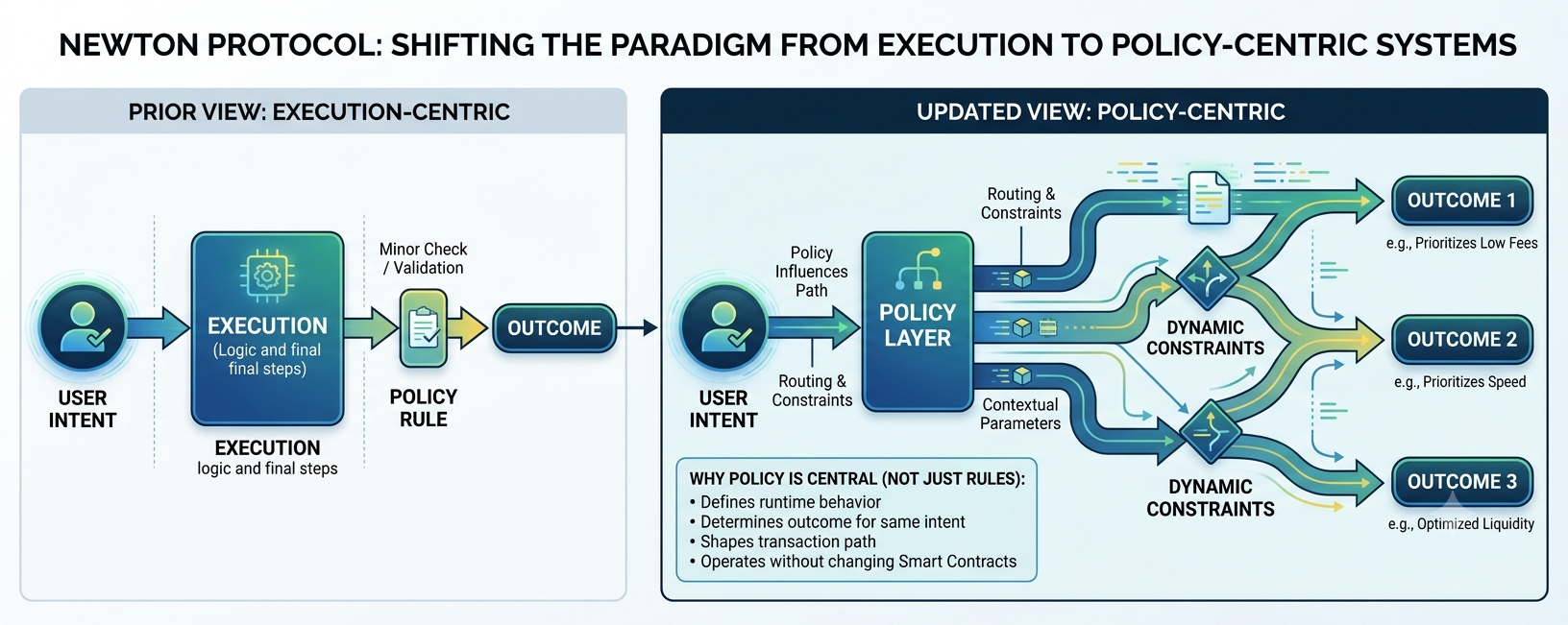
I once looked at @NewtonProtocol how an intent-based execution system is quite clear. Users only need to state their intent, the system will handle the rest automatically, and return the result. Back then, I thought policy was just a layer of rules in the middle—something like validating and then letting it through. It didn’t seem special beyond the role of filtering and protecting the system.
But when I looked deeper, I realized that understanding doesn’t hold up. Policy no longer just sits in the place of a gatekeeping check. It doesn’t only determine what can pass through; it also directly affects how the system responds to the same intent. And importantly, the same input with different policies can produce completely different outcomes.
This makes me rethink execution. In the past, I thought execution is where everything gets decided. But the more carefully I look, the more I see execution is just the final step. The overall direction of the transaction was shaped by policy beforehand—I just didn’t notice.
If I try to redraw the flow in my head, it’s no longer a straight line. The intent enters the system, but it doesn’t go directly into execution. It’s affected by policy right from the start, and then branches out under different conditions. Sometimes it’s only a slight deviation, but other times the final result is completely different even when the input is the same.
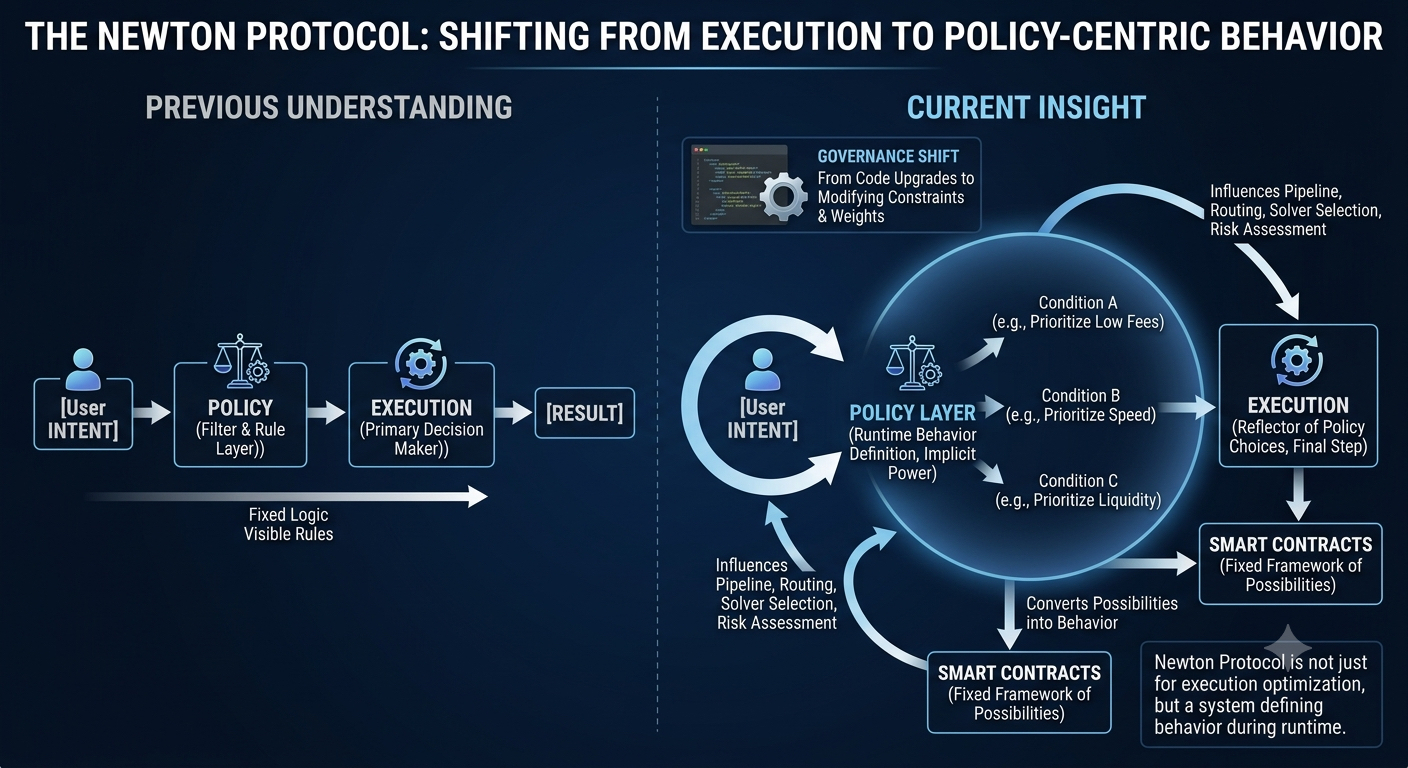
What’s notable is that as long as the smart contract doesn’t need to change, the system can still change its behavior. The code stays the same, the logic stays the same—but just changing the policy’s prioritization or weighting can make the whole flow different. This is when I realized the issue isn’t simply whether the logic is right or wrong, but how that logic is applied in practice.
Honestly, I’m not sure what to call “policy” exactly. It’s not really a rule engine, and it’s not really a logic layer in the traditional sense either. It’s like a layer between intent and outcome, but it doesn’t sit at a fixed point. It spreads across the entire pipeline, seeping into how the system processes each intent.
At this point, execution is just the final display of a process that has already been decided in advance. It doesn’t disappear, but its role as the “decision-maker” is no longer there. It’s like a reflection of the choices that policy has shaped beforehand.
One thing that grabs my attention is that policy isn’t always visible. It doesn’t show up as clearly as a smart contract, and it’s not something users interact with directly. But it directly affects what the user ultimately receives. And this very “hiddenness” makes it a layer of power that’s hard to see.
Looking a bit deeper, I start to see that the system isn’t purely technical anymore. It’s like there’s an intermediary layer that decides how the system understands intent the moment it enters. And this layer isn’t fixed—it can change over time, according to the system’s state, or based on runtime operating conditions.
I no longer think of Newton Protocol as just an execution optimization system. It’s more like a system whose focus is defining behavior while the system is running. It’s not about running a fixed logic, but about choosing how to apply that logic in each specific context.
This made me start to rethink the power structure in the system. Previously, I thought whoever writes the smart contract controls everything. But in reality, smart contracts only define the capability framework. They say what the system can do, but they don’t decide what it will do. Policy is where that capability gets turned into actual behavior.
I started to see that the smart contract is like a fixed foundation layer. It’s stable, changes little, and mainly ensures the system doesn’t break its logic. But the new policy is where the system shows its “operational personality” at any given time. It’s not fixed, yet it directly affects every outcome.
Sometimes I try to simplify it: the same intent—“swap”—but with different policies, the system can produce completely different results.
One side prioritizes low fees, another prioritizes speed, and another prioritizes liquidity. It’s not that one is “more correct” than the others—it’s that the system is being tuned toward which priority.
Digging even deeper, I see that policy doesn’t just affect execution—it also affects how the system chooses routes. It influences routing, solver selection, how risks are evaluated, and even how priorities are set among different options. In other words, it’s not located at a single point; it runs through the entire pipeline.
I also started to think that governance in this model changes completely. In the past, to change the system you had to upgrade the smart contract. But with policy, you only need to change constraints or weighting for the system to operate in a different direction. Governance is no longer about changing code—it’s about adjusting runtime behavior.
If you reset the entire Newton Protocol architecture this way, it’s no longer just a single execution system. It’s like a three-layer system: intent, policy, and execution. Intent is the objective, execution is the result, and policy is the middle layer that determines how intent gets turned into outcomes.
In the end, I realized the most important thing doesn’t lie in execution or in the smart contract. It lies in the policy layer, because this is where the system defines how it operates in real life. And when power lies in defining behavior rather than writing fixed logic, then whoever controls the policy controls the true shape of the entire financial system.
@NewtonProtocol $NEWT #Newt $TAC $BTW