
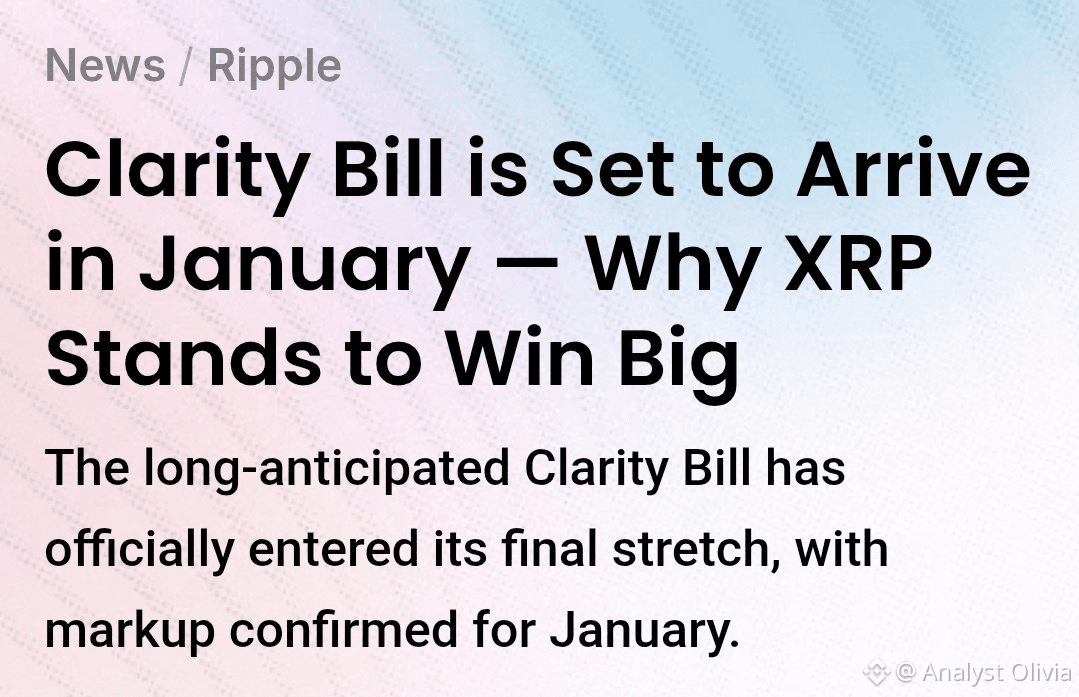
 For years, XRP has lived under a cloud of regulatory uncertainty in the United States. Not because the technology failed , but because the rules were never clearly defined. That uncertainty has weighed heavily on price action, institutional adoption, and long-term confidence.
That may finally be about to change.
The Clarity Act, expected to pass in January 2026, aims to formally define how digital assets like XRP are classified under U.S. law 🇺🇸. Instead of vague interpretations and case by case enforcement, the bill seeks to establish clear legal frameworks for what constitutes a security, a commodity, or a payment-focused digital asset.
This matters ,a lot.
For XRP, legal clarity removes a major overhang that has persisted for years. Markets don’t price assets purely on utility or technology; they price risk. And regulatory ambiguity is one of the biggest risks in crypto.
If the Clarity Act passes as expected:
Legal uncertainty around XRP could significantly diminish
Institutional players may re engage with confidence
Enterprise and cross-border payment adoption could accelerate
Market perception may shift from “regulatory risk” to “regulatory readiness”
XRP was built for seamless value transfer. But seamless technology needs seamless regulation to scale globally , especially in the world’s largest capital market.
This isn’t about hype.
It’s about rules finally matching reality.
With clearer classification, XRP can integrate more deeply into U.S.-based financial infrastructure without the constant shadow of enforcement ambiguity. That clarity could unlock long term growth not just in price, but in real world usage.
January 2026 may not mark overnight gains , but it could mark the end of uncertainty.
And in markets, certainty is fuel 🚀
#XRP #CryptoRegulation #CLARITYAct #Blockchain #BinanceSquare
