
Every week, another protocol claims to be the missing piece for AI-powered finance. Some are genuinely solving difficult problems. Others simply attach "AI" to their branding because it still attracts attention.
What stood out to me was how much the market has changed. Capital is no longer flowing into every shiny narrative. Investors have become more selective.
AI still captures attention, but flashy demos alone aren't enough anymore. People increasingly want to know who owns the infrastructure, how it works, and whether it can actually be trusted.
That shift is what made Newton Protocol interesting.
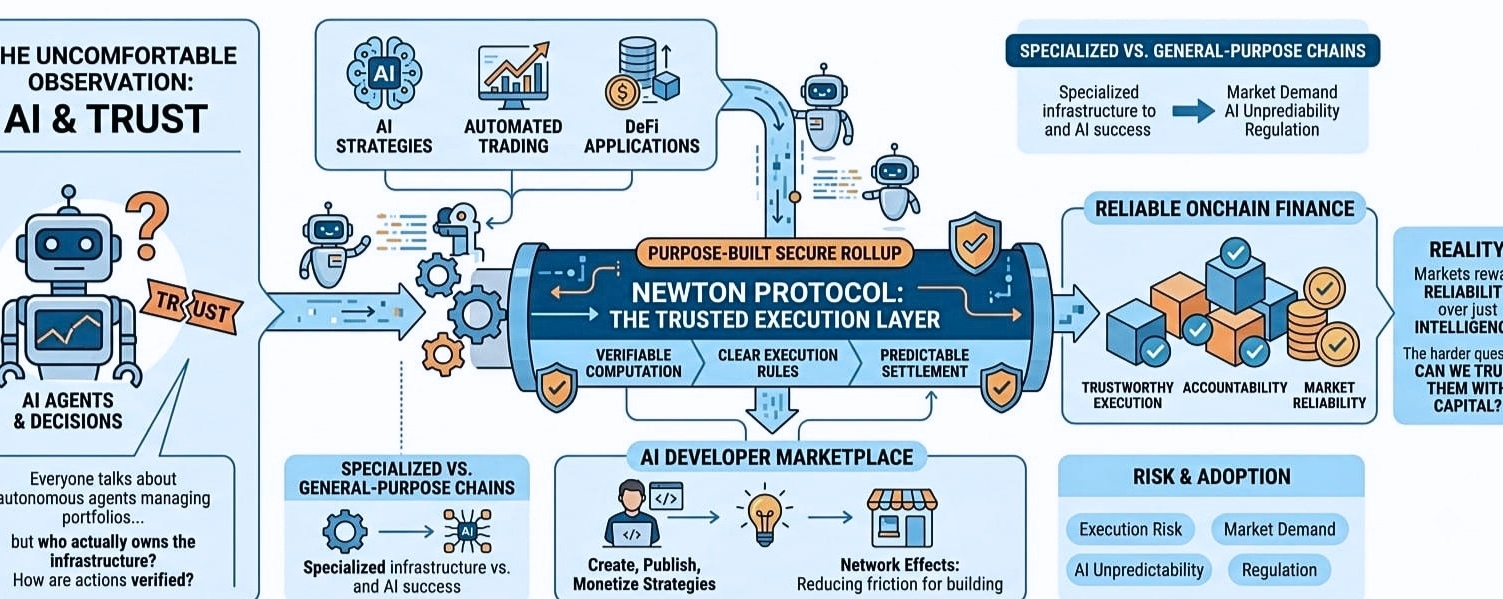
Unlike projects racing to build another AI assistant or chatbot, Newton focuses on something far less glamorous but arguably far more important: creating a secure environment where AI agents can safely interact with on-chain finance.
at first, that didn't sound exciting. But the more I thought about it, the more I realized how important the problem really is.
Everyone talks about AI agents managing portfolios, executing trades, optimizing yields, or automating complex DeFi strategies.
Yet very few conversations focus on the infrastructure behind those actions.
Where do these agents operate? How are their decisions verified?
And what happens if something goes wrong?
Crypto was designed to reduce the need to trust people. AI introduces a different challenge we're now trusting software to make financial decisions on our behalf.
Newton starts by acknowledging that reality instead of ignoring it.
Its goal is to provide a dedicated execution layer where AI-driven actions happen under transparent rules, verifiable computation, and predictable settlement.
Rather than treating AI as just another application running on existing blockchains, Newton is building infrastructure specifically designed for autonomous financial agents.
That difference may sound subtle, but it could become increasingly important as AI becomes more involved in decentralized finance.
Another aspect that caught my attention was the developer marketplace.
Technology alone rarely creates lasting ecosystems. The strongest networks are usually built because developers have reasons to stay.
If builders can create AI strategies, publish them, monetize their work, and allow users to discover those strategies without rebuilding the same infrastructure every time, the ecosystem becomes much more valuable
That's where network effects begin.
Of course, that's also where the challenge becomes much bigger.
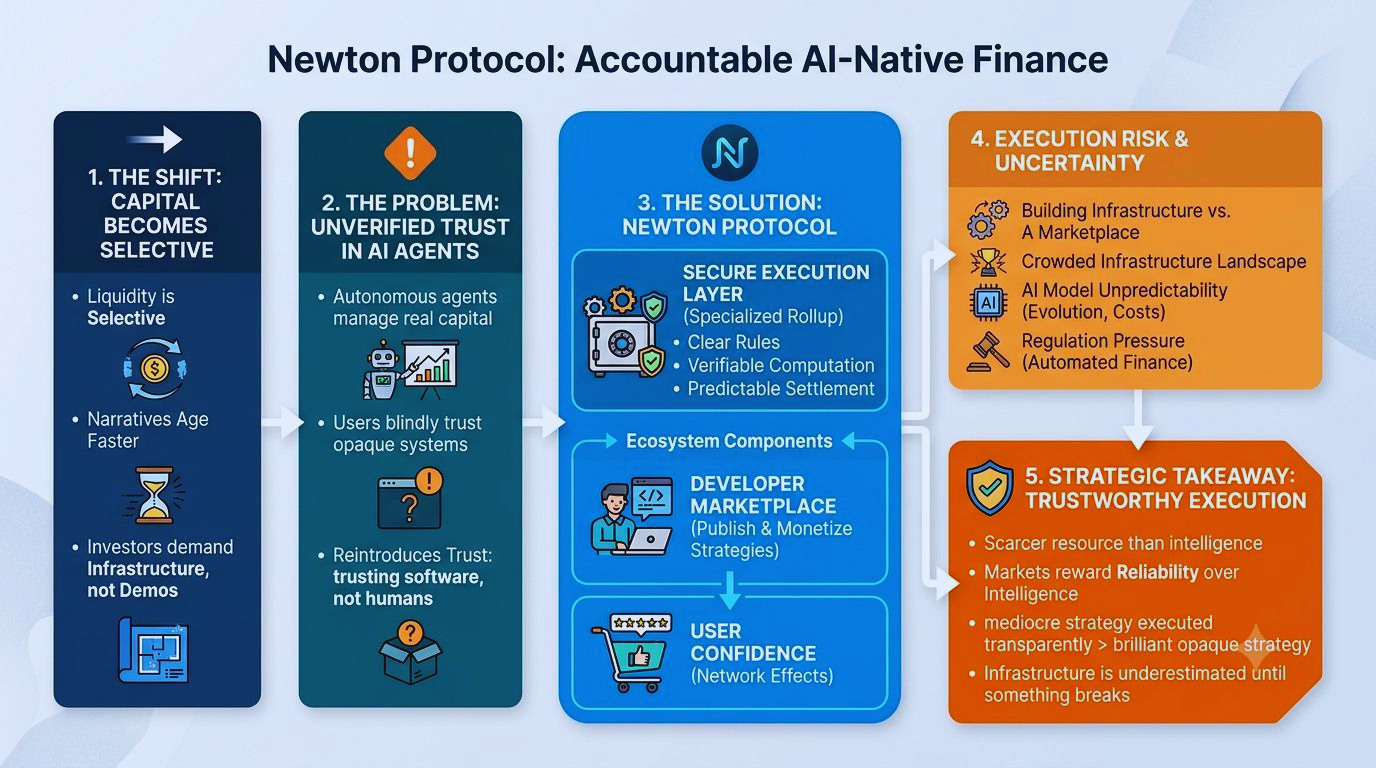
Building impressive technology is difficult. Building an active marketplace with developers, users, and sustainable demand is even harder. Crypto is full of technically brilliant projects that never gained meaningful adoption because they couldn't attract enough real participants.
Newton will ultimately face the same test.
The infrastructure space is also becoming increasingly competitive. Every cycle introduces new protocols promising better execution, modular architectures, AI coordination, or specialized rollups. On paper, many of them appear remarkably similar.
What makes Newton feel different is its willingness to specialize.
Instead of trying to become the foundation for every possible blockchain application, it focuses specifically on AI-native execution. That narrower approach could become an advantage. General-purpose infrastructure competes with almost everyone, while specialized infrastructure only needs to become the best solution for one rapidly growing category.
If AI agents eventually become major participants in on-chain markets, dedicated infrastructure may become less of a niche and more of a necessity.
Still, there are important questions.
AI evolves incredibly fast. Models improve, costs change, and entirely new architectures emerge within months. Infrastructure built for today's assumptions must remain flexible enough to adapt tomorrow.
For infrastructure projects, long-term value depends on utility rather than speculation. If the token helps secure execution, coordinates participants, pays for computation, and rewards contributors, it becomes an essential part of the protocol's economy.
But sustainable demand can only come from real usage not temporary hype.
That distinction matters more than ever.
One thing I appreciate is that Newton's growth story doesn't feel overly manufactured. There isn't a constant stream of announcements designed purely to generate attention. Instead, the project appears focused on building useful tools.
Developers rarely stay because of marketing campaigns. They stay because the infrastructure solves real problems and helps them build products people actually use.
The longer I looked at Newton Protocol, the less I found myself thinking about AI itself.
Instead, I kept thinking about accountability.
Many people assume the biggest challenge for AI in crypto will be creating smarter agents. I'm not convinced. AI models will continue improving regardless of what happens in crypto.
Crypto has repeatedly shown that infrastructure only becomes visible when it fails. Until then, most people overlook it.
Whether Newton Protocol becomes a foundational layer for AI-driven finance or simply an ambitious experiment that arrived ahead of its time remains uncertain.
Both outcomes are possible.
But as AI continues moving closer to real financial activity, the conversation may become less about building smarter agents and more about building infrastructure capable of earning trust.
That's exactly why Newton Protocol is worth watching.