
Artificial intelligence is becoming smarter every month, but one important question remains unanswered: Who controls AI when it starts managing real money on-chain?
Today, AI can analyze markets, execute trades, rebalance portfolios, manage DeFi positions, and interact with multiple blockchains. The problem is that most automation still depends on centralized servers, private bots, API keys, or systems that users cannot fully verify. People are expected to trust software they cannot see working behind the scenes.
Newton Protocol was created to solve exactly this problem.
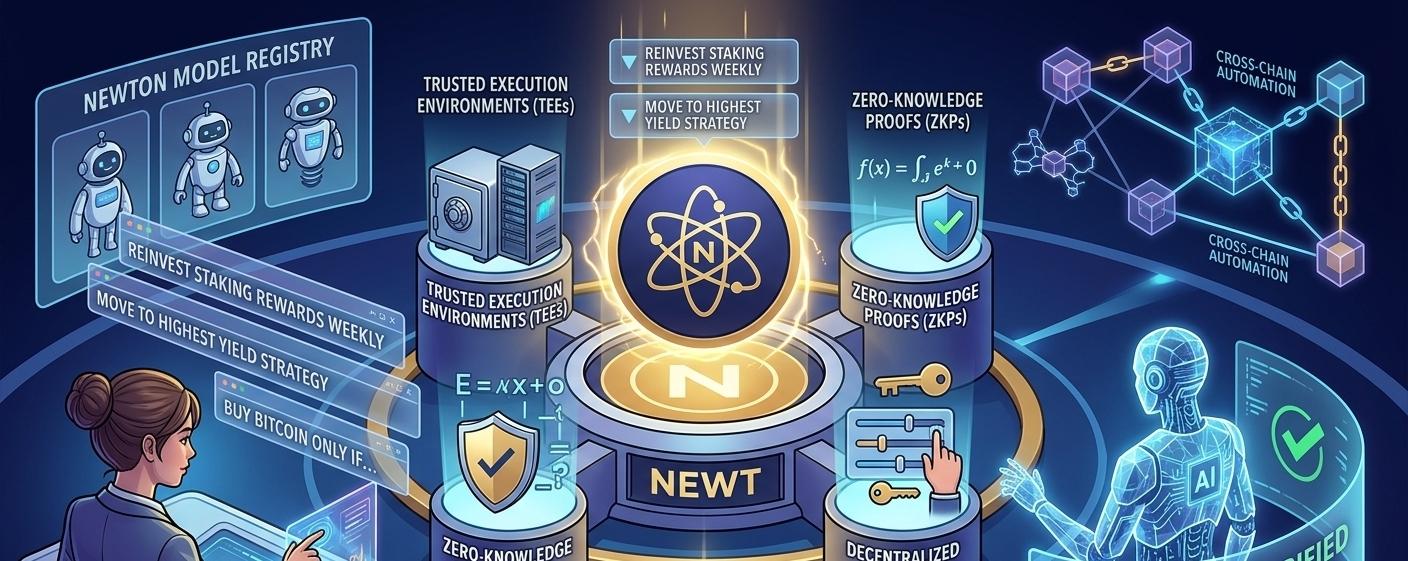
Instead of asking users to trust an AI agent, Newton wants every important action to be cryptographically verifiable. The protocol combines blockchain security, zero-knowledge proofs, Trusted Execution Environments (TEEs), and programmable permissions so autonomous agents can safely act on behalf of users while staying inside strict rules defined by those users.
This idea is becoming increasingly important because crypto is entering an era where AI agents may execute thousands or even millions of transactions every day. Automation without security creates enormous risk. Newton is trying to build the infrastructure layer that makes AI-powered finance trustworthy.
Unlike many AI crypto projects that mainly focus on creating AI models, Newton focuses on something deeper—the operating system that allows AI agents to safely interact with digital assets.
One way to think about Newton is this:
Traditional DeFi requires humans to click every transaction.
Current trading bots require users to trust private infrastructure.
Newton wants AI agents to become independent workers that follow user-defined rules while proving every important action.
That difference is what makes the project interesting.
The protocol describes itself as decentralized infrastructure for verifiable on-chain automation. Users create permissions that specify exactly what an AI agent is allowed to do. The agent cannot simply act however it wants. Instead, every action must satisfy predefined policies before execution. These permissions can later be updated or revoked whenever the user decides.
This design could reduce one of the biggest fears surrounding autonomous finance: losing control over assets.
Imagine telling an AI:
"Reinvest my staking rewards every week."
"Move my stablecoins into the highest yield strategy."
"Buy Bitcoin only if specific market conditions happen."
Normally this requires trusting a centralized automation service.
Newton wants those instructions to become verifiable blockchain permissions.
The protocol achieves this through several technologies working together.
The first is Trusted Execution Environments (TEEs). These provide isolated computing environments where sensitive operations can execute securely.
The second is Zero-Knowledge Proofs (ZKPs). Instead of revealing private information, the protocol generates mathematical proofs showing that an action followed the approved rules.
The third component is modular AI agents that specialize in different types of automation.
Together these components create a system where users keep ownership while AI performs work under verifiable limits.
Another important piece is the Newton Model Registry.
Think of it as an on-chain marketplace for AI models and automation agents.
Developers can publish their AI models.
Operators can deploy them.
Ubers can choose which verified agents they trust.
Developers receive a share of protocol fees when their models are used successfully, creating an economic incentive to build higher-quality automation instead of simply launching another speculative token.
This marketplace approach could eventually create an ecosystem where thousands of specialized AI agents compete on performance, security, and reputation.
One agent may specialize in yield farming.
Another may focus on arbitrage.
Another may manage DAO treasuries.
Another may optimize stablecoin strategies.
Insnead of one company controlling all automation, independent developers could contribute new agents to the ecosystem.
Security also extends beyond software.
Operators running AI agents must provide collateral in NEWT tokens.
If operators behave dishonestly or fail protocol requirements, their collateral can potentially be slashed.
This creates financial consequences for bad behavior while rewarding reliable service providers.
The NEWT token sits at the center of this entire system.
It is much more than a governance token.
According to official documentation, NEWT has four primary functions.
First, it secures the network through delegated Proof-of-Stake. Validators and delegators stake NEWT to help maintain network security while earning rewards.
Second, NEWT serves as the native gas token for protocol operations, including issuing, updating, and revoking permissions.
Third, it powers the Newton Model Registry by paying registration fees and enabling economic rewards for developers and operators.
Fourth, it eventually enables decentralized governance through community voting as the protocol becomes more decentralized.
The protocol has a fixed supply of 1 billion NEWT, meaning no inflationary minting is planned after launch according to official documentation. The initial circulating supply represented approximately 21.5% of the total supply, with remaining tokens unlocking gradually according to predefined schedules.
Token allocation is designed to support long-term development.
A majority of the supply is reserved for community-related purposes including ecosystem growth, development funds, rewards, and incentives, while the remaining allocation supports contributors, early backers, the foundation, and operational needs through structured vesting schedules.
From an ecosystem perspective, Newton is attempting to connect several large trends that are developing at the same time.
Artificial intelligence.
On-chain finance.
Smart accounts.
Autonomous agents.
Cross-chain execution.
Programmable compliance.
Veifiable automation.
Most crypto projects only participate in one of these sectors.
Newton is trying to become infrastructure connecting all of them.
The protocol also supports expressive policies that can operate across multiple blockchains instead of remaining limited to one ecosystem. It aims to integrate off-chain data sources while ensuring on-chain actions still satisfy predefined policy rules before execution.
Another interesting direction is compliance.
Many institutions want blockchain efficiency but cannot ignore regulatory requirements.
Newton positions itself as a decentralized policy engine capable of embedding programmable compliance into digital asset operations.
This could become increasingly important if stablecoins, tokenized real-world assets, and institutional capital continue moving on-chain.
The long-term roadmap reflects gradual decentralization.
Initially the foundation guides protocol development.
Oger time governance responsibilities are expected to shift toward validators, token holders, developers, and the broader community through a DAO structure.
The protocol also plans continued development of its Keystore rollup architecture, staking infrastructure, model registry, policy engine, and broader automation ecosystem.
Of course, there are meaningful challenges.
AI infrastructure has become one of crypto's most competitive sectors.
Many projects are building AI agents.
Others focus on decentralized compute.
Some specialize in inference.
Others target autonomous trading.
Newton must convince developers that its security architecture offers clear advantages.
User education is another challenge.
Zero-Knowledge Proofs, Trusted Execution Environments, programmable permissions, and policy engines are powerful ideas, but they are technically complex.
For mainstream adoption, users should not need deep cryptography knowledge simply to automate financial tasks.
Developer adoption is equally critical.
The Newton Model Registry becomes valuable only if talented builders continuously create useful AI agents.
Without a thriving developer community, the marketplace cannot reach its full potential.
Network effects will matter.
Users attract developers.
Developers attract more users.
Operators increase service quality.
Each part strengthens the others.
Finally, token demand must increasingly come from real protocol activity rather than speculation alone.
If more users create permissions, launch AI agents, pay fees, stake validators, and interact with the marketplace, NEWT develops stronger utility.
If activity remains limited, long-term value becomes harder to justify.
Overall, Newton Protocol is attempting something ambitious. Instead of simply adding AI to crypto, it is building an infrastructure layer where autonomous agents can safely operate under user-defined rules while proving their actions cryptographically. By combining TEEs, Zero-Knowledge Proofs, delegated Proof-of-Stake, programmable permissions, and an open marketplace for AI agents, the protocol aims to create a foundation for trustworthy on-chain automation. Whether Newton ultimately succeeds will depend less on marketing and more on real developer adoption, active users, ecosystem growth, and continuous execution. If the future of blockchain includes millions of AI agents managing digital assets, protocols that provide security, verification, and accountability could become essential infrastructure—and that is exactly the future Newton Protocol is trying to build.