

Over the past couple of days, I went through the @NewtonProtocol Mainnet Beta materials carefully and found that what Newton truly wants to move onto the chain isn’t just capital, but the thing financial institutions value most—while also being the hardest for smart contracts to understand: trading discipline.
Many DeFi treasury vaults now write a set of risk-control rules, such as limiting how much of a single asset can be held, which protocols cannot be interacted with, at what level a collateral’s de-anchoring must trigger a halt in operations, and which user identities and regions are eligible to participate.
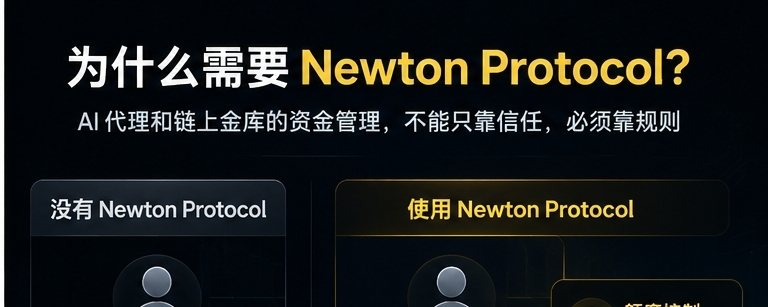
The problem is that most of these rules are still left in documents, back-office processes, and manual approvals.
On-chain smart contracts only execute; they don’t know whether the transaction exceeds position limits or whether the counterparty is on a restriction list. As long as the signature and call conditions are satisfied, the money may move first. By the time the monitoring system detects the abnormality, the risk has often already occurred.
It’s like a fund posts a dozens-of-pages risk control manual on the office wall, but nobody checks orders before the trader hits the confirm key. The rules exist, but there’s a layer of air between the rules and the execution of funds.
Newton Protocol Mainnet Beta fills that layer.
Newton is already live on Base and Ethereum. Developers can first choose or write a set of policies, then connect Newton to existing smart contracts. Before each transaction is formally settled, Newton AVS will make decisions based on on-chain and off-chain signals such as identity, sanctions lists, risk parameters, position limits, and more.
As long as the rules allow it, the trade can continue.
If the rules reject it, or the system can’t complete validation, the operation won’t go through.
This “stop when validation fails” design is crucial, because real risk control can’t be casually turned off when it’s inconvenient. Otherwise, the so-called restrictions are nothing more than a prompt box on the frontend.
VaultKit is the first piece of the puzzle that brings Newton Mainnet Beta to the DeFi vault scenario.
It’s not about recreating a closed vault and locking all funds and strategies inside Newton’s own system. Instead, it adds a layer of programmable authorization to existing vaults. The vault managers’ existing centralized limits executed manually—anchor depeg triggers, maximum drawdown, contract whitelisting, and investor eligibility rules—can gradually become on-chain policies that must be satisfied before a transaction is allowed.
More importantly, every policy decision generates a signed on-chain credential.
Depositors and auditors no longer have to rely only on managers saying, “We’ve always followed risk control.” Instead, they can directly verify on the Newton Explorer what authorizations were checked before a given transaction was executed.
This actually changes the trust relationship for on-chain vaults.
In the past, users trusted whether the team would follow the rules. What Newton wants to do is make it unnecessary for users to rely solely on trusting the team, because the rules are now embedded in the transaction execution path, and the judgment results also leave public evidence.
Newton hasn’t handed validation authority to a centralized server. According to the project’s published architecture, policy evaluation is carried out by a network of independent operators, combined with the economic security provided by EigenLayer and succinct zero-knowledge proofs—so that sensitive identity, compliance, and risk data don’t all need to be fully disclosed, while the validation result can still be proven.
That’s also why I think the Newton Mainnet Beta is worth studying on its own.
Many projects emphasize on-chain transparency, yet ignore that institutions can’t possibly disclose their complete risk models, customer data, and internal rules in full. What Newton aims to solve is how to not leak underlying sensitive information while still proving that a transaction has truly passed the required checks.
It’s not selling higher APY—it’s selling a provable form of control.
For ordinary DeFi users, this system may not feel as intuitive as a new mining pool or new points mechanics. But when institutional capital truly considers entering on-chain, the first questions are usually not whether the yield can be higher by two percentage points, but who can move the money, how much they can move, in what circumstances operations must stop, and whether—if something goes wrong—they can produce tamper-proof execution records.
Newton Protocol Mainnet Beta has moved this authorization logic from the whitepaper into real execution on Base and Ethereum. VaultKit’s SDK and the first batch of open-source policy bundles are also already available.
Next, what truly needs to be observed is how many vaults are willing to turn risk control from “written in documents” into “encoded into transaction preconditions,” and how many asset managers are willing to use on-chain credentials to prove to users that they truly follow the rules.
In the past, DeFi solved how assets can move freely.
What Newton solves now is: before asset flows, who checks whether it has crossed the boundaries?
This infrastructure layer may not sound exciting, but when on-chain vaults start handling larger-scale capital, what they may be missing is not more strategies, but a door that no one can secretly bypass.