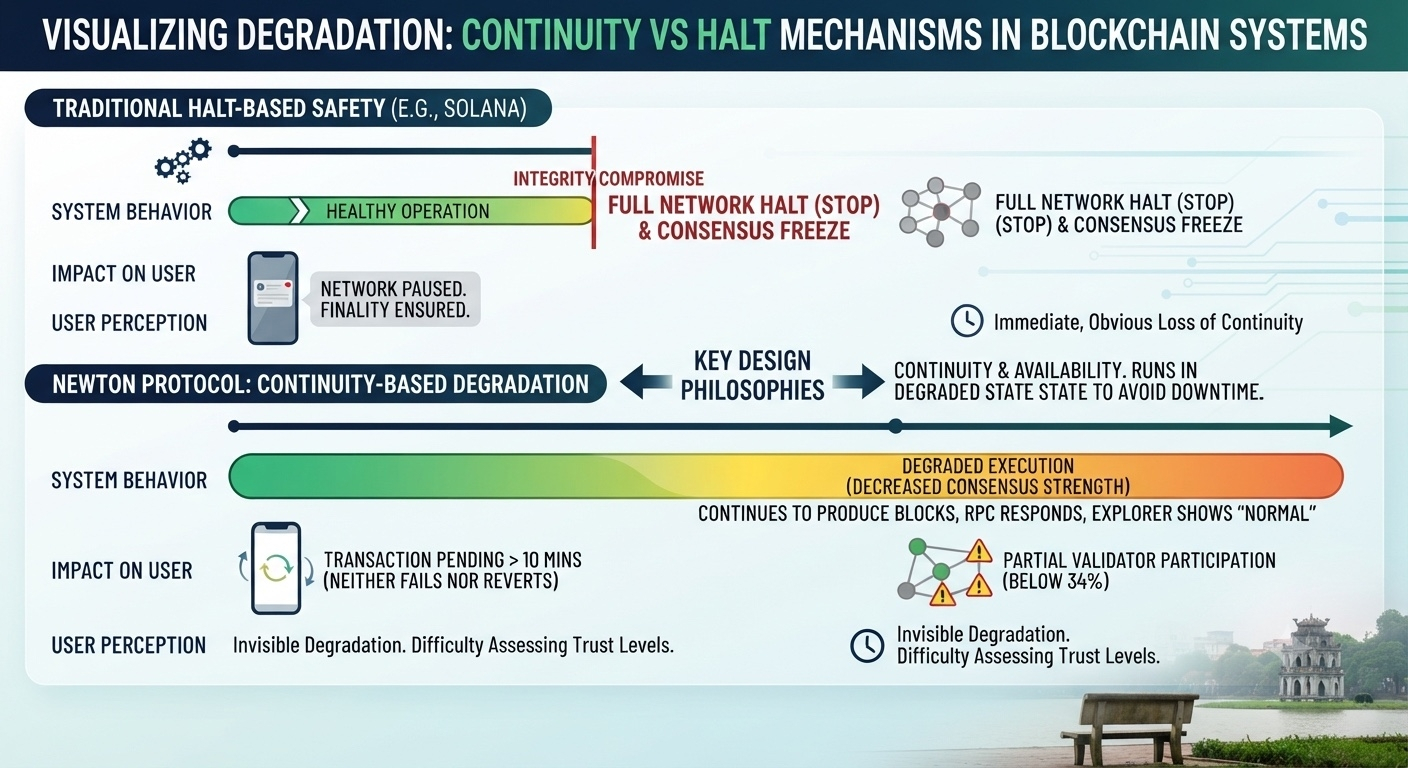
Minh Anh and I took a walk around Hoan Kiem Lake, then stopped at a stone bench near Turtle Tower. Minh Anh’s phone lit up—on the Newton Protocol, a transaction had been pending for more than 10 minutes, but it didn’t fail or revert. The explorer is still green, and the RPC is responding normally. But there’s a very clear feeling that the system isn’t “standing still,” even though nothing appears to be stopping.
Minh Anh asks: if this system is wrong, does it stop? The question sounds simple, but it’s actually about how the Newton Protocol defines an error state. A system can keep running while it’s wrong always creates a blind spot of cognition. And that blind spot does not appear on any interface.
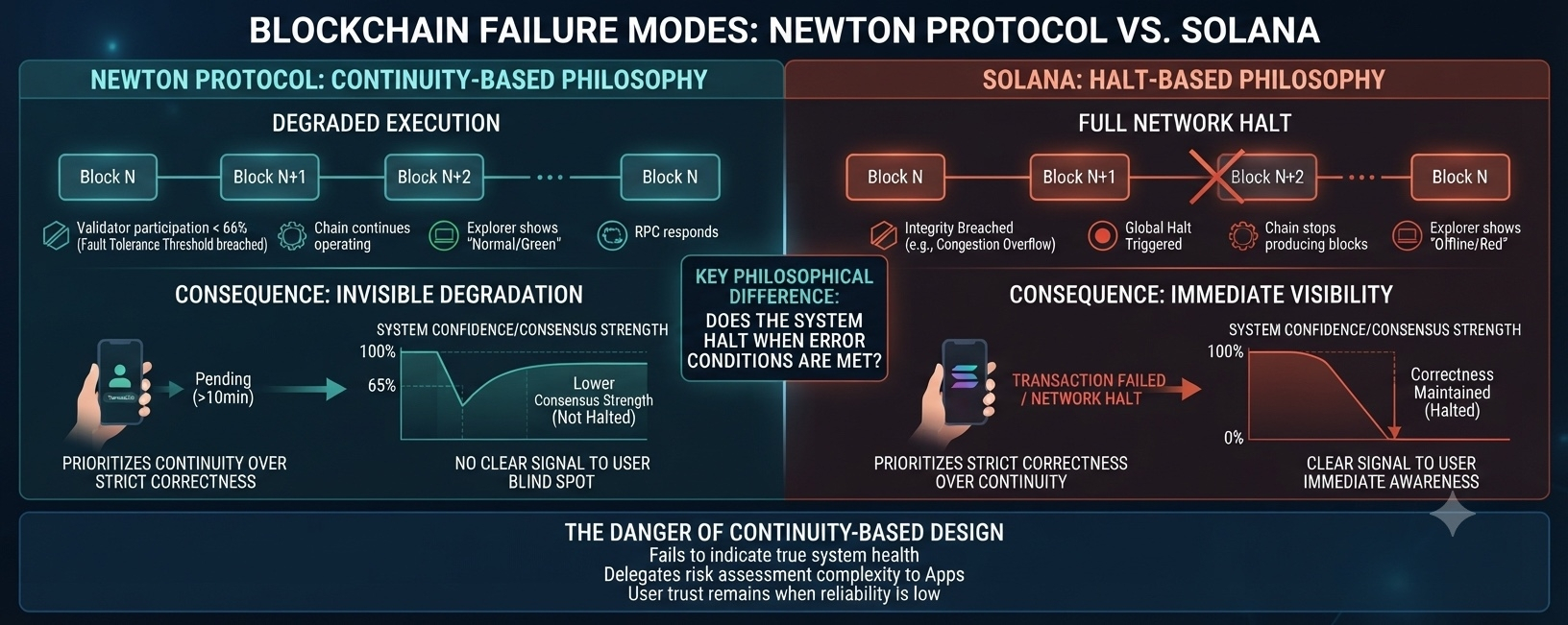
In the whitepaper, Newton Protocol does not treat failure as an endpoint, but as a state with a degree. When validator participation falls below a safe threshold, about 34% of the weight degrades according to the fault-tolerance model. The system does not halt; it switches to degraded execution. That means the chain keeps operating, but under conditions where there are no longer sufficient guarantees about consensus strength.
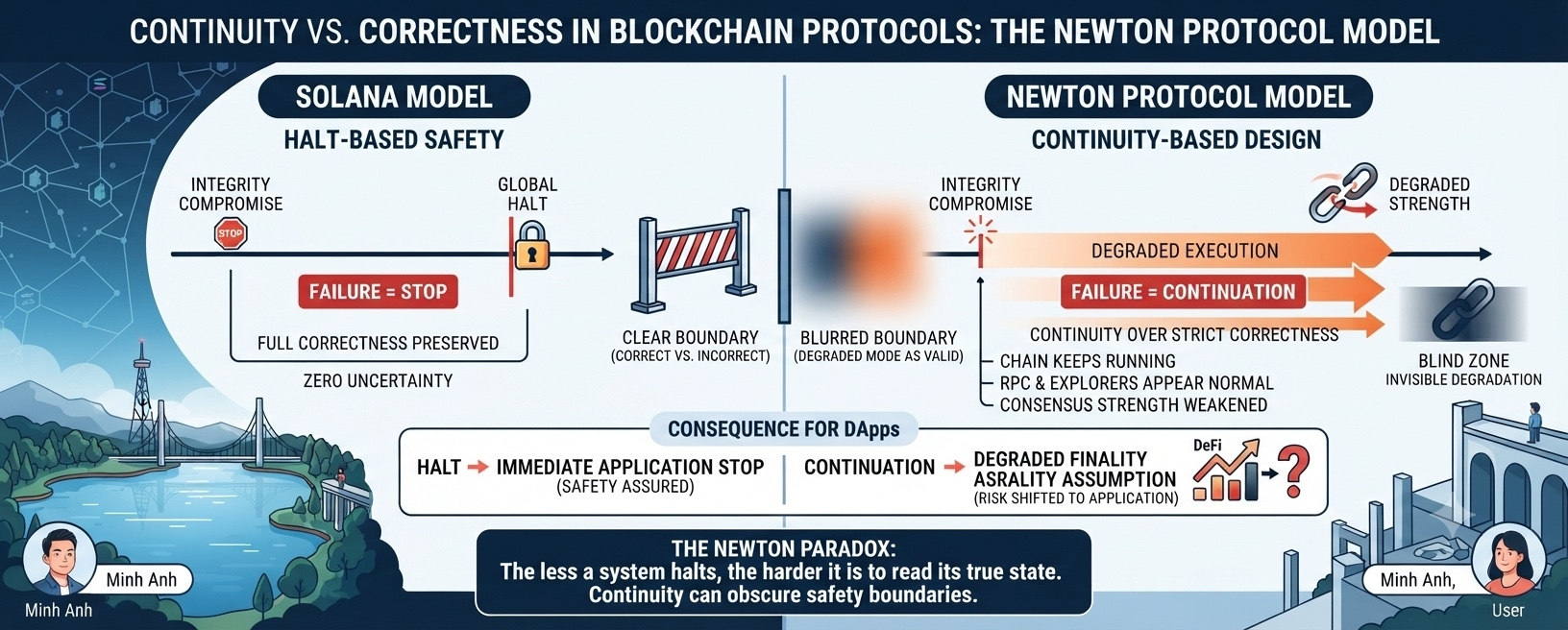
If you place it side by side with Solana, the difference lies in philosophy. Solana chose full halting when integrity is violated to preserve absolute correctness of the state. Newton Protocol goes the opposite direction: it accepts continuing to run in a degraded condition to avoid interrupting the entire ecosystem. One side draws a clear boundary between right and wrong; the other blurs that boundary to maintain continuity.
But once failure becomes a valid mode, the system starts to have the ability to keep going without being sure it is completely right. Continuity is prioritized over strict correctness. This helps reduce the risk of the entire network collapsing, but at the same time it weakens the signal that shows the system is not in an ideal state.
In periods of volatility after the listing on Binance, there were times when transaction failures increased, but no global halt event appeared. The chain continued producing blocks, the RPC kept responding, and the explorer still displayed normal status. But actual execution quality showed signs of localized degradation without corresponding warnings.
The key point is that the system does not stop, so there is no clear signal to users about when they should reduce their trust. This is a form of invisible degradation, where the system’s state quality declines without a corresponding visible boundary. Users still see that it is “running,” but they do not see that it is “weak.”
A circuit-level isolation mechanism is used to limit error propagation. A degraded module does not drag the entire system down, much like how microservices operate in web2. This approach improves fault tolerance and keeps uptime higher in a volatile environment. But a blockchain is not just a compute system—it is a state-economy consensus system.
In a degraded state, applications like lending or liquidation can still read state and execute logic. The problem is not whether each individual step is right or wrong, but whether the finality assumption is still strong enough to serve as the foundation for financial decisions. When this assumption weakens without a clear signal, the responsibility for assessing risk shifts to the application.
Minh Anh said that if the system stops entirely, at least you know not to trust it. But if it doesn’t stop, then there is no clear way to know where the trustworthiness stands. That sentence touches the limits of continuity-based design: the fewer halts there are, the harder it is to read the true state.
Newton Protocol chooses continuity instead of halt-based safety. This helps reduce cascade failures and keeps the experience smoother under volatile network conditions. But the price is that the boundary between safe and unsafe becomes blurred. When that boundary disappears, the system no longer makes clear how right or wrong it is.
We sat a little longer at Hoan Kiem Lake, then stood up. There was no clear conclusion because the system’s design itself doesn’t create a clear boundary for a “conclusion.” All that remains is a feeling that some systems are not wrong in the sense that they stop. They are wrong in the sense that they keep running, but no longer say clearly how right they are.
@NewtonProtocol $NEWT #Newt $VOOI $BASED