
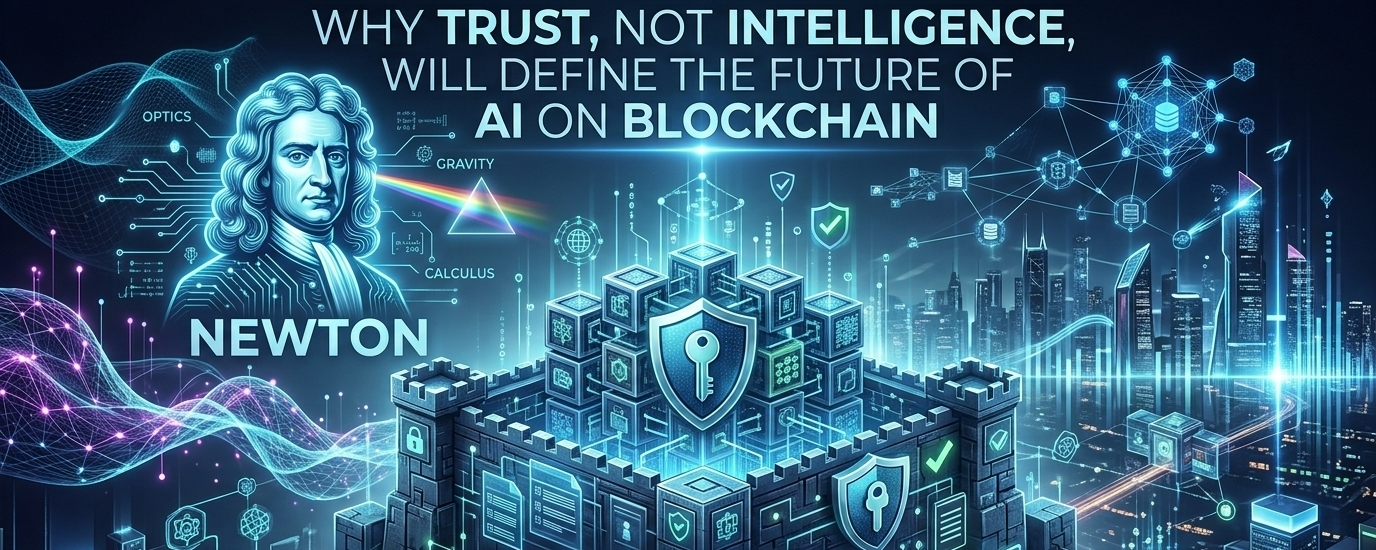
Most conversations about AI in crypto begin with intelligence. I think they should begin with trust. An AI agent can generate ideas in seconds, rebalance portfolios while we sleep, or coordinate complex strategies across multiple networks. But none of that matters if users cannot verify what the agent is allowed to do, when it can act, or how its actions are secured. That is why Newton Protocol caught my attentionnot because it promises smarter automation, but because it treats security as part of the user experience instead of an invisible technical layer.
Imagine hiring an exceptionally talented financial assistant who never sleeps. You would not simply hand over your entire bank account and hope for the best. You would define spending limits, require approvals for sensitive actions, and expect a complete record of every decision. Newton Protocol follows a similar philosophy for AI-powered on-chain activity. Instead of assuming intelligence automatically creates value, it asks a more practical question: how can automated systems earn enough trust to handle meaningful assets?
This changes how I think about AI infrastructure. The most valuable network may not be the one with the most sophisticated models, but the one that makes autonomous execution predictable. Intelligence attracts attention, while reliability earns long-term adoption. That difference is easy to overlook in a market where every project competes to sound smarter than the last.
A useful analogy is modern air travel. Passengers rarely think about the thousands of safety checks happening behind the scenes, yet those systems are the reason flying feels routine rather than risky. The experience is simple precisely because the security is complicated. Newton Protocol appears to pursue the same outcome, where users interact with AI strategies confidently because the safeguards become part of the product rather than an afterthought.
Another comparison is a city's traffic network. Cars move independently, but traffic lights, road rules, and intersections coordinate millions of decisions every day. Without that coordination, speed would quickly become chaos. AI agents operating across decentralized systems face a similar challenge. The goal is not only to move faster but to move safely while many independent actors interact simultaneously.
One point I believe receives too little attention is that better AI models alone will not define the next generation of decentralized applications. Models improve rapidly and eventually become accessible to everyone. Trust infrastructure is much harder to replicate. If multiple projects can access comparable AI capabilities, the competitive advantage shifts toward execution quality, permission management, and transparent verification. In that sense, security may become a stronger differentiator than intelligence itself.
The NEWT token also makes more sense when viewed as a coordination tool rather than merely a tradable asset. Networks need mechanisms that encourage honest participation, align developers with users, and create sustainable incentives for maintaining infrastructure. Tokens become meaningful when they coordinate behavior across a growing ecosystem instead of existing solely for speculation. The long-term question is not whether the token can attract attention today, but whether it becomes increasingly useful as more AI services, developers, and automated strategies rely on the network.
There are still important questions worth watching. Can developers build applications that people genuinely use rather than simply demonstrating technical possibilities? Will security mechanisms remain efficient as activity grows? Can decentralized governance respond quickly enough as AI evolves at an extraordinary pace? These are not weaknesses unique to Newton Protocolthey are challenges facing every project attempting to combine autonomous intelligence with decentralized execution.
What makes this space interesting is that we are moving beyond the era where blockchains simply recorded transactions. Networks are beginning to coordinate decisions made by software acting on behalf of humans. That is a fundamentally different responsibility. Success will depend less on who builds the loudest AI narrative and more on who creates the most trustworthy environment for autonomous action.
My biggest takeaway is surprisingly simple. The future of AI on-chain may not belong to the smartest agents. It may belong to the networks that make those agents accountable, transparent, and safe enough for everyday users to trust. If that vision continues to mature, Newton Protocol could represent something more significant than another AI projectit could help redefine what secure automation feels like in decentralized finance
