


1. Project Overview: What is Hyperliquid?
Over the past few years, decentralized exchanges (DEXs) have been trying to challenge the market position of centralized exchanges (CEXs). However, constrained by blockchain performance, gas costs, and matching efficiency, most DEXs have been unable to compete with industry giants like Binance and Bybit in terms of trading experience. Users often have to deal with high gas fees, trading slippage, low liquidity, and longer confirmation times—making professional traders more willing to choose CEXs.
The birth of Hyperliquid is precisely intended to fully solve these problems.
Hyperliquid is not just a simple DEX deployed on Ethereum or Solana; it is a Layer 1 blockchain specifically designed for high-frequency trading. The team did not adopt the traditional DeFi common AMM (automated market maker) model; instead, it built a fully on-chain order book (CLOB), so that all order matching, order cancellations, executions, and settlements happen directly on-chain.
This design lets Hyperliquid deliver both the smooth experience of a CEX and the transparent, secure, and verifiable characteristics of blockchain. Users don’t need to trust centralized custodians; all trading records, fund flows, and order statuses can be verified on-chain.
As of now, Hyperliquid has become one of the largest protocols for on-chain perpetual contract trading. In multiple time periods, its daily trading volume has even exceeded some centralized exchanges, making it one of the most representative foundational infrastructure projects in DeFi.
II. Why does Hyperliquid build its own Layer 1?
Many people wonder: why not just deploy on Ethereum, Arbitrum, or Solana—why build your own public chain?
The answer lies in performance.
For perpetual contract trading, what matters most is not smart contract functionality, but trading matching efficiency. Professional trading platforms need to satisfy:
Millisecond-level matching speed
High-frequency order cancellation capability
Handling a large number of orders simultaneously
Extremely low trading latency
Real-time risk control and settlement
These requirements are far higher than those of ordinary DeFi protocols. Even a high-performance public chain like Solana still needs to accommodate various application scenarios. Hyperliquid, however, is optimized entirely around the trading system at the underlying layer. Its official documentation states that it uses a specially designed HyperBFT consensus mechanism at the base layer, combined with a high-performance matching engine, so that the on-chain order book can deliver a trading experience close to CEX while keeping data on-chain verifiable.
In short, Hyperliquid builds a public chain because only by owning its underlying infrastructure can it truly break through the performance bottlenecks of DEX.
III. Hyperliquid’s core architecture
The Hyperliquid ecosystem mainly consists of three parts: HyperCore, HyperEVM, and HyperBFT.
1. HyperCore: On-chain order book
The trading core is also the biggest technological advantage.
Adopts the CLOB order book model (not AMM); all buy and sell orders are sorted by price and time.
Users can place limit orders, cancel orders, and modify orders to get more precise execution prices.
Effectively reduces slippage and improves capital utilization, making it more suitable for professional traders and institutions.
The entire order book runs on-chain—public, transparent, and verifiable.
2. HyperEVM: an ecosystem expansion engine
Provides an EVM-compatible smart contract environment, making it easy for developers to deploy applications such as DeFi, lending, stablecoins, and RWA.
Enabling Hyperliquid to gradually evolve from an “exchange” into a complete financial infrastructure.
In the future, HYPE will take on multiple roles such as gas, staking, governance, and ecosystem incentives, forming a closed-loop value system.
3. HyperBFT: balancing performance and security
A consensus mechanism optimized specifically for high-frequency trading.
It emphasizes transaction confirmation speed and low latency while ensuring network security.
Users can enjoy faster order placement/cancellation, more timely settlement, and an experience close to Binance and Bybit.
IV. Business model: How does Hyperliquid make money?
Hyperliquid relies on real trading revenue, not liquidity mining subsidies, making it highly sustainable.
Revenue source Description Perpetual contract fees Biggest revenue source. Provide discounts based on Maker/Taker fee rates and users’ trading volume and HYPE staking. Spot trading fees Currently a small proportion, but as more assets are listed and the ecosystem expands, it is expected to become a new growth point. Builder revenue Provides asset issuance and liquidity support for ecosystem projects; the platform earns a share from it, expanding the application boundaries. Future HyperEVM revenue Smart contract gas, DeFi protocol fees, lending, stablecoins, RWA, etc., will diversify the revenue structure.
V. A value closed loop driven by real revenue
The most worth paying attention to about Hyperliquid is its value-capture mechanism built around real revenue.
Protocol revenue does not simply go into the team’s account; instead, it is used according to predefined mechanisms to support the ecosystem, including core modules such as the Assistance Fund. This foundation uses protocol revenue to continuously buy HYPE in the open market, creating a direct link between protocol revenue and HYPE value.
The entire logic loop is:
Trading volume growth → protocol revenue increases → Assistance Fund accumulates and buys HYPE → circulating supply of market float decreases → HYPE’s long-term value is supported
This mechanism is sharply different from DeFi projects that rely on inflationary issuance incentives. It is also a key reason why the market regards Hyperliquid as a “high-quality cash flow protocol.”
Data breakdown: Why can Hyperliquid become the king of DeFi revenue?
I. Absolute leader in on-chain derivatives trading
For a trading platform, trading volume (Volume) reflects competitiveness better than TVL.
Cumulative perpetual contract trading volume: over $4.7 trillion
Perp trading volume in the last 30 days: approximately $250 billion
Perp trading value (24h): approximately $8.8 billion
Open interest (OI): approximately $9.1 billion
This scale is far ahead of most on-chain derivatives protocols and has begun competing with mid-sized CEXs. More importantly, all trading occurs on Hyperliquid’s own L1, and the fees fully accrue inside the protocol.
II. TVL is an outcome, not a cause
The essence of DEX is a trading market, not a liquidity pool. What truly affects revenue is trading frequency × transaction size × fee rate.
As of now, Hyperliquid L1’s TVL has reached about $5.4 billion—up by dozens of times compared to the early stage after launch. The reasons for continued capital inflows include: the migration of professional traders, higher capital efficiency, better order depth, lower slippage, and complete on-chain transparency.
III. Revenue analysis: How strong is its ability to make money?
According to DefiLlama’s latest data:
Cumulative protocol revenue: approximately $1.18 billion
Cumulative fees: approximately $1.38 billion
Annualized revenue: approximately $870 million
Protocol revenue in the last 30 days: approximately $63.8 million
Since the end of 2024, revenue has grown rapidly—reaching hundreds of millions of dollars across multiple quarters, with profitability already in a mature stage.
IV. Breakdown of revenue sources
Perpetual contract trading fees (Perps Fees): absolutely dominant—because of high trading frequency, it contributes the most.
Spot trading fees (Spot Fees): currently a small proportion, but there is substantial room for growth as HyperEVM issues more assets.
Builder Fees: a new growth point that expands ecosystem boundaries.
V. Why is the quality of revenue so high?
There are almost no long-term liquidity mining incentives, and revenue is nearly equal to profit.
It does not rely on issuing tokens for growth, making it highly sustainable.
VI. Assistance Fund: the core of value capture
According to the official mechanism, approximately 99% of protocol revenue from perpetual contracts and spot order books (excluding Builder allocations, etc.) flows to the Assistance Fund, which is used to continuously buy HYPE in the open market.
This means: every time a user completes a trade, it indirectly increases the market’s demand for HYPE.
Trading → Fees → Protocol Revenue → Assistance Fund → Buy HYPE → Token Value Capture
HYPE token economics model: Why is it considered one of the DeFi tokens with the strongest value-capture capability in this cycle?
I. HYPE is not just a governance token
HYPE plays multiple core roles in the Hyperliquid network:
Network governance
Network security and staking
HyperEVM’s gas assets
Protocol ecosystem incentives
Builder ecosystem support
A vehicle for value capture
As HyperEVM develops, its use cases will become even more diverse.
II. Total token supply and distribution
Maximum supply: fixed at 1 billion tokens, with no additional issuance.
No traditional VC private rounds; it is more community-oriented.
Allocation recipient Proportion Community (airdrops, ecosystem incentives, future rewards) about 70.2% Core contributors about 23.8% Foundation and others Remaining portion
Core contributor shares adopt long-term locking and linear release to reduce near-term sell pressure.
III. Distribution Supply and Unlock Mechanism
Release cadence is smooth, and team allocation is locked long-term.
Investors should pay attention to the official unlock schedule and whether Assistance Fund purchases can offset newly added supply.
IV. Assistance Fund: the core mechanism of value capture
Similar to traditional company share buybacks, but more decentralized:
Profit → Stock buybacks(Traditional)
Trading fees → Assistance Fund → Buy HYPE(Hyperliquid)
As long as trading continues, continuous buying demand will be generated.
V. Analysis of the Supply-Demand Model
Supply: team unlocks, community incentives, and ecosystem rewards.
Demand: Assistance Fund purchases, staking, gas consumption, governance, and demand from new ecosystem projects.
If trading volume continues to grow, the supply-demand structure is likely to remain healthy.
VI. Staking: an important mechanism to reduce circulating supply
Reduce circulating supply
Increase holder willingness
Enhance network security
VII. HyperEVM: The largest source of future demand
If HyperEVM develops into a complete ecosystem, every smart contract call and on-chain interaction will increase demand for HYPE, upgrading HYPE from a “trading platform token” to a “Layer 1 native asset.”
VIII. Why is the value-capture ability recognized by the market?
Real revenue to support value
A clear value-reflux mechanism (Assistance Fund)
Diverse use cases (Gas, governance, staking, ecosystem incentives)
Ecosystem expansion potential (HyperEVM)
Competitive advantages, valuation logic, risk analysis, and investment summary
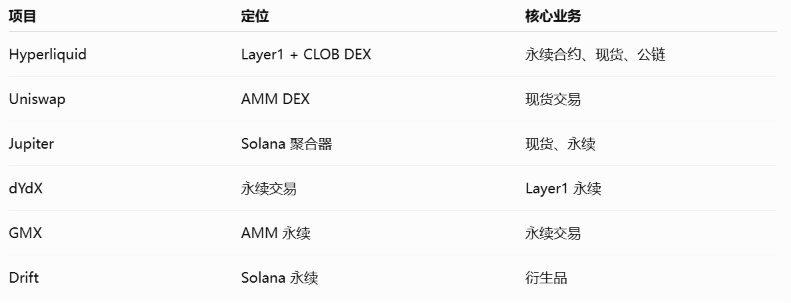
I. Competitor analysis
Project Type and Competitive Relationship with Hyperliquid dYdX On-chain order book derivatives Direct competition Drift Derivatives on Solana Direct competition Uniswap Spot AMM has a different positioning, indirectly competing GMX Liquidity pool derivatives has a different positioning, indirectly competing
Hyperliquid is closer to an “on-chain Binance or OKX,” not a typical DEX.
II. Core Competitive Advantages
A real on-chain order book (CLOB): low slippage, high capital efficiency—ideal for professional traders.
A complete Layer 1 architecture: not constrained by other public chains, revenue doesn’t leak out, and the ecosystem is scalable.
Real cash flow: revenue comes from real trading, not subsidies, so the business model is sustainable.
Strong value-capture mechanism: Assistance Fund directly links revenue to the HYPE token.
III. Future growth opportunities
HyperEVM: the biggest growth engine, expected to form a complete ecosystem including DeFi, RWA, chain games, and AI agents.
Spot markets: launch more high-quality assets to expand fee revenue.
Institutional users: attract quant funds and market makers to improve depth and liquidity.
Global on-chain financial infrastructure: a long-term goal beyond a single trading business, becoming an integrated financial network.
IV. Potential Risks
Risk category Description Market cycle risk In a bear market, trading volume declines, revenue decreases, impacting value capture. Competition risk dYdX, Solana ecosystem, new DEXs, and on-chain products of CEXs may erode market share. HyperEVM deployment risk If developer growth is slow and there are insufficient DApps, the valuation logic could be impaired. Regulatory risk As global regulation tightens, it may affect user growth and capital inflows. Token unlock risk In the future, team and ecosystem incentives will be released gradually; whether the added circulating supply can be absorbed by demand needs to be watched.
V. Investment logic summary
Trading-volume-driven revenue growth—solid business fundamentals.
Revenue-driven value capture—rewarding the token through the Assistance Fund.
HyperEVM opens a second growth curve—upgrading from an “exchange” to a “public chain.”
A community-oriented token model—no VC private placement, long-term locking, and a clearly defined value design.
Conclusion
Hyperliquid is not a traditional DEX in the conventional sense, but a high-performance Layer 1 financial network built around on-chain trading.
It proves that real trading demand itself is a sustainable growth driver, without relying on liquidity subsidies. As of now, it has established:
On-chain leading scale in perpetual contract trading
Sustained growth in real protocol revenue
Professional trading experience brought by the order book model
A value-capture closed loop between revenue and HYPE
HyperEVM provides growth space for future ecosystem expansion
Of course, risks remain: market cycles, intensifying competition, the speed of HyperEVM deployment, and the regulatory environment all need ongoing attention.
However, based on publicly available data, Hyperliquid has grown from a derivatives protocol into a Layer 1 network with trading, infrastructure, and ecosystem expansion capabilities. If it can continue to maintain trading volume growth and successfully drive HyperEVM development, HYPE’s long-term value will depend more on the network’s ability to create cash flow and attract developers—not just short-term market sentiment.
This report is for information organization and sharing only and does not constitute any investment advice.