
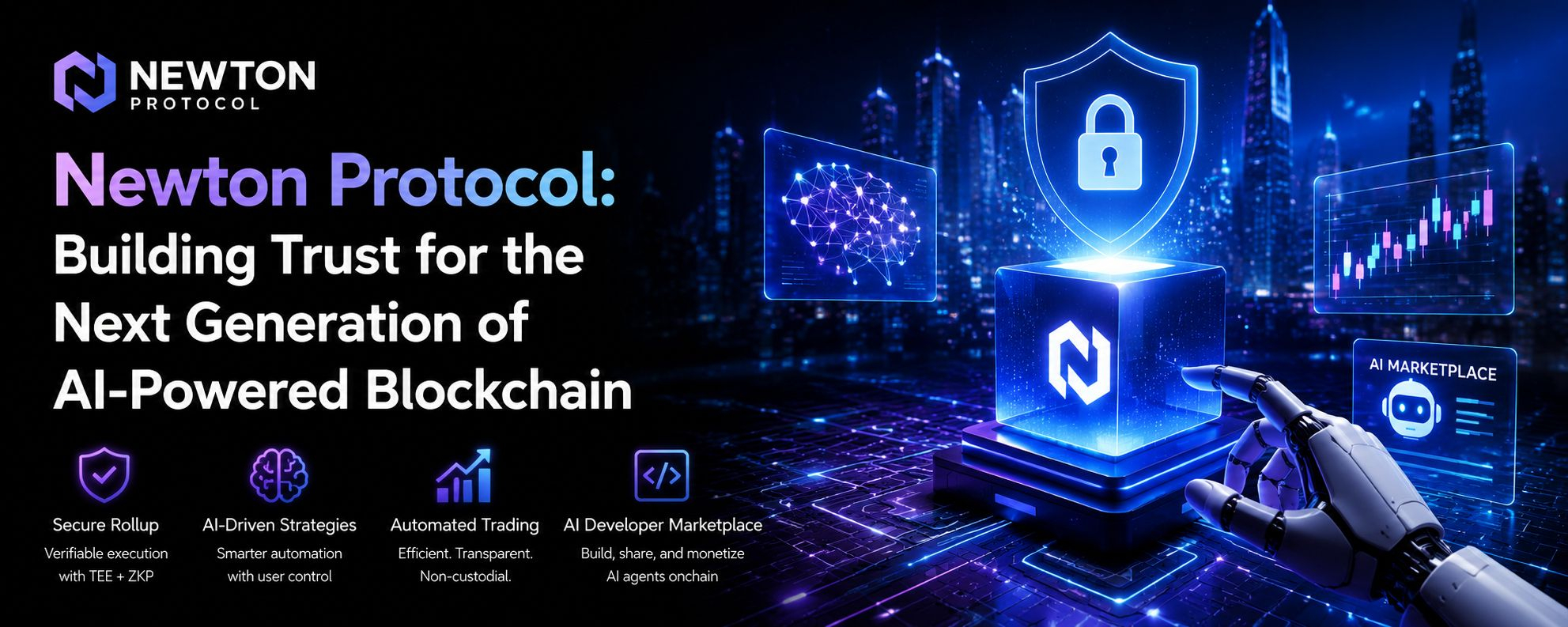
When I first looked at Newton Protocol, I assumed it was simply another project trying to combine artificial intelligence with blockchain. The crypto industry has seen countless platforms promise smarter automation, faster execution, and more efficient decentralized applications. After spending more time studying how Newton Protocol is being built, I realized its direction is different. Instead of focusing only on making transactions faster, the protocol is attempting to solve a more difficult problem: how to let AI perform actions on behalf of users while keeping every important decision verifiable, secure, and under the user's control. This becomes increasingly important as AI agents begin handling trading strategies, portfolio management, decentralized finance operations, and other financial activities that previously required constant human attention. According to the project's documentation, Newton combines Trusted Execution Environments (TEEs) with Zero-Knowledge Proofs (ZKPs) so automated actions can be cryptographically verified rather than blindly trusted.
The protocol is being developed by Magic Labs together with the Magic Newton Foundation. Magic Labs is already known throughout Web3 for simplifying wallet creation through embedded wallet technology, allowing millions of users to access blockchain applications without managing traditional seed phrases. That previous experience appears to influence Newton Protocol's philosophy. Rather than expecting users to understand every technical detail behind automation, the goal is to create infrastructure where users can safely delegate specific permissions while still maintaining ownership of their assets. Instead of replacing human control, the protocol attempts to define clear boundaries that AI agents must follow. Every permission can be created, modified, or revoked on-chain, making automation more transparent than many existing off-chain solutions.

The NEWT token sits at the center of this ecosystem. Unlike projects that rely mainly on speculation, NEWT has several operational functions inside the protocol. It serves as the native utility token for transaction fees, delegated proof-of-stake security, validator incentives, governance participation, and permission management. The total supply is fixed at one billion tokens, with no planned inflation after launch. The protocol also plans to migrate from its current ERC-20 implementation on Ethereum toward its own Keystore rollup architecture as development progresses. This fixed-supply approach creates predictability while allowing governance decisions to shape future protocol upgrades instead of introducing unlimited token issuance.
From an investment perspective, what makes Newton Protocol interesting is not simply its token price but the indicators that demonstrate whether developers and users are actually adopting the network. Serious observers will likely watch validator participation, staking activity, transaction growth, developer engagement, AI agent deployments, protocol fees, and ecosystem integrations more closely than short-term market movements. Infrastructure projects rarely prove themselves through price action alone. They create value gradually as more applications depend on their services and as developers begin treating the protocol as essential infrastructure rather than an experimental technology. If Newton succeeds in becoming the verification layer for autonomous blockchain activity, network usage could become a far more meaningful indicator than speculative trading volume. At the same time, adoption remains the largest challenge because even technically advanced infrastructure must convince developers that integration provides real advantages over existing alternatives.
Today the broader blockchain industry is entering a period where artificial intelligence is becoming increasingly integrated into decentralized finance, digital identity, payments, and asset management. That trend naturally creates new security questions. People may eventually become comfortable allowing AI agents to execute complex strategies, but only if every action can be independently verified and every permission remains under user control. Newton Protocol is positioning itself around this exact problem. Whether that vision ultimately becomes industry standard is still uncertain, but the project is addressing a challenge that many blockchain ecosystems are only beginning to recognize. As AI continues expanding across Web3, the need for verifiable automation may become just as important as scalability itself, making Newton Protocol a project worth following as both its technology and ecosystem continue to mature.
