
The opinions of analysts from the prestigious financial research firm Fundstrat Global Advisors regarding the future of Bitcoin have sparked widespread debate on social media platforms, specifically on the X platform, about whether these opinions are contradictory or reflect multiple analytical frameworks within a comprehensive research strategy.
The origin of the controversy: seemingly contradictory comments
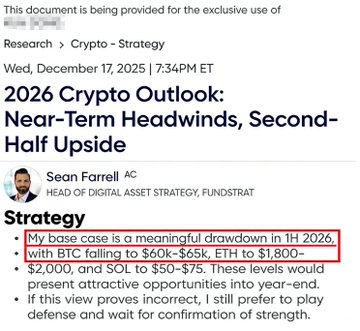
The controversy arose when a user on the X platform known as "Heisenberg" (Heisenberg@Mr_Derivatives) posted screenshots of two separate documents attributed to two leaders at Fundstrat, raising questions about mixed signals being provided by the company.
1. First view: Focus on short-term risks (Sean Farrell)
• Source: Sean Farrell, Head of Digital Asset Strategy at Fundstrat.
• Forecast: Farrell presented an analysis outlining a baseline scenario in which the price of Bitcoin (BTC) is expected to decline to the $60,000 to $65,000 range during the first half of 2026.
• Context and details: To clarify further, Farrell's analysis was not a long-term bearish forecast for Bitcoin. Instead, it was part of a hedging framework that focused specifically on:
• Drawdown Risk: Measuring the probability of a potential price decline.
• Capital flows: Monitoring the movement of funds into and out of the market.
• The Investor Cost Rule: Understanding the average purchase price for investors, which is an important psychological level that may influence buying and selling decisions.
• Practical action: In line with this precautionary analysis, Farrell reportedly reduced his exposure to cryptocurrencies within the Model Portfolio managed by Fundstrat, as a risk management measure during periods when high volatility is expected.
2. The second view: The long-term optimistic outlook (Tom Lee)
• Source: Tom Lee, co-founder of Fundstrat.
• Predictions: Lee publicly predicted that Bitcoin's leadership in the cryptocurrency market could achieve new all-time highs, perhaps as early as 2026.
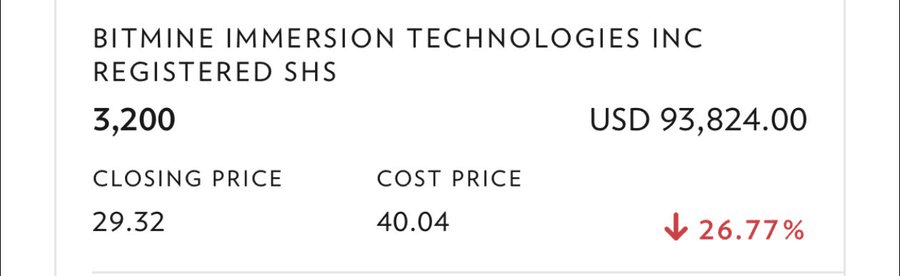
• Context and details: Lee's analysis focuses on entirely different factors, namely:
• Macro Liquidity Cycles: Predicting the monetary policy trends of central banks (such as the US Federal Reserve) and how the injection or withdrawal of liquidity will affect all asset classes, including cryptocurrencies.
Structural shifts: This focuses on the long-term impact of major financial institutions' adoption of Bitcoin and the growth of associated exchange-traded products (ETPs), which Lee believes could alter the historical dynamics of Bitcoin's familiar four-year cycle. He argues that these factors could drive the price to new highs, even if temporary pullbacks occur along the way.
Explanation and clarification: Different disciplines within one framework
A detailed response to this debate came from another user claiming to be a Fundstrat client, named Cassian (Cassian @ConvexDispatch). Cassian explained that the differing opinions did not reflect a contradiction, but rather a difference in roles and responsibilities within the company's research framework.
According to Kassian, Farrell and Lee view the market through different analytical lenses, and neither adheres to a single, unified forecast. Their perspectives can be summarized as follows:
Analyst/Leader: Role and Key Focus, Timeframe, Objective of Analysis
Sean Farrell is a digital asset strategist who focuses on risk management and portfolio positioning. His short- to medium-term (monthly) strategy is to protect capital and avoid significant losses during periods of high volatility.
Tom Lee is a macro strategist, focusing on structural trends and large-scale liquidity cycles. His long-term (years) approach identifies key growth trends and the potential for significant returns.
Mark Newton (a technical analyst at Fundstrat) is a purely technical analyst, working independently of macro or fundamental narratives. He focuses on short-term analysis (days to weeks) of price action and chart patterns to identify precise entry and exit points.
Cassian explained that when viewed in isolation, these analyses may appear contradictory. However, within the broader research framework of a firm like Fundstrat, they offer complementary insights that cater to different types of investors with varying investment objectives: a cautious investor might be more interested in Farrell's analysis, while an ambitious investor might be more interested in Lee's.
The official (indirect) response and market consensus
Tom Lee's response: Neither Lee nor Farrell issued a direct official statement commenting on the screenshots. However, Lee's reply to Cassian's post with the phrase "Well stated" is a clear indication of his support for this interpretation, which sees the views as complementary rather than contradictory.
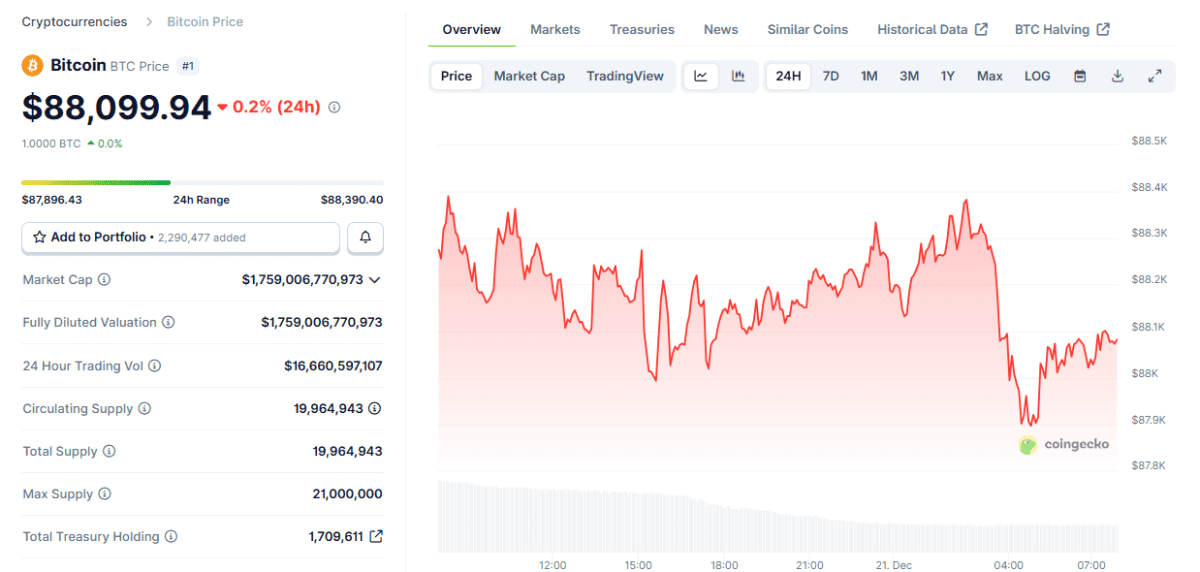
• Market reaction: In reality, this online debate had no noticeable impact on cryptocurrency prices. At the time of the original report, Bitcoin was trading around $88,099, down only 0.2% over 24 hours, while the market as a whole was either stable or slightly higher. This suggests that institutional traders and the markets did not perceive these discussions as a significant trading indicator.
Summary and main ideas
This case highlights several important facts in the world of modern investment and financial research, especially in the field of new and volatile assets such as cryptocurrencies:
1. The complexity of financial analysis: There is no single "correct" opinion when predicting complex markets. Large research firms build their views using several analytical tools (fundamental, technical, quantitative, macro).
2. The importance of the time frame: The difference between "short-term expectations" and "long-term vision" is fundamental. A potential 25% decline within six months (Farrell's analysis) does not necessarily contradict a doubling of the price within three years (Lee's vision).
3. Different investor needs: An investor who manages a $10 million portfolio and is risk-averse needs a different kind of advice (such as Farrell's analysis) compared to a hedge fund looking for bold growth opportunities (such as Lee's analysis).
4. The maturity of the cryptocurrency market: The fact that such an in-depth discussion about the divergence of analyses has emerged within a prestigious financial institution is in itself evidence of the increasing maturity of the cryptocurrency market and its integration into the mainstream financial system, where multiple viewpoints are the rule and not the exception.
In short, Fundstrat's "signals" were not "contradictory," but rather comprehensive. Through its various voices, the firm presented a more complete roadmap that highlighted potential short-term bumps (Farrell) while simultaneously emphasizing the positive long-term direction (Lee)—a crucial distinction for experienced investors.

