
Azu has seen too many people participate in events as if they are gambling: today they forward a post, tomorrow they echo a trend, and by the end of the month, they find they are not on the leaderboard and have not received any rewards, then they start to doubt, 'Is there an inside story?' But Yap2Fly is the exact opposite; it clearly states the rules: whether you can get rewards depends on two verifiable things - your 'Mindshare' generated on X (measured by Kaito's engine for content originality, interaction quality, and genuine dissemination) and your real on-chain usage behavior in the Falcon product (corresponding to Miles, badges, and task progress). This is not 'posting to wait for airdrops', but more like 'submitting assignments according to the rules.'

First, clarify the core that is most easily misunderstood: The Yap2Fly leaderboard does not just look at how loudly you shout, but ties together 'what you said' and 'what you did'. When you 'yap' on X, the system will update your ranking based on Mindshare; when you mint USDf in Falcon, stake it as sUSDf, provide liquidity, and participate in tasks, Miles will also push your leaderboard score, and the leaderboard changes daily, rather than suddenly revealing results at the end of the month. More importantly, the official later made the weight clearer: in certain months' refreshes, the proportion of Mindshare will be higher (for example, there have been adjustments of 80% Mindshare and 20% Miles), meaning that if you want to take shortcuts by 'only piling up financial actions without producing content' or 'only producing emotional content without real usage', it will become increasingly difficult.

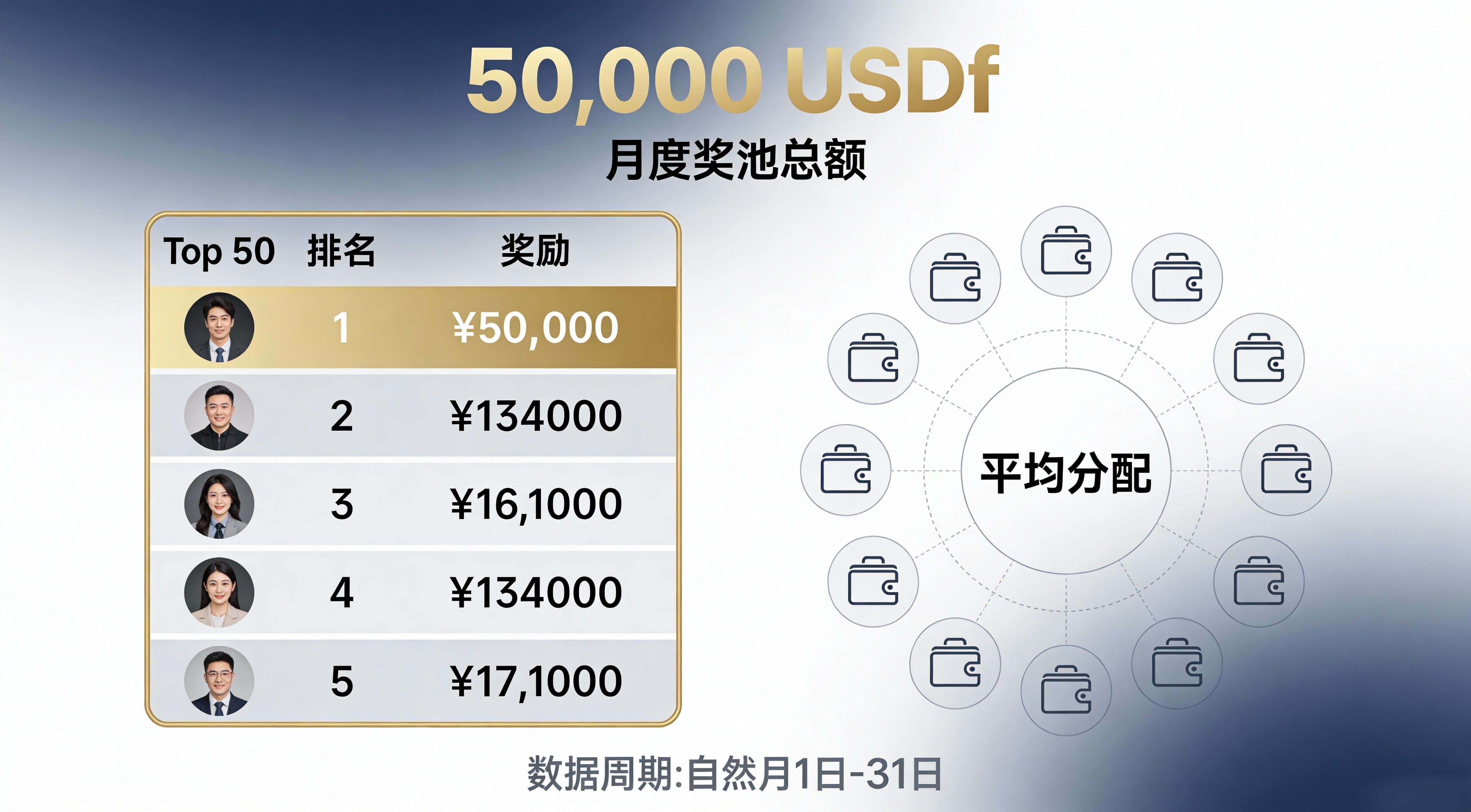
Now let's talk about the most concerning 'monthly $50,000 USDf prize pool', where there is almost no room for speculation: The document clearly states that there is a monthly prize pool of $50,000 USDf, distributed according to the Top 50 of the month, and it is evenly divided among each wallet; at the end of the month, a snapshot will be taken at 23:59:59 UTC on the last day of the month, and after the snapshot, it can be claimed, but the claiming window is only 30 days. You should understand from this that the so-called 'invalid participation' is most commonly not because you are not trying hard enough, but because the way you are trying is wrong: if you concentrate your output in the last two or three days, or only remember to make up operations the day before the end of the month, it is likely already too late for Mindshare and Miles to be reflected on the leaderboard; if you achieve Top 50 but do not claim within 30 days, it is equivalent to returning the reward to where it came from.
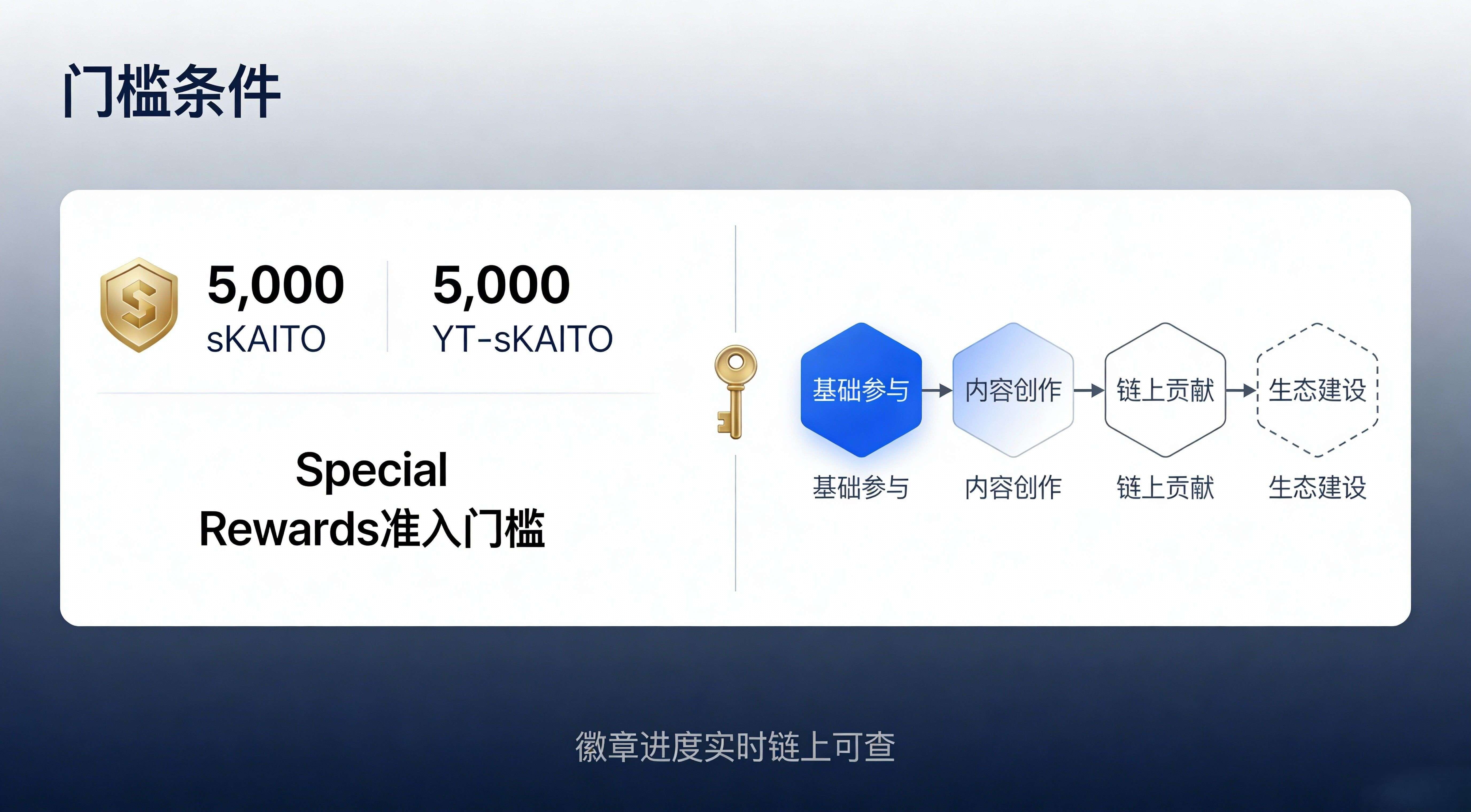
Then there are many people who are more likely to fall into the trap of 'Special Rewards'. It is not the kind of reward that 'I can just post to get involved', but has clear thresholds and a segmented unlocking structure: The document states that 0.3% of the FF token supply will be used as special rewards, primarily aimed at the Top 200 (as well as wallets related to Kaito staking that meet the criteria), and it also requires holding at least 5,000 sKAITO or YT-sKAITO during the event period; furthermore, it adopts a badge-based phased unlocking mechanism, meaning you do not simply 'get everything once you enter the pool', but the unlocking ratio is tied to your badge completion rate, and the unclaimed portion is also specified for future redistribution in the rules. Therefore, Azu interprets this part as 'long-term player rewards', not prepared for sprinters or movers.
By now, you should be able to see: Yap2Fly truly rewards the combination of 'high-quality content + real on-chain behavior', rather than emotional retweets and copy-pasting. The reason is very practical — Mindshare does not look at how many times you have retweeted, but whether your insights can be discussed, referenced, and spread; Miles also does not care how loud you shout, but what measurable actions you have taken within the product, and the official has also made it clear that any attempt to abuse or cheat may result in point removal or direct disqualification. If you try to play by 'boosting your presence', you might gain a little exposure in the short term, but in the long run, you will only turn yourself into a low-reputation account: others will not consider you as an information source, and your content will struggle to form lasting Mindshare.

Azu has only one action suggestion for you, but it is very useful: produce 'verifiable' content once a week, allowing others to compare with the original source. You can keep it very simple, such as running through the process with the smallest amount, taking screenshots of key steps; or spending two minutes each week looking at the transparency panel, recording the changes in backing ratio, custody distribution, and the proportion of on-chain versus exchange, clearly writing down 'why I am not nervous this week/why I will be more cautious this week'; or choosing a mechanism point (such as the conversion rate of sUSDf and settlement rhythm) to explain clearly, allowing readers to verify against the official documentation. The benefit of doing this is that your content naturally carries 'verifiability', making it easier for Mindshare to settle, and your on-chain behavior is also more likely to form a closed loop, rather than being so busy that you end up with 'I seem to have participated, but left nothing behind.'

