

Lately, I've been thinking about something that doesn't get discussed very often in crypto.
Whenever a new protocol launches, the conversation almost always revolves around performance. People compare transaction speed, fees, scalability, or security. Those are important topics, but they also raise another question in my mind.
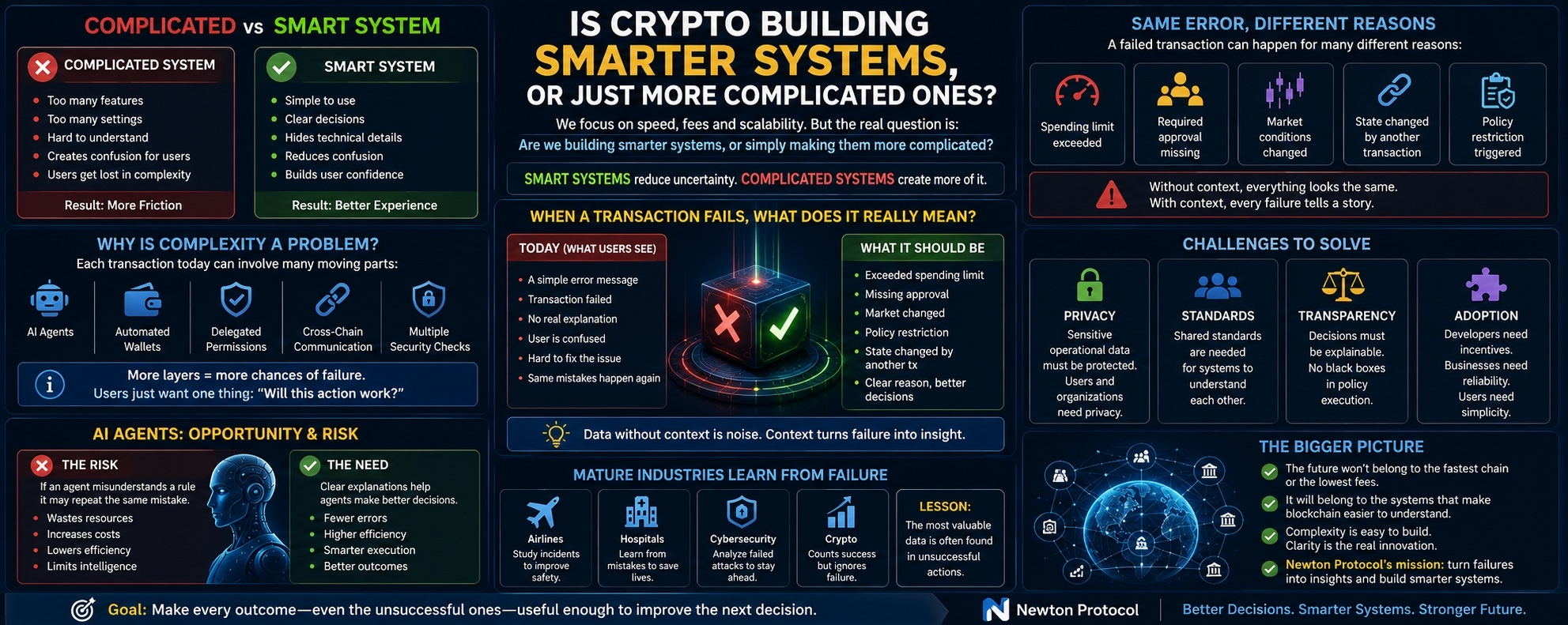
Are we actually building smarter systems, or are we simply making them more complicated?
The difference matters.
A complicated system has more features, more settings, and more moving parts. A smarter system, on the other hand, helps people make better decisions without forcing them to understand every detail happening in the background.
I think crypto is slowly reaching the point where this distinction becomes important.
A few years ago, sending tokens was the main activity on-chain. Today, a single transaction can involve smart contracts, automated wallets, delegated permissions, AI agents, cross-chain messaging, and multiple security checks. None of those ideas are bad on their own. In fact, they solve real problems.
But every new layer also introduces another opportunity for confusion.
The average user doesn't wake up thinking about execution environments or policy engines. They simply want to know one thing.
"Will this action work?"
That's why I found myself looking at Newton Protocol from a different perspective.
Most discussions focus on its technical architecture, but I think the more interesting question is what kind of user experience that architecture could create.
Technology should reduce uncertainty.
Too often, crypto does the opposite.
Think about what happens when a transaction is rejected today.
Most wallets display a short error message that means very little to the person reading it. Sometimes the issue is insufficient permissions. Sometimes it's a spending limit. Sometimes market conditions changed before execution. Sometimes another transaction altered the blockchain state a moment earlier.
To the user, those completely different situations often look identical.
That's not because blockchain is broken.
It's because the explanation usually stops where the transaction stops.
I wonder if that's one of the biggest gaps in today's infrastructure.
People often say blockchain creates transparency.
That's true when we're talking about data.
But transparency isn't just about seeing information.
It's about understanding it.
Those are not the same thing.
A public blockchain can show every transaction that has ever happened. That doesn't automatically explain why those transactions happened or why others never did.
Context is missing.
And context becomes increasingly valuable as automation grows.
Everyone seems excited about AI agents managing wallets and executing financial strategies. I understand why. Automation can save time and reduce manual work.
But automation also changes the kind of mistakes we make.
Humans usually make different mistakes every day.
Machines are different.
If an AI agent misunderstands one rule, it may repeat the exact same mistake hundreds of times before anyone notices.
That isn't just inefficient.
It's expensive.
This is where policy-based systems become interesting to me.
Not because they prevent every mistake.
I don't think any technology can completely eliminate failure.
Markets change.
Rules evolve.
Unexpected situations always appear.
Instead, I think their real value is helping systems understand why something happened.
There's a huge difference between saying, "This transaction failed," and saying, "This transaction failed because it exceeded the organization's spending policy."
The first statement ends the conversation.
The second one helps improve future decisions.
That feels much more valuable.
It also reminds me that most mature industries don't improve by celebrating success alone.
Hospitals review medical errors.
Airlines investigate incidents that never became accidents.
Cybersecurity teams study failed attacks just as carefully as successful ones.
The goal isn't to prove perfection.
The goal is continuous improvement.
Crypto sometimes feels different.
We proudly count successful transactions while treating failed ones as noise.
Maybe that's backwards.
Perhaps unsuccessful actions contain some of the most useful operational data available.
Of course, there's another side to this discussion.
More information isn't always better.
Recording every decision, every rejection, and every policy outcome could eventually create privacy concerns.
Organizations won't want sensitive operational details exposed.
Users won't want every unsuccessful attempt permanently attached to their wallets.
That's why transparency has to be balanced with privacy.
Finding that balance may end up being harder than building the technology itself.
Shared standards present another challenge.
Policy systems only become powerful if different applications can understand one another.
Otherwise, every protocol simply creates another isolated rulebook, and the industry ends up with more fragmentation instead of less.
That isn't a technical problem alone.
It's a coordination problem.
History shows that shared standards often become more valuable than individual products.
The internet didn't grow because every company built its own communication protocol.
It grew because enough people agreed on common rules.
Crypto may eventually face the same moment.
Not around tokens.
Not around blockchains.
But around how systems communicate trust, permissions, and intent.
Whether Newton Protocol becomes that standard is impossible to know today.
Good ideas don't automatically become widely adopted.
Developers need incentives.
Businesses need reliability.
Users need experiences that feel simpler instead of more complicated.
Those are difficult challenges.
Still, I think the bigger lesson goes beyond any single project.
Maybe the next generation of blockchain infrastructure won't be defined by whichever network processes the highest number of transactions per second.
Maybe it will be defined by whichever systems make blockchain easier to understand.
Because in the end, complexity is easy to build.
Clarity is much harder.
And if crypto wants to reach millions of everyday users instead of remaining a tool for specialists, clarity may become its most valuable innovation of all.