

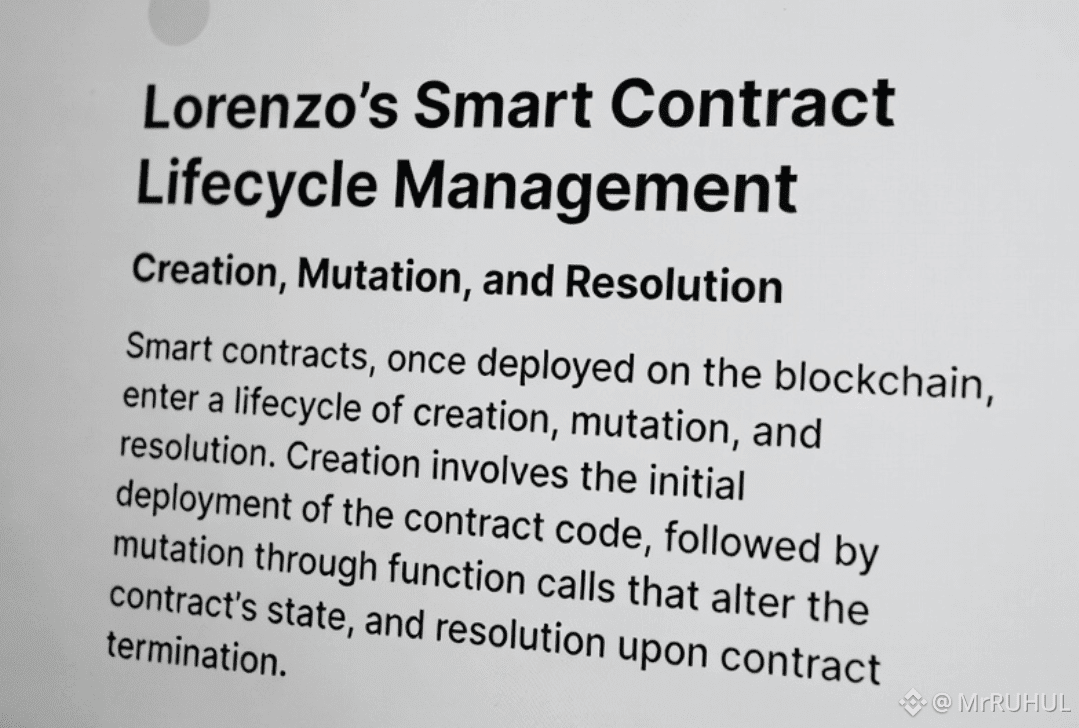
Most on-chain systems act like once you launch a smart contract, it’s set in stone. You deploy it, and that’s it—it just sits there, stuck in place, slowly turning into a headache. Upgrades become a hassle. Contracts turn into these weird black boxes. Bugs linger way longer than they should. Lorenzo flips all of that on its head. Instead of treating contracts like frozen relics, Lorenzo treats them more like living things, with an actual beginning, middle, and end—all managed right at the protocol level.
So, how does this actually start? With Lorenzo, you can’t just throw any contract onto the chain and hope nobody notices the mess. Everything begins with strict templates and rules. These templates lay the groundwork, so contracts are clean and predictable from day one. No sneaky loopholes, no broken junk slipping through. The protocol enforces these standards, so only solid, well-formed contracts make the cut.
Right from the jump, every Lorenzo contract spells out its starting conditions. You know exactly what it does, what states it can move through, and who gets to poke at it. No surprises. Everyone’s on the same page. That means contracts don’t break just because someone missed a small detail or made a mistake—it’s all locked in from the start.
Now, here’s where Lorenzo really changes the game: mutation. In most setups, if you want to upgrade a contract, you’re stuck with awkward workarounds—proxies, slow governance, all that mess. It just piles on confusion and makes it harder to trust what’s going on. Lorenzo skips the hacks. Change is built in. Contracts can evolve, but only in specific ways, under strict rules.
Every update goes through a protocol-level check. Contracts can’t just rewrite themselves whenever they feel like it. They only change if the current state says it’s allowed, and every step follows set logic. The rules for mutation and the contract’s own logic are kept separate—contracts request changes, but the protocol decides if they go through. It’s like a tough update system: one place sets the rules, and everyone plays by them. No contract gets to make up its own process.
Timing matters, too. Some updates only happen if certain conditions are met or during special windows. Lorenzo bakes these limits right into the system, blocking a whole pile of bugs and exploits that sneak in because of weird timing or unsynced changes. Mutation isn’t some hidden background thing—it’s visible, tightly controlled, and everyone knows what’s happening.
And then there’s the ending. Instead of letting contracts drift along forever—even after they’ve done their job—Lorenzo spells out exactly when and how they wrap up. Once a contract finishes, it’s marked as resolved. That’s it—no more actions, no lurking risks.
That kind of definite ending matters. It clears out dead weight, makes audits easier (since resolved contracts can’t change), and just keeps the protocol clean. The system runs fast and doesn’t get bogged down by useless leftovers.
The best part? Creation, mutation, and resolution—they’re all wired into the same state machine. Everything fits together, nothing’s tacked on as an afterthought. So contract behavior stays consistent from start to finish.
By treating smart contracts as things with a real life cycle, Lorenzo ditches the old, stuck-in-time approach. Contracts start with clear rules, evolve in a controlled way, and actually finish. That’s what makes Lorenzo different. It’s the foundation for building on-chain systems you can actually trust.@Lorenzo Protocol #LorenzoProtocol $BANK

