


There is a time when markets close, cities quiet down, and systems show who they really are. Midnight is that time. Not the clock, but the interval. A space between what is public and what needs to remain private, between the transparency that builds trust and the exposure that destroys utility. In a world where blockchains have learned to speak too loudly, Midnight enters the room with a soft yet loaded voice. It’s not about hiding everything; it’s about choosing what doesn’t need to be shouted.
Midnight was born as an infrastructure of smart contracts focused on protected data, where logic is executed with cryptographic proofs that preserve confidentiality without sacrificing verifiability. The trick is not new, but the choreography is. Instead of treating privacy as a late accessory, it is the script. The execution is anchored in zero-knowledge proofs, but the differential lies in the development experience and alignment with the real world: identities, compliance, sensitive data, rules that change according to context. Midnight does not try to win the war of pure speed; it tries to win the war of silent utility.
Here enters the first unlikely combination: privacy and regulation walking hand in hand. Most narratives place these two on opposite sides of the street. Midnight crosses in the middle of the lane. The proposal is simple and uncomfortable at the same time: allow rules to be verified without revealing underlying data. KYC without leaks, eligibility without exposure, auditing without voyeurism. It's the difference between showing the entire document and proving that you are old enough to enter. Does the market understand this nuance? Anyone who has tried to operate in regulated sectors knows that the answer is yes — and it hurts when it doesn't exist.
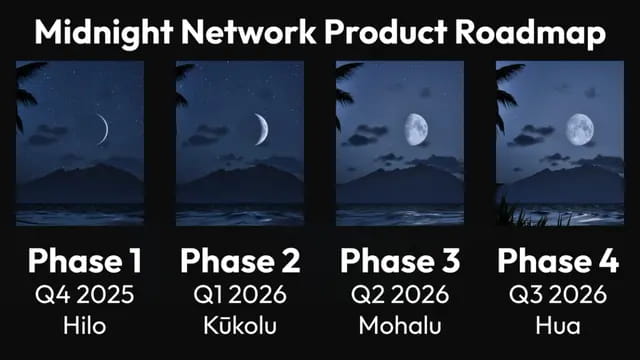
The token enters as the fuel and the judge. It pays for execution, anchors incentives, and participates in the governance that defines which tools stay sharp and which return to the sheath. In Midnight, governance is not a noisy forum; it is a set of technical choices that shape the behavior of the system. Proof updates, cost parameters, prioritization of features for developers who need confidentiality today, not in a distant roadmap. The token gains relevance when it decides what is expensive and what is cheap, what scales and what remains limited.
The second unlikely combination: sensitive data and open source culture. #Night does not close the vault and throw away the key. It opens the manual, documents the engine, and invites the community to tinker with the screws. The protection lies in the method, not in secrecy. This creates a productive paradox: the more people understand how it works, the more robust it becomes. The community is not a background actor; it is part of the cast that tests, critiques, and rewrites dialogues. Hackathons become bars where bad ideas die quickly and good ones survive the night.
In the midst of this narrative, use cases emerge that seem like cut scenes from different movies, but belong to the same universe. On-chain credit where income is proven without being revealed. Games that validate player attributes without exposing identity. Data markets where permission is granular and reversible. Corporate voting with real confidentiality and public verification. All of this happens when you accept that privacy is not the enemy of trust; it is its foundation.
The third unlikely combination: emotional performance and cold engineering. #night knows that developers choose tools just as directors choose cameras. It's not enough to promise; it needs to work when the pressure is on. The stack prioritizes ergonomics, familiar languages, and abstractions that do not require a PhD in cryptography to run an MVP. The result is an ecosystem that grows through practical adoption, not through slogans. The community feels when the tool respects the time of those who build.
Risks exist and are handled without makeup. Zero-knowledge proofs still have computational costs; poorly abstracting them can drive away users. Poorly calibrated governance can make upgrades slow. The promise of compatibility with real-world rules requires continuous dialogue with regulators and companies, a game of patience. And there is the classic risk: privacy being confused with malicious opacity. Midnight responds with design: prove without revealing, audit without exposing, punish without snooping.
Community engagement does not come from slogans, but from shared utility. Living documentation, real examples, programs for builders who need to solve ugly problems — those that no one posts on the feed. $NIGHT grows when it solves what hurts. When the developer realizes that they can comply with rules without sacrificing users. When the company understands that it does not need to choose between blockchain and confidentiality. When the user feels they are not naked in public.
In the end, Midnight does not ask for applause. It asks for functional silence. A system that works while the world sleeps, validating without exposing, executing without leaking, growing without shouting. It is the time when the infrastructure stops being a spectacle and becomes a service. And services that work, sooner or later, become habits.