


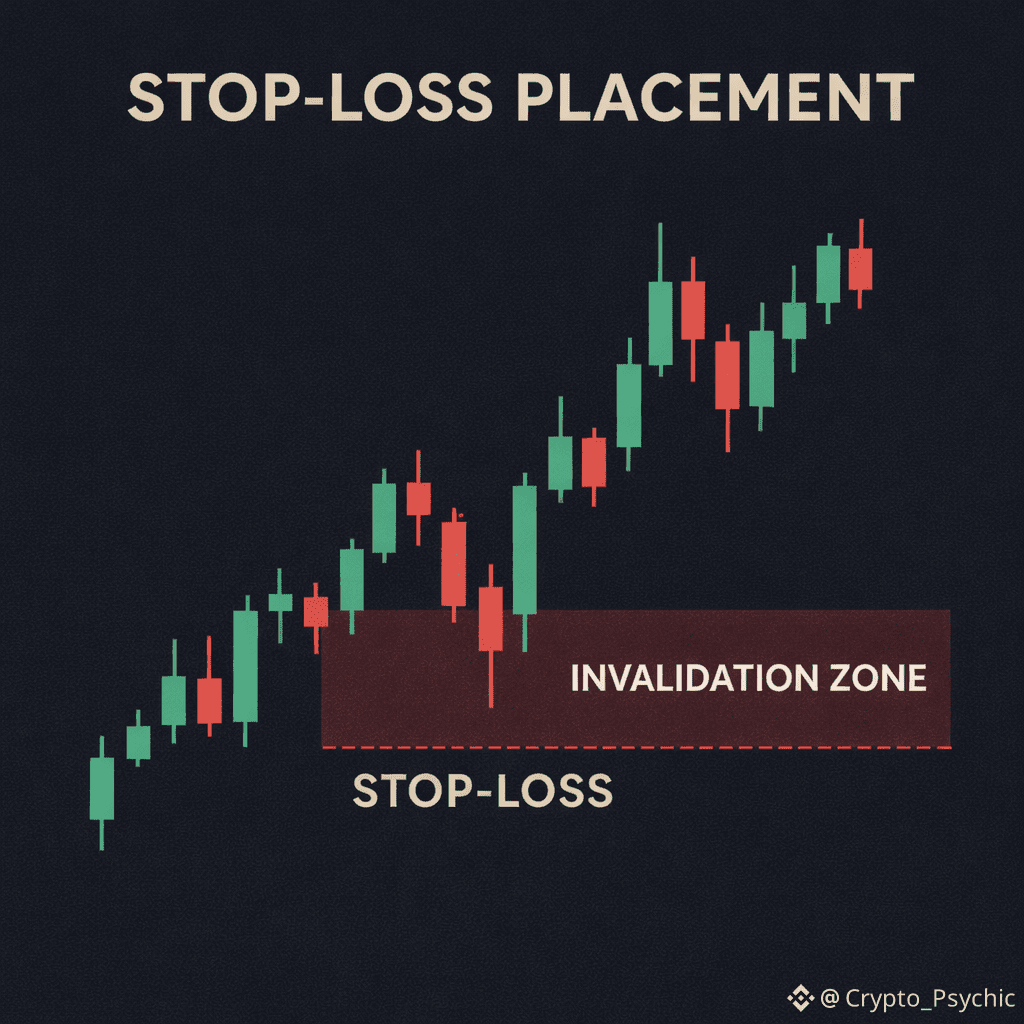
Stop-loss placement is one of the most misunderstood elements of trading. Many traders treat it as a defensive afterthought — a line drawn simply to limit damage if a trade goes wrong. In reality, a stop-loss is not just protection; it is a structural statement. It defines where your idea is invalid, not where your pain threshold lies. When placed correctly, it keeps you aligned with market logic. When placed emotionally, it becomes an invitation for the market to take you out.
Most stop-loss errors originate from convenience. Traders place stops at obvious highs and lows, round numbers, or fixed percentages because these locations feel logical and easy. But the market does not respect convenience — it exploits predictability. Obvious stop locations are rarely safe because they cluster liquidity. When many traders define invalidation at the same place, that level becomes a target rather than protection.
This is why traders often experience the same frustrating pattern: price moves against them just enough to hit their stop, then reverses cleanly in the original direction. The trade idea wasn’t wrong — the placement was. The stop was not aligned with structure; it was aligned with fear.
Proper stop-loss placement begins with understanding why a trade should fail. Every trade idea is based on a narrative: a trend continuation, a reversal, a structural hold, or a liquidity reaction. The stop should be placed at the point where that narrative breaks down objectively. If price reaches that level, the market has proven your thesis incorrect — not temporarily uncomfortable.
For example, in a bullish structure, a stop should not sit just below the most recent minor low if that low exists inside a liquidity zone. It should sit beyond the level where buyers are no longer defending higher lows. Similarly, in an order block setup, a stop belongs beyond the zone that invalidates institutional intent — not inside the block where liquidity is engineered to be taken.
This distinction separates professionals from reactive traders. Professionals don’t ask, “How much am I willing to lose?” They ask, “At what point is this idea no longer valid?” Risk is then adjusted through position sizing, not emotional compromise. The stop defines logic; size defines exposure.
Another common mistake is tightening stops to improve risk-to-reward artificially. While this may look good on paper, it often leads to repeated stop-outs in live markets. Price does not move in straight lines. It breathes, sweeps liquidity, and probes weak hands. Stops that are too tight are not efficient — they are fragile. Over time, this creates frustration, revenge trading, and loss of confidence in otherwise sound strategies.
Effective stop-loss placement also requires context. In high-volatility environments, stops must allow more room. In low-volatility, structured markets, tighter invalidation may be acceptable. There is no universal distance that works across all conditions. The market dictates placement — not preference.
One of the most powerful mindset shifts a trader can make is accepting that being stopped out correctly is not a failure. A well-placed stop that gets hit confirms discipline. It proves that the trader respected structure rather than hope. Over a large sample size, this discipline protects capital and preserves psychological clarity. Poorly placed stops do the opposite — they turn trading into a battle of emotions rather than execution.
Ultimately, a stop-loss is not about avoiding losses. Losses are unavoidable. It is about controlling where and why they happen. When stops are placed beyond liquidity, beyond structure, and beyond emotional comfort zones, they stop being hunted and start being respected.
A trader who masters stop-loss placement no longer fears volatility. They understand that price movement is not hostile — it is expressive. And once invalidation is defined with clarity, execution becomes calmer, confidence stabilizes, and the trading process becomes sustainable.