

@KITE AI For the past year, “agentic payments” has had a tell. An AI assistant finds the right thing, compares options, even drafts the polite message to the seller. Then it hesitates at checkout, waiting for a human to tap a phone or type a card number. That hesitation is the real product gap. It isn’t that agents couldn’t shop; it’s that the internet never gave them a clean way to prove permission, move money, and leave behind a record that merchants, banks, and users can live with.
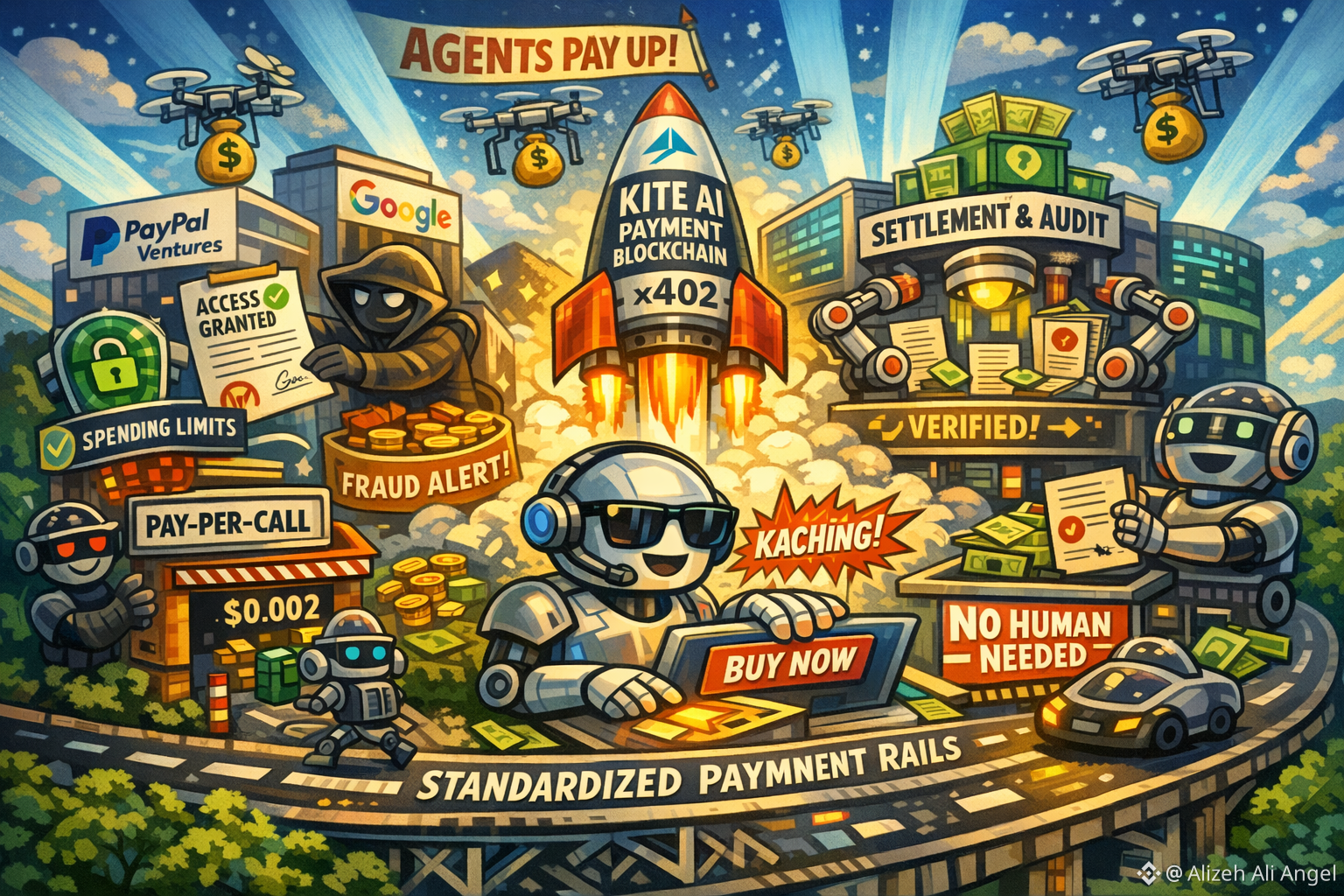
In 2025, the tone changed because the paperwork finally showed up. Google’s Agent Payments Protocol (AP2) treats a purchase less like a click and more like a signed instruction, using cryptographically signed mandates to capture what the user asked for and preserve evidence afterward. Mastercard has been pushing an Agent Pay acceptance framework so merchants can recognize trusted agents and accept tokenized transactions with minimal disruption to existing flows. Taken together, it’s a quiet admission: if agents are going to transact, we need systems that can explain who acted, under what authority, and with what limits.
Still, standards only describe the handshake, not the highway. If an agent is going to pay for a single API call, a one-time data pull, or a small digital service, today’s rails are awkward. Card networks were built for human-sized purchases and human-time disputes. Subscriptions and invoices assume accounts, logins, and customer support. Agents operate in small increments and odd hours, and they need pricing that looks like a meter, not a plan. Once you notice that mismatch, the “checkout pause” starts to feel less like a UX nuisance and more like a structural failure.
This is where the GoKiteAI story becomes more than “another agent payments startup.” Kite’s public footprint—its site at gokiteAI and its presence as GoKiteAI—matters because it’s positioning itself not as a plugin to existing systems, but as a base layer designed around how agents actually behave. Its own framing is blunt: “The First AI Payment Blockchain,” built so autonomous agents can authenticate, transact, and operate with identity, payment, governance, and verification in one place. Whether you agree with the “first” label or not, the ambition is clear: take the messy bundle of agent identity, authorization, settlement, and audit trails—then make it coherent enough that developers can build without inventing a new trust model every time.
That’s the practical difference between infrastructure and demos. A demo can show an agent paying once. Infrastructure has to assume the agent pays a thousand times, across many counterparties, without waking anyone up. That pushes you toward boring, unglamorous requirements: consistent identity, a way to express spending limits, a receipt that can be verified later, and a settlement system that can handle lots of small payments without turning each one into a customer support ticket.
Kite’s credibility here isn’t just branding. In September 2025, PayPal’s own newsroom announcement said Kite raised $18 million in a Series A led by PayPal Ventures and General Catalyst, bringing total funding to $33 million. Funding doesn’t prove product-market fit, but it does show serious payments players are spending attention on a very specific wedge: trust infrastructure for agents, not consumer apps with an “AI” label slapped on.
The most practical bridge between “agents” and “payments” right now is x402. x402 revives the long-reserved HTTP 402 “Payment Required” response and turns it into a straightforward exchange: a server replies with machine-readable payment terms, the client pays, then retries the request with proof of payment. That matters because it collapses the distance between access and settlement. The payment becomes part of the request-and-response loop, not a separate customer journey full of logins and dashboards.
GoKiteAI becomes especially relevant because it’s been leaning into x402 as something to implement deeply, not merely support on paper. Kite has publicly described itself as one of the first Layer 1 systems to fully implement x402-compatible payment primitives, letting AI agents “send, receive, and reconcile” payments through standardized intent authorization. This phrasing sounds technical, but the point is simple: an agent can pay and then keep its own books in a way that can be checked later. That’s the kind of detail that separates “we can pay” from “we can run a business process without a human shadowing it.”
It’s also telling that stablecoin-style settlement keeps showing up in the x402 conversation. Tiny amounts and instant finality are hard to do cleanly with card rails, especially if you’re imagining agents buying granular digital resources all day long. In that world, “pay-per-call” isn’t a pricing gimmick; it’s the only model that feels honest. If an agent needs to buy 2,000 micro-services in an afternoon, the payment method has to be cheap, fast, and predictable. Otherwise, the agent can reason perfectly and still fail on the most basic step: actually acquiring the thing.
Kite’s pitch, as expressed through @GoKiteAI and its white-paper materials, is that you don’t just need a payments protocol—you need an execution layer that can speak the same language as the broader agent ecosystem. The white-paper claims native compatibility not only with x402, but also with pieces like Google’s A2A and Anthropic’s MCP, along with OAuth-style authorization patterns, so developers don’t have to build bespoke adapters for every new agent framework. Even if you treat that as an aspiration rather than a finished reality, it’s the right direction: agent payments won’t scale if every integration is a custom snowflake.
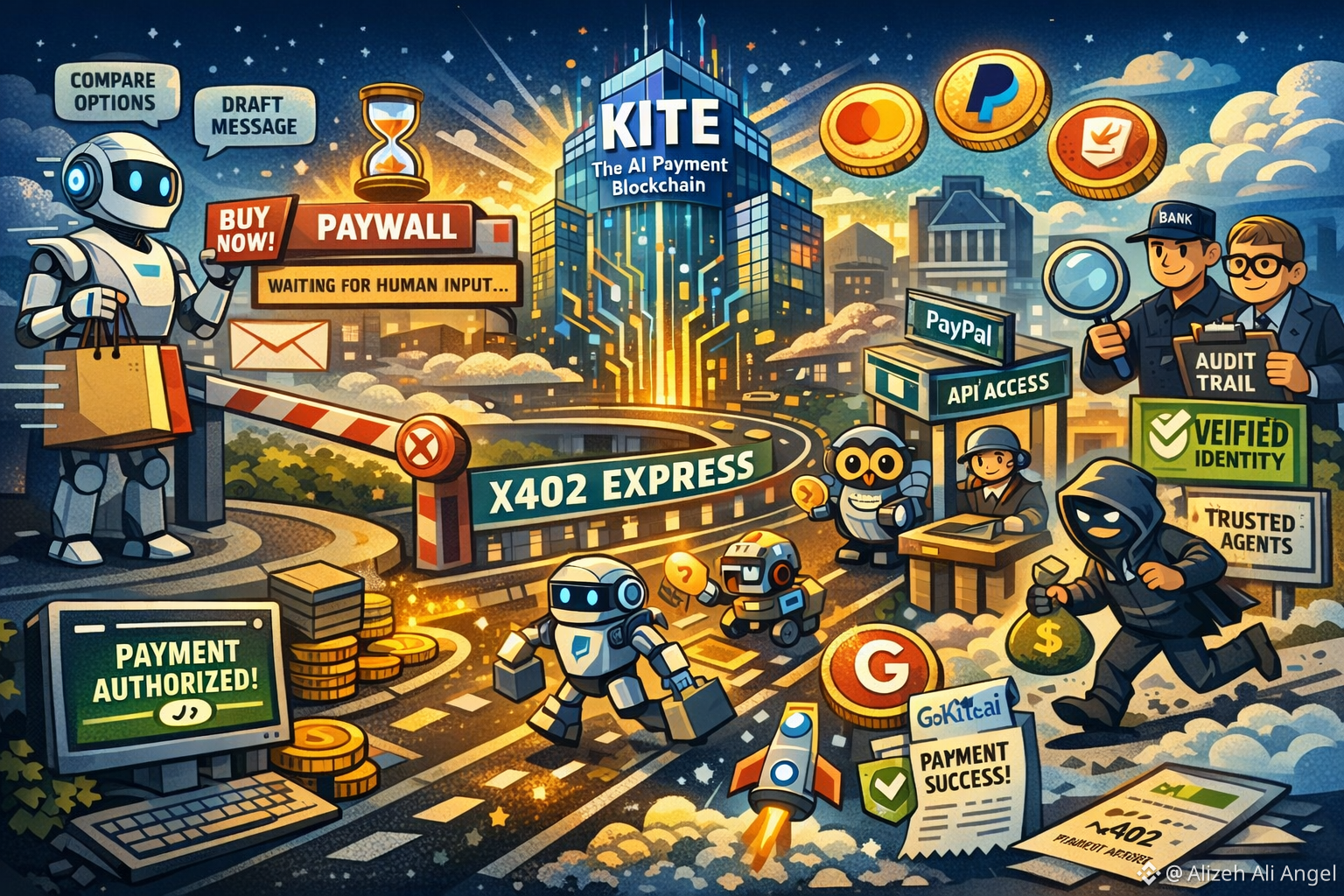
Then came the October 2025 reinforcement. A GlobeNewswire release announced an investment from Coinbase Ventures to advance agentic payments with the x402 protocol, framing it as an extension of Kite’s earlier round and explicitly tied to accelerating development and adoption of x402. This is where GoKiteAI’s relevance sharpens: if the payments handshake is becoming standardized, and a major crypto exchange is backing a specific implementation, it suggests the industry is converging around a few concrete building blocks rather than endlessly debating architecture.
None of this dissolves the hard questions. The moment you make payments more automatic, you make abuse more scalable. An agent can be copied and pointed at thousands of endpoints; a bad actor can hide behind “it was the bot.” Infrastructure has to reduce friction for legitimate agents while adding friction for the bad ones, and it has to do both without becoming unreadable to the humans who will still be accountable. That’s why the conversation keeps circling back to intent mandates, verifiable identity, and audit trails—terms that sound dry until the first real fraud wave hits.
Agentic payments are trending now because agents are finally capable enough to act, and institutions are finally uncomfortable enough to demand shared rules before that acting becomes chaos. GoKiteAI’s significance, specifically, is that it’s trying to turn those shared rules into an always-on substrate: identity plus authorization plus settlement, packaged in a way that can live behind APIs and services without a human hovering over each transaction. Kite may not be the winner, and it doesn’t need to be for the bigger shift to land. The turning point is the move from charming demos to shared rails that work when nobody is watching—and GoKiteAI is increasingly showing up where those rails are being laid.

