
- Michael Saylor hints at another large Bitcoin purchase for Strategy (formerly known as MicroStrategy), reinforcing its overall treasury strategy in Bitcoin.
- This move comes at a time when the company faces the possibility of being removed from the MSCI index, which could lead to a forced sale of over 11 billion dollars by passive funds.
- A new Bitcoin purchase will lower the company's average cost and send a strong signal of commitment, despite regulatory pressures and increasing market losses.
Michael Saylor hints at another aggressive Bitcoin accumulation for Strategy.
This indicates that the company is unwilling to back down from its high-risk treasury strategy even as MSTR's share price declines.
### Why is Saylor hinting at a new Bitcoin purchase for Strategy?
On December 21, Saylor posted a mysterious image on platform X with the caption "green dots generate orange dots ₿", referring to a chart of the company's wallet known as the "Saylor Tracker".
> green dots generate orange dots ₿.
> — Michael Saylor (@saylor)
> December 21, 2025
This post continues a pattern Saylor has used for a full year to hint at new Bitcoin purchases. Notably, such a hint over the weekend is usually followed by a filing with the US Securities and Exchange Commission on Monday morning confirming a large purchase.
At the same time, a new purchase will add to an already massive inventory.
As of the time of writing, Strategy holds 671,268 Bitcoin — approximately worth $50.3 billion — representing 3.2% of the total Bitcoin supply.
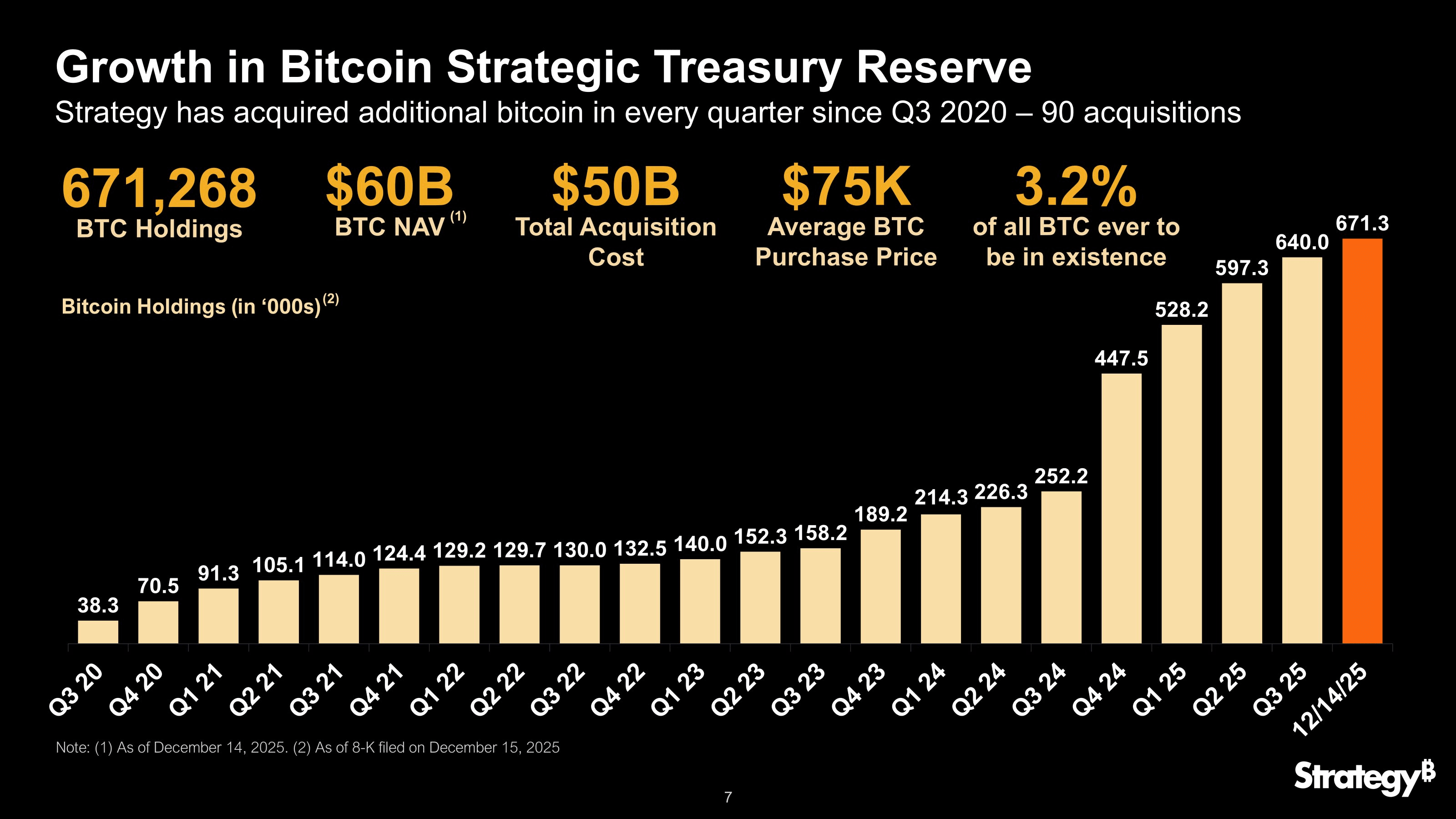
However, the market punished the stock in 2025. MSTR's share price has dropped by 43% since the beginning of the year to trade around $165, coinciding with Bitcoin's decline of 30% from its peak in October at $126,000.
While the company promotes the "Bitcoin yield" of 24.9% — a proprietary metric measuring Bitcoin's increase per share — institutional investors are increasingly focusing on looming external risks rather than internal metrics.
However, the most pressing threat to Saylor's strategy is not the price of Bitcoin, but a potential regulatory reclassification.
MSCI is considering removing Strategy from its global indices during its review in February. The index provider expressed concerns that the company is now functioning more as an investment vehicle rather than an operating company.
Market analysts pointed out that the financial implications of this move are severe.
J.P. Morgan estimates that the exclusion will lead to a forced sale of about $11.6 billion as passive exchange-traded funds and index-tracking funds liquidate their positions in MSTR.
This mechanical selling pressure could decouple the stock from Bitcoin holdings, creating a vicious cycle of liquidity shortage.
In response, Strategy launched a strong defense.
The company described the MSCI proposal as "arbitrary, discriminatory, and unworkable", arguing that it unfairly targets digital asset companies while ignoring other heavyweight holding companies.
> "The proposal incorrectly introduces political considerations into indexing. The proposal conflicts with US policy and would stifle innovation".
> As argued.
Thus, the potential new purchase from Saylor serves a dual purpose: it lowers the company's average cost during the market correction, but more importantly, it sends a signal to the market that the "all in" strategy remains unchanged despite the MSCI threat and poor stock performance.
