


When we talk about blockchain transactions, we usually imagine the moment of payment—namely, the transfer of money from one wallet to another. However, concluding a transaction between two parties is actually only part of it. For a transaction to happen, many things must occur behind the scenes.
In traditional finance, before a transaction is approved, all teams step in to check issues such as compliance, fraud, and security. In cryptocurrencies, this layer is largely missing, which has pushed it outside the chain, where enforcement is insufficient and verification is difficult. And if we want blockchain to reach mainstream adoption, there is only one thing we cannot do: it’s not only the payment mechanism. Everything that determines whether a transaction will take place must be placed on-chain, at scale, and in a secure way.
This missing layer is the problem Newton was invented to solve.
Why do you need a separate authorization layer?
Today, if you wanted to apply this kind of logic in a way that can be verified on-chain without the @NewtonProtocol algorithm, you’d need to code it directly into your smart contract and manually wire in the relevant data providers. And contracts aren’t designed for that. Running the logic is slow and expensive. Changes require redeployment. And all of this approach opens up a new attack surface.
It’s helpful to think of traditional blockchains like the EVM ecosystem as general-purpose computing infrastructure. They’re designed to do almost anything. Newton, on the other hand, is designed from the ground up to do policy and authorization. This focus is what enables everything else in the stack.
Policies are written in the Rego language.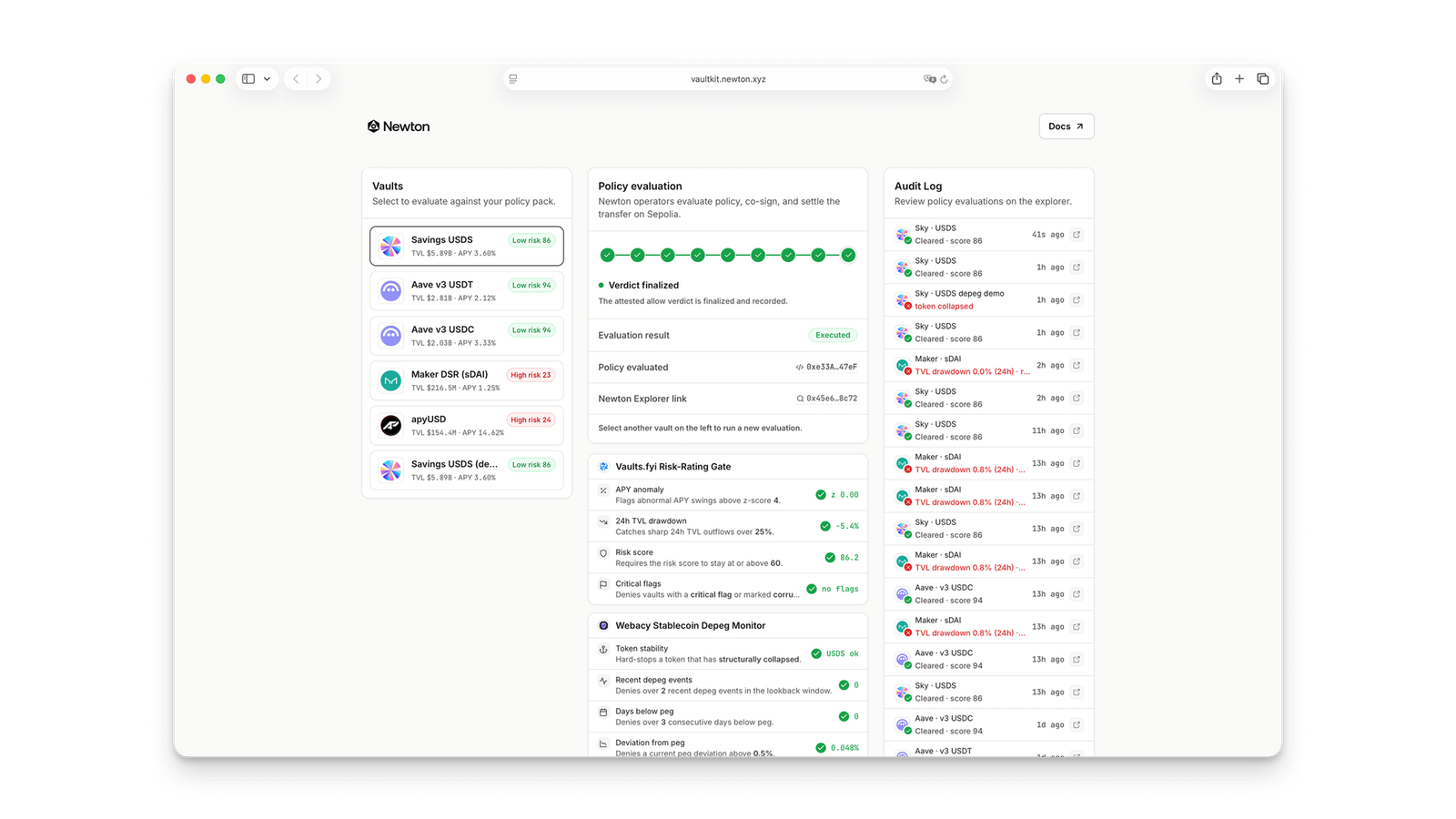 The policies in Newton are written in the Rego language, and there are two big reasons for that.$NEWT
First, Rego is an industry standard that goes far beyond blockchain. It’s the same language that IT teams already use in traditional businesses for compliance and policy enforcement, which means there’s a mature tooling and documentation ecosystem around it.
Secondly, it’s far more flexible and easier to use than smart contract languages like Solidity. With Rego, you can write very expressive policies that enforce any kind of conditions on a transaction, and Newton is built from scratch to use that to the fullest.