.The Biggest Challenge for Autonomous Finance Might Not Be AI
The more I think about autonomous finance, the less I believe artificial intelligence is the hardest problem.
AI is improving incredibly fast. Every few weeks there's another model that's better at analyzing data, identifying patterns, or making complex decisions. Looking at that progress, it's easy to assume the future depends on building smarter systsystems.
I'm not so sure anymore.
What keeps coming back to my mind is a much simpler question.
Will people actually trust AI with their money?That's the question that led me to Newton Protocol.
Most conversations around AI in crypto focus on what autonomous agents will eventually be able to do. They'll manage portfolios, move assets across chains, optimize yields, and execute strategies without constant human involvement.
Technically, that future doesn't seem impossible.But technology and adoption aren't always the same thing.People don't automatically trust something just because it's intelligent.
Money makes that even more complicated.
If software is going to make financial decisions on our behalf, most people will want to know one thing before anything else:What keeps it within the limits we've agreed to?That's what made Newton interesting to me.
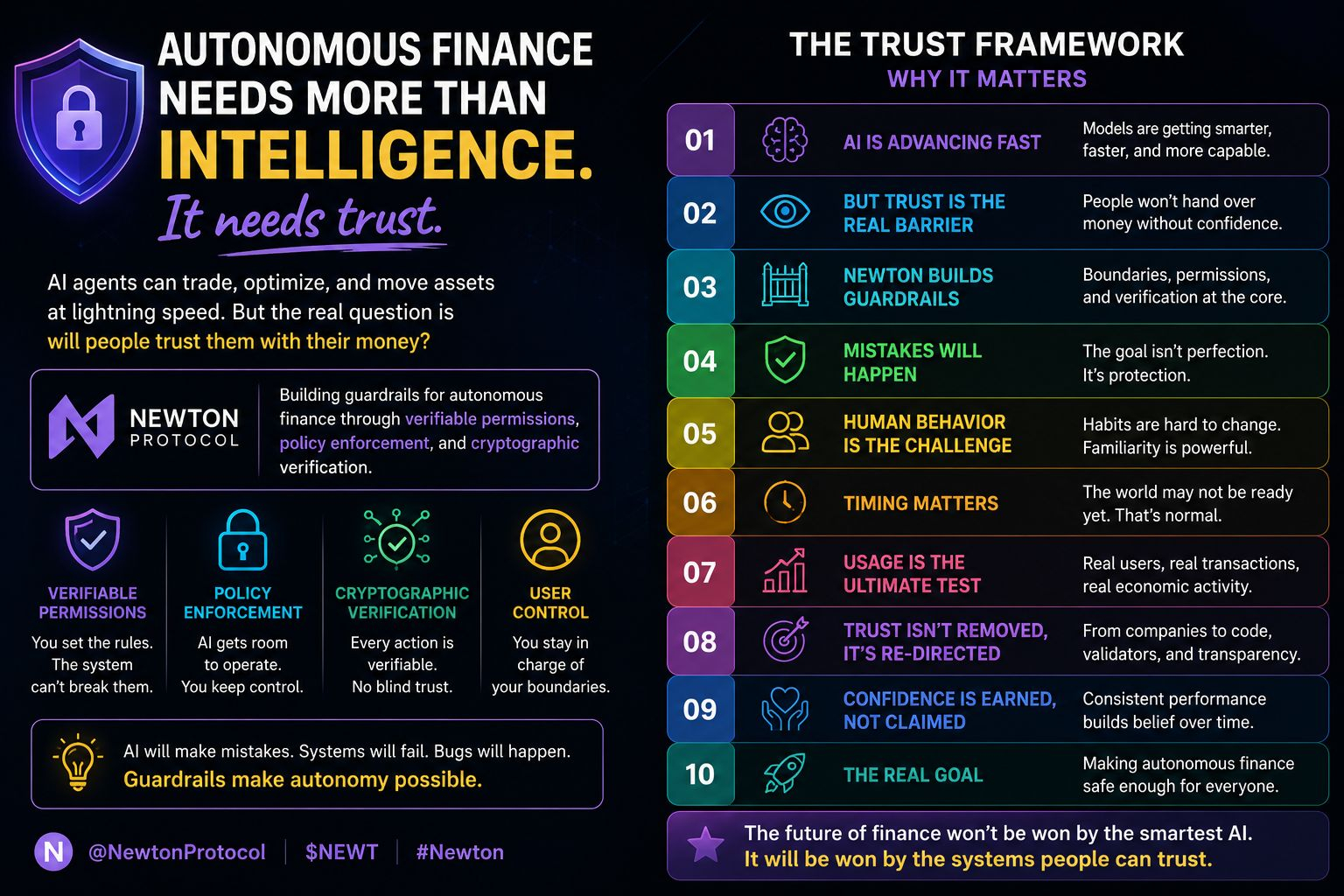
Instead of trying to convince everyone that AI is smarter than humans, it appears to focus on making AI more accountable. Through verifiable permissions, policy enforcement, and cryptographic verification, the goal isn't to remove human control. It's to make sure autonomous systems operate inside boundaries that users can actually verify.
That feels like a more realistic direction.Because AI will make mistakes.Software will contain bugs.Markets will behave unpredictably.Pretending those risks don't exist doesn't make them disappear.
Building guardrails around them seems far more practical than pretending perfect intelligence is enough.
Still, good technology doesn't automatically create successful products.History has shown that countless times.People rarely compare blockchain architectures before choosing an application.
They care whether something feels reliable Whether it's easy to use.Whether it works consistently.Habits are surprisingly difficult to change.That's probably Newton's biggest challenge.It isn't competing only against other blockchain projects.
It's competing against the way people already manage money today.Centralized exchanges already offer automated investing.
Traditional financial platforms already provide familiar user experiences.Many DeFi users already have workflows they're comfortable with.Being technically better isn't always enough to convince people to leave what already feels safe.
That makes timing just as important as technology.Autonomous finance is still in its early stages.Regulation continues evolving.Businesses are still experimenting with AI.
Most users still prefer having the final say before significant amounts of money move.
Newton may be solving a problem that becomes obvious a few years from now rather than today.Ironically, that could become both its greatest strength and its biggest challenge.
Being early only matters if you survive long enough for the market to catch up.Eventually, every blockchain faces the same test.
Real usage.
Real transactions.
Real economic activity.
Token incentives can attract attention for a while.
Long-term demand only appears when people continue using a network after those incentives become less important.
That's the point I'll be watching most closely.Not whether Newton has impressive technology.But whether people gradually become comfortable trusting autonomous systems built on top of it.
Because in the end, I don't think autonomous finance will be decided only by smarter AI.
It will be decided by something much more human.Confidence.People don't trust because someone tells them to.
They trust because something keeps working consistently, again and again, without giving them a reason to doubt it.Maybe that's Newton Protocol's real challenge.Not building more intelligent software.
Building enough confidence that ordinary people eventually feel comfortable letting that software work on their behalf.I actually think this angle is stronger than most Newton articles because it doesn't try to explain the protocol first—it starts with human behavior, then naturally arrives at Newton. That's a perspective readers are less likely to have seen repeatedly.