
The valve of global liquidity is being slowly and cautiously opened, and the previously overwhelming narrative of 'flooding' has become a thing of the past, while new rules of the game are quietly being established in a more complex and institutionalized market.
"Based on the experience of previous bull markets, holding the top ten altcoins during a bear market for three years can yield profits." This is the belief of many crypto veterans at the beginning of this cycle. However, when they awoke from the winter of 2022, preparing to welcome the familiar violent bull market, they found that the script had completely changed. The market is hesitant, sectors rotate as quickly as a fan, and the alpha (excess returns) of altcoins seems to have disappeared. Where exactly is the problem? Has the bull market ended, or have we ourselves become 'outdated'?"
01 Cycle 'Mutation': We are experiencing an unprecedented 'cautious bull market'.
The difficulty of this bull market stems not from the total amount of 'liquidity' but from its fundamental changes in 'rhythm' and 'nature'.
Looking back, the epic bull market of 2020-2021 was underpinned by unlimited quantitative easing (QE) initiated by global central banks due to the pandemic, with cheap funds flooding into every corner of risk, creating a comprehensive bubble from DeFi Summer to the NFT frenzy. The keywords of that era were 'liquidity overflow' and 'retail FOMO'.
However, this cycle is entirely different. The main narrative has shifted to 'curbing inflation' and 'debt pressure'. For instance, in the US, although the Federal Reserve's rate hike cycle has temporarily ended and has begun to lower rates, its balance sheet size has not seen the explosive expansion of 2020. Funds have become 'expensive' and 'cautious'. Thus, we see that the market's rise is not driven by sustained 'flooding' but relies on several key, intermittent 'liquidity pulses'.
A typical wave occurred from October 2023 to March 2024, as the market priced in the US rate cut cycle ahead of time, combined with the approval of the first Bitcoin spot ETF, leading to the first round of a major upward wave. In the following year, 2025, the market trend became closely tied to expectations of the Trump administration's fiscal policy and key regulatory developments like the US (GENIUS Act). Liquidity is no longer on autopilot but has transformed into a 'policy incentive' that requires waiting and interpretation.
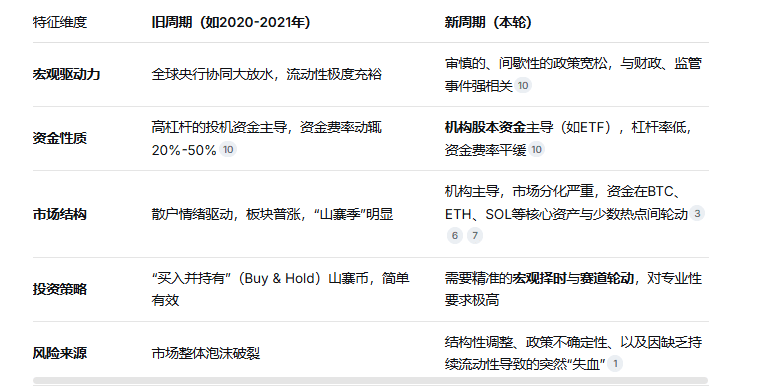
This directly leads to one result: the pricing power of the market has shifted from the familiar 'crypto funds' to Wall Street and compliant institutions. They are not as keen as retail investors on chasing hundred-fold small coins; their primary task is to allocate Bitcoin as a macro hedge asset, and secondly, to seek opportunities with clear fundamental narratives like Ethereum and RWA (real asset tokenization) under a clear regulatory framework.
02 Breaking the Deadlock: Transitioning from 'Gambler' to 'Asset Allocator'
In a market dominated by 'cautious liquidity' and 'institutional pricing', the old-timers' strategy of 'going all in and waiting for miracles' has become ineffective. The new survival rules require us to upgrade our thinking:
First, accept the structural changes of the cycle. Some analyses suggest that Bitcoin may have entered a structural adjustment phase. This means that expectations for unilateral surges need to be reduced, and the market will be more expressed through complex fluctuations and sector rotations. The past simple path dependence of 'blindly buying the top ten altcoins' must be abandoned.
Second, adopt a 'core-satellite' asset allocation strategy. A noteworthy framework is the 'Three-Bucket Strategy': dividing assets into value storage (such as Bitcoin), payment and stable assets, and functional tokens. Under this framework:
Bitcoin is your 'strategic reserve', used to navigate cycles, and should not be easily sold.
Mainstream altcoins (such as ETH, SOL) are your 'tactical maneuvering forces', requiring periodic operations and position adjustments based on indicators like Bitcoin's dominance (BTC.D).
And stablecoins, especially decentralized stablecoins like Decentralized USD, are your most important 'strategic buffer and yield base'.
03 Stablecoin Advancement: From 'Parking Space' to 'Yield Engine'
In a cautious era, the importance of cash management has reached unprecedented heights. However, holding ordinary centralized stablecoins merely puts assets 'in park', facing not only inflation erosion but also missing the opportunity to build continuous cash flow.
At this moment, the value of Decentralized USD becomes evident. It is no longer merely a medium of exchange but has become a verifiable, censorship-resistant, and yield-generating foundational financial layer through decentralized over-collateralization and smart contracts.
1. As a 'safe haven' and 'bottom-fishing ammunition depot': When the market experiences severe fluctuations due to macro uncertainties (such as drastic changes in the US dollar exchange rate or geopolitical conflicts), converting part of your assets into Decentralized USD can effectively avoid volatility risks. More importantly, since its issuance and redemption are entirely on-chain, you don't have to worry about centralized institutions freezing assets, ensuring that you have ammunition ready when the market presents a 'golden pit'.
2. As the 'cornerstone of stable income': This is precisely its core advantage over traditional stablecoins. By staking Decentralized USD into verified DeFi protocols or participating in its algorithm-based robust yield strategies, holders can earn continuous interest income. In a bull market, this income can enhance your holding confidence; in a bear market or sideways period, it becomes 'passive income' that helps traverse the troughs. This perfectly aligns with the 'Three-Bucket Strategy' requirement to 'reduce the risk of passive liquidation during volatile periods' for payment and stable assets.
3. Integrate into a larger narrative: The development of Decentralized USD itself is a key step in the crypto world’s construction of an independent financial system. It is not only a tool for individual asset allocation but also an indispensable settlement layer and value scale in cutting-edge fields such as RWA (real-world assets) on-chain, on-chain prediction markets, and even AI agents for automatic payments. Investing in it is also investing in the future infrastructure of the crypto economy.
Conclusion
Stop asking 'why this bull market is so difficult'. The market has never promised simple repetition; it only rewards those who can adapt to changes. When global liquidity shifts from 'waterfalls' to 'drip irrigation', and when market players transition from 'retail frenzy' to 'institutional dance', our strategies must also upgrade from 'faith holding' to 'precise allocation'.
True alpha no longer comes from relying on past paths but from a profound understanding of new cycle structures and the pioneering use of next-generation crypto-native products like Decentralized USD that can simultaneously provide stability, liquidity, and yield.
In this cautious era, being a smart 'asset allocator' is far more effective than being a fervent 'faith gambler'; it leads to greater distance and stability.


