
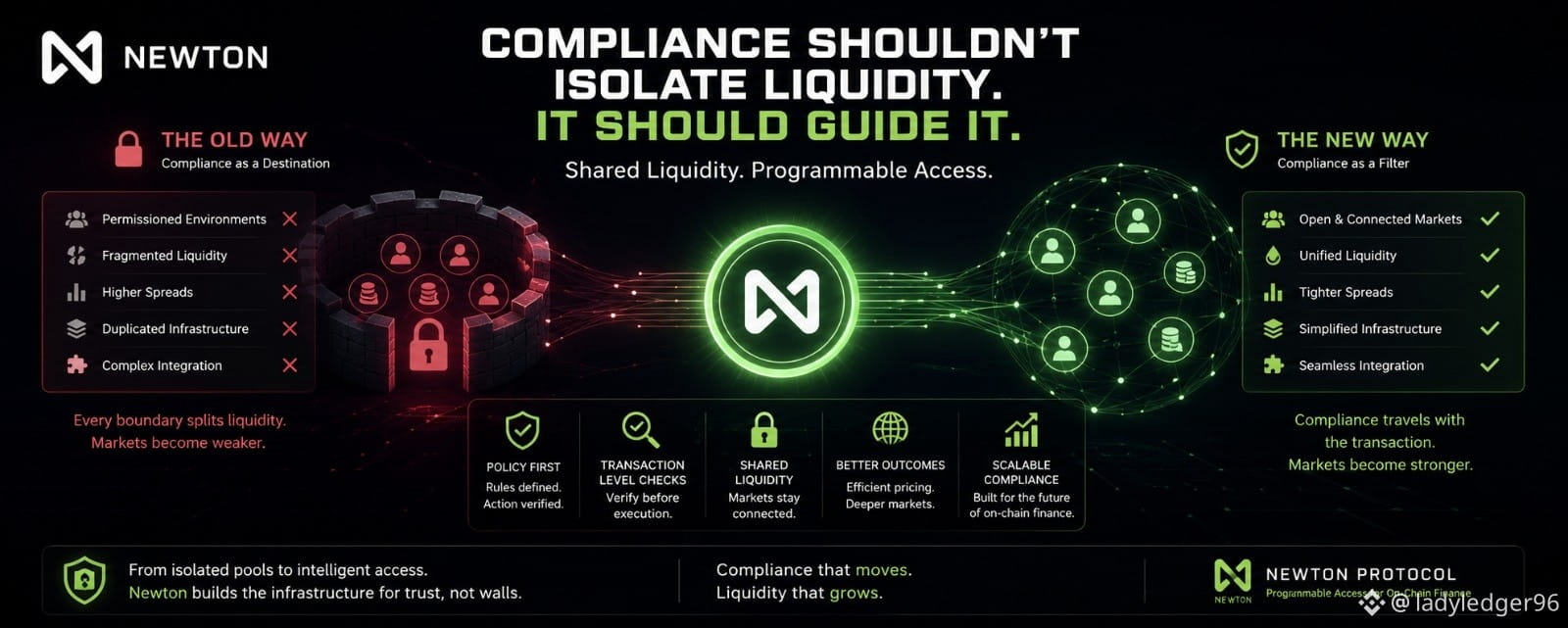
I think the biggest mistake we make is to think of compliance as a destination rather than a filter.
For years the answer has been simple: build another permissioned environment, segregate the participants and call it “safe”. It solves one problem but silently creates another.Every new boundary splits liquidity a little further.
Markets are not becoming stronger because capital is isolated. Trust and access can coexist and make them stronger.
That's why I think Newton's approach is interesting. It asks compliance to travel with the transaction itself, rather than asking liquidity to flow into compliant environments. The market stays connected . Rules stay enforceable . Every action can be checked against predefined policies prior to execution .
That changes the dialogue.
The question is no longer, “Who can get into this market?” but “Does this specific transaction satisfy the necessary conditions?”
Those are radically different questions.
Fragmentation gets more expensive as stablecoins and tokenized assets increasingly become real settlement infrastructure. Each isolated pool leads to less efficient pricing, less efficient use of capital and more operational complexity for builders and institutions alike.
Programmable compliance isn’t magic, of course. Policies still need to be governed, data sources still need to be trusted, and bad rules can still lead to bad outcomes. Technology doesn't replace judgment; it just makes that judgment programmable.
The more interesting shift is in architecture.
Rather than building financial walls around liquidity, we can build verification around individual actions.
I think that's a more scalable direction for on-chain finance.
If Newton pulls it off, its biggest contribution may not be tighter compliance—it may be showing that markets don’t have to give up shared liquidity to meet regulatory demands.
Perhaps the future isn’t permissionless vs permissioned.
Maybe it's shared liquidity with programmable access control.