

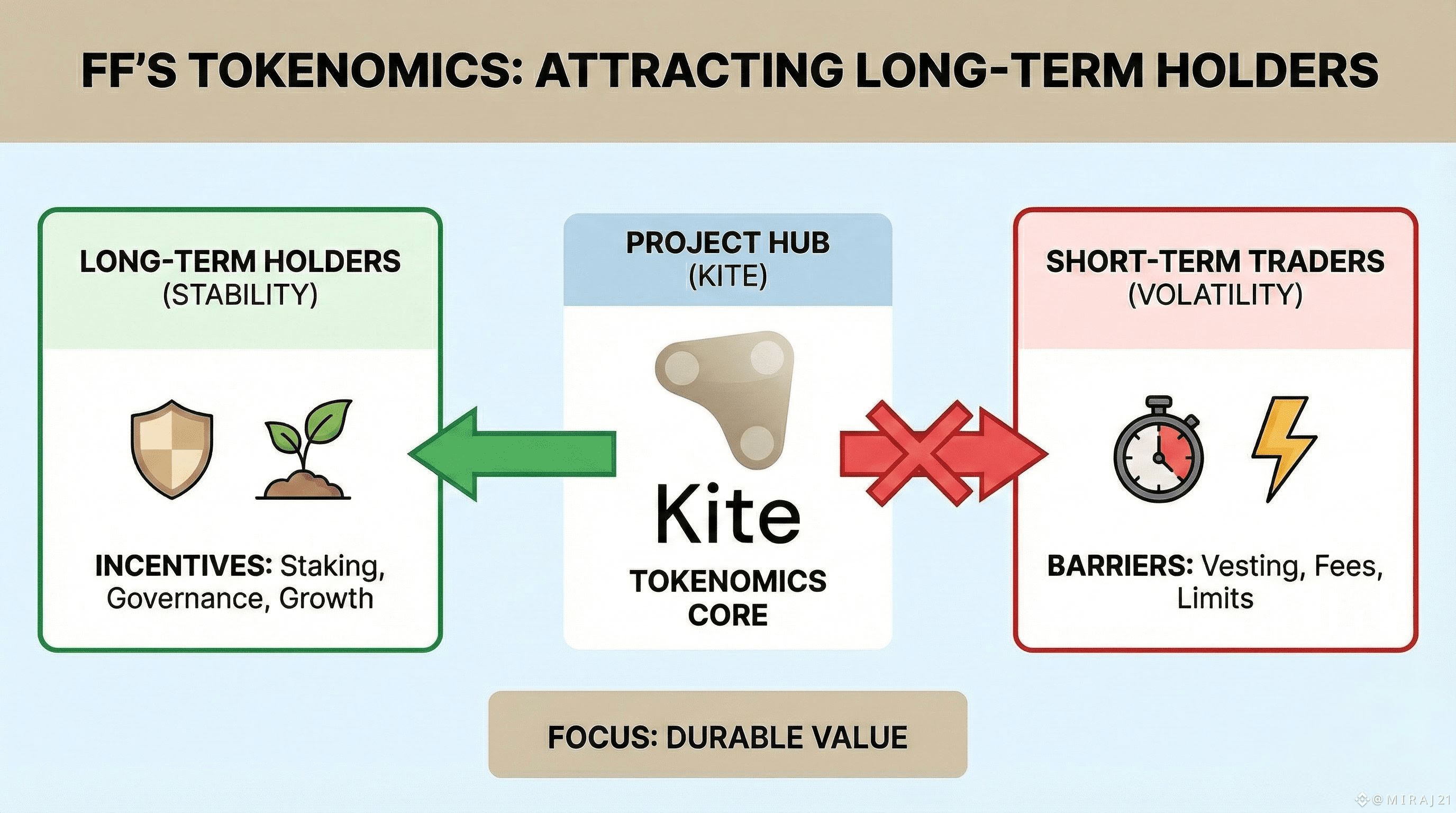
 Some protocols are traded; others are observed. KITE falls firmly into the second category.
In crypto markets conditioned to chase volatility, narratives often compress projects into charts and catalysts. But every cycle produces a small group of protocols that resist this treatment not because they lack momentum, but because their value proposition unfolds over infrastructure timelines, not trading ones. KITE is increasingly viewed through this lens: less as a speculative asset and more as a foundational layer whose relevance compounds quietly.
Short-term trades depend on reflexivity; protocol layers depend on inevitability.
Traders look for feedback loops: attention drives volume, volume drives price, price reinforces attention. Protocol layers operate differently. Their success is measured by dependency, not excitement.
KITE is being evaluated on questions like:
Will applications rely on it?
Will agents default to it?
Will workflows be designed around it?
Will capital route through it automatically?
These are not questions that resolve in days or weeks. They resolve when switching costs emerge.
KITE’s core value is coordination, not speculation.
At its heart, KITE is designed to coordinate autonomous agents, enforce policy-driven execution, and route tasks, payments, and resources without human micromanagement. This is infrastructural work.
Markets struggle to price coordination layers early because they do not create immediate visible demand spikes. Instead, they:
reduce friction
standardize behavior
absorb complexity
enable other systems to scale
By the time price action reflects this, the protocol is usually already embedded.
Usage on KITE is background activity, not attention-seeking behavior.
Many protocols depend on user-facing interaction to generate volume. KITE does not. Its activity often comes from:
agent-to-agent transactions
automated task execution
policy-enforced treasury actions
machine-scale micro-payments
continuous instruction routing
This kind of usage grows quietly. It does not trend on social media but it does create structural dependency. That distinction matters.
Protocol layers are judged by who builds on top, not who trades around.
When developers, enterprises, or system architects evaluate KITE, they are not asking, “Will this pump?”
They are asking:
Can this run unattended?
Can this enforce rules automatically?
Can it survive stress without manual intervention?
Can it support machine-native economies?
These questions are architectural. They place KITE in the same evaluative category as operating systems, not applications.
Price is a lagging indicator for systems that optimize away speculation.
KITE deliberately abstracts friction that often fuels short-term trading: unpredictable fees, manual approvals, emotional user behavior. In doing so, it also abstracts some of the volatility traders rely on.
This creates a temporary disconnect where:
network capability increases
integration deepens
usage becomes more consistent
price discovery lags
For short-term traders, this feels uninteresting. For long-term allocators, it looks like underpriced optionality.
Institutions watch layers that reduce operational risk, not those that amplify it.
From an institutional perspective, volatility is not opportunity it is liability. KITE’s appeal lies in its emphasis on:
deterministic execution
policy-based controls
predictable cost structures
auditable agent behavior
safe failure modes
These properties are invisible on charts but decisive in deployment decisions. Capital that thinks in years notices them early.
The strongest signal is not hype, but integration gravity.
Protocol layers become valuable when:
removing them breaks workflows
replacing them is expensive
retraining systems is impractical
alternatives increase complexity
KITE is being watched because it is moving toward this gravity point where agents, applications, and enterprises build assumptions around its presence.
At that stage, the market no longer asks if value accrues only how fast it will be recognized.
Short-term trades end; protocol layers persist.
Trading narratives expire with cycles. Infrastructure narratives compound across them. KITE’s design places it in the latter path: slow to excite, hard to displace, and increasingly necessary as autonomous systems scale.
This is why many observers are not trading KITE they are monitoring it.
In crypto, the most important layers often look quiet before they look obvious.
By the time protocol layers become consensus trades, the asymmetry is gone. The advantage lies in recognizing when a system is being evaluated on architectural merit rather than price momentum.
KITE is not trying to win the next week.
It is trying to become unavoidable.
Professional Thought of the Day
Traders chase movement; builders chase foundations. The protocols worth watching are often the ones doing neither loudly.

