
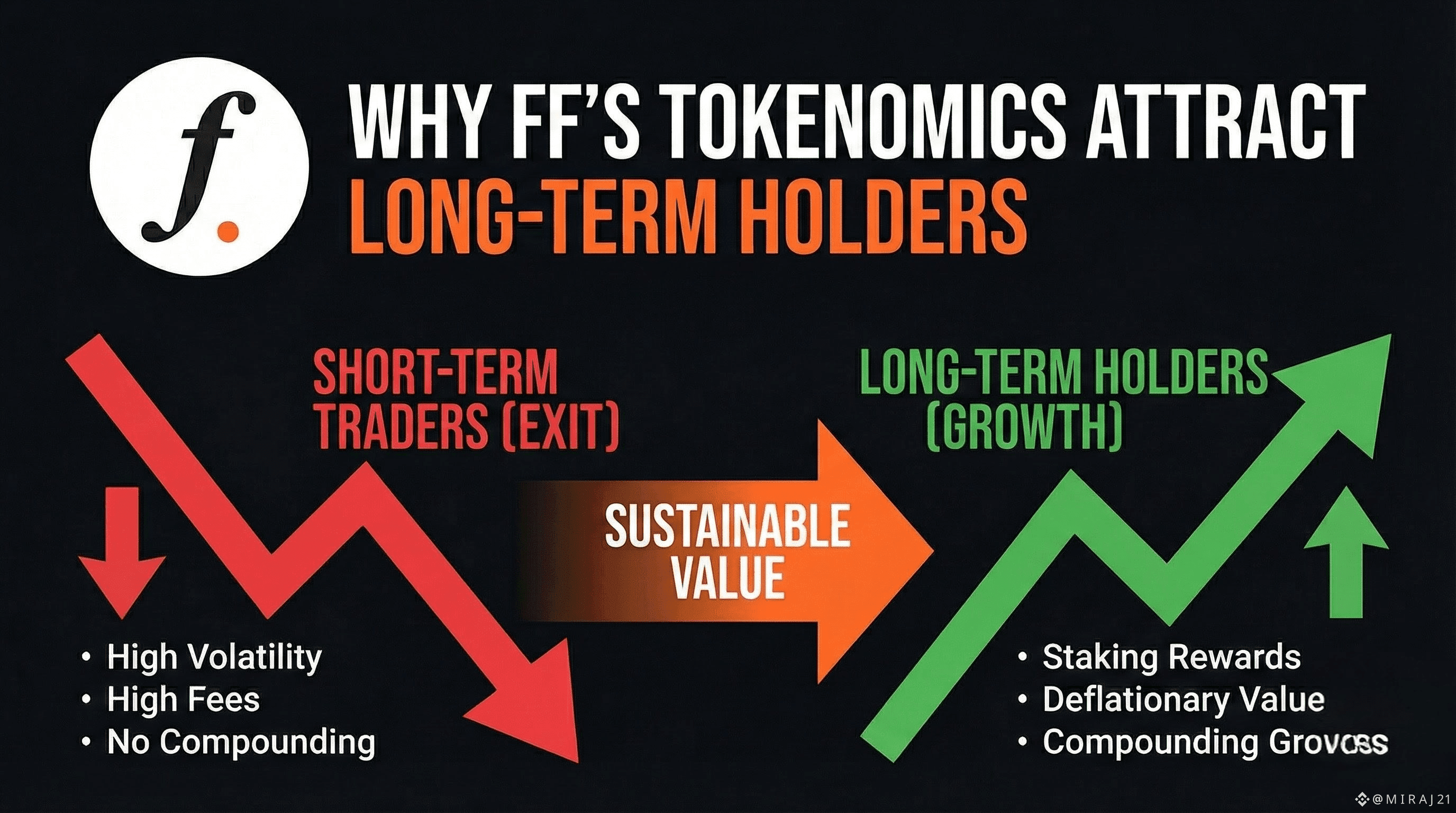
 Not every token is designed to move fast some are designed to stay.
Tokenomics has emerged as the subtle whisper that discriminates between cryptocurrencies that live for the moment versus those that truly have staying power. Falcon Finance (FF) is one such project that has an economic model that does not incentivize speculating in its assets but instead attracts those who value what comes naturally to holders over speculating traders.
Short-term traders look for reflexivity; FF optimizes for alignment.
Speculative traders thrive on sharp incentives: emissions spikes, liquidity mining bursts, or narrative-driven catalysts. FF’s tokenomics avoids these accelerants. Emissions are measured, distribution is structured, and rewards are tied to sustained protocol participation rather than momentary volume.
This design dampens short-term reflexivity but that is precisely why it strengthens long-term conviction.
Utility accrues slowly, but it compounds structurally.
The utility of FF's token is not based on constant transactional demand, rather in:
protocol-level alignment
governance influence over strategy direction
long-horizon yield participation
exposure to protocol growth, not daily activity
This means value accrues as the system matures-not as trading volume spikes. For long-term holders, this creates a compounding logic akin to equity-like exposure, not a trading instrument.
Emission restraint reduces the incentive to churn.
Most of the DeFi tokens bleed their value through aggressive emissions that incentivize farming, dumping, and rotation. FF's restrained issuance schedule cuts down sell pressure and limits the "free supply" available to fuel short-term trading loops.
When emissions are not designed for immediate monetization, the traders lose interest, but the holders start to develop confidence in supply discipline.
The holders value governance weight more than the traders do.
Governance rarely matters for active traders; it does matter, however, for a long-term participant.
The governance model of FF grants relevant control over:
strategy parameters
risk exposure
integration decisions
Treasury Alignment
protocol evolution
It transforms a token that was designed to act as a coordination instrument and not a trading chip: holders gain voice in proportion to commitment, reinforcing long-term alignment over transactional behavior.
Yield exposure is based on durability rather than maximization.
Rather than chasing the highest possible APY, FF's economic logic emphasizes
sources of sustainable yield
controlled risk profiles
reduced dependence on outside incentives
long-duration strategy implementation
That appeals to the capital that prioritizes predictability and survivability over opportunistic returns. The traders looking for volatility leave early; the holders looking for stability stay.
Liquidity design discourages mercenary capital.
FF is not relying on temporary liquidity incentives as a means to inflate TVL. Without offering short-lived liquidity programs, it filters out the capital that enters only to extract rewards.
What remains is slower-moving liquidity capital that is more likely to stay through market cycles. Tokenomics acts as a sieve, not a magnet.
The absence of constant catalysts is not a bug, it's a feature.
To a trader, FF may seem "quiet."
From a holder’s perspective, that quietness signals:
reduced headline risk
fewer narrative-driven drawdowns
lower vulnerability to coordinated exits
more stable accumulation of protocol value
Markets are apt to misprice this silence - until the fundamentals ultimately reassert themselves.
Time asymmetry favors the long-term holder. Tokenomics reward those who allow time to do the work. Holders capture upside that traders-constantly rotating-systematically miss as the protocol usage grows, integrations deepen, and strategy performance compounds.
Time ceases being an enemy but becomes an ally-a surefire characteristic of holder-friendly design.
This is how DeFi matures: from trading instruments to ownership instruments.
Early DeFi tokens were built for speculation. Mature DeFi tokens increasingly resemble governance-bearing, cashflow-aligned assets. FF’s design sits firmly in this second category.
It does not try to win attention.
It tries to win commitment.
In markets obsessed with speed, patience becomes a structural advantage.
FF’s tokenomics will likely never be ideal for short-term traders seeking rapid catalysts. But for participants who value:
disciplined supply
governance relevance
sustainable yield
protocol-aligned growth
downside protection through design
the token offers something rarer than volatility durability.
Speculators profit from motion; owners profit from structure. Tokenomics that favor holders over traders often look boring right up until they prove resilient.

