
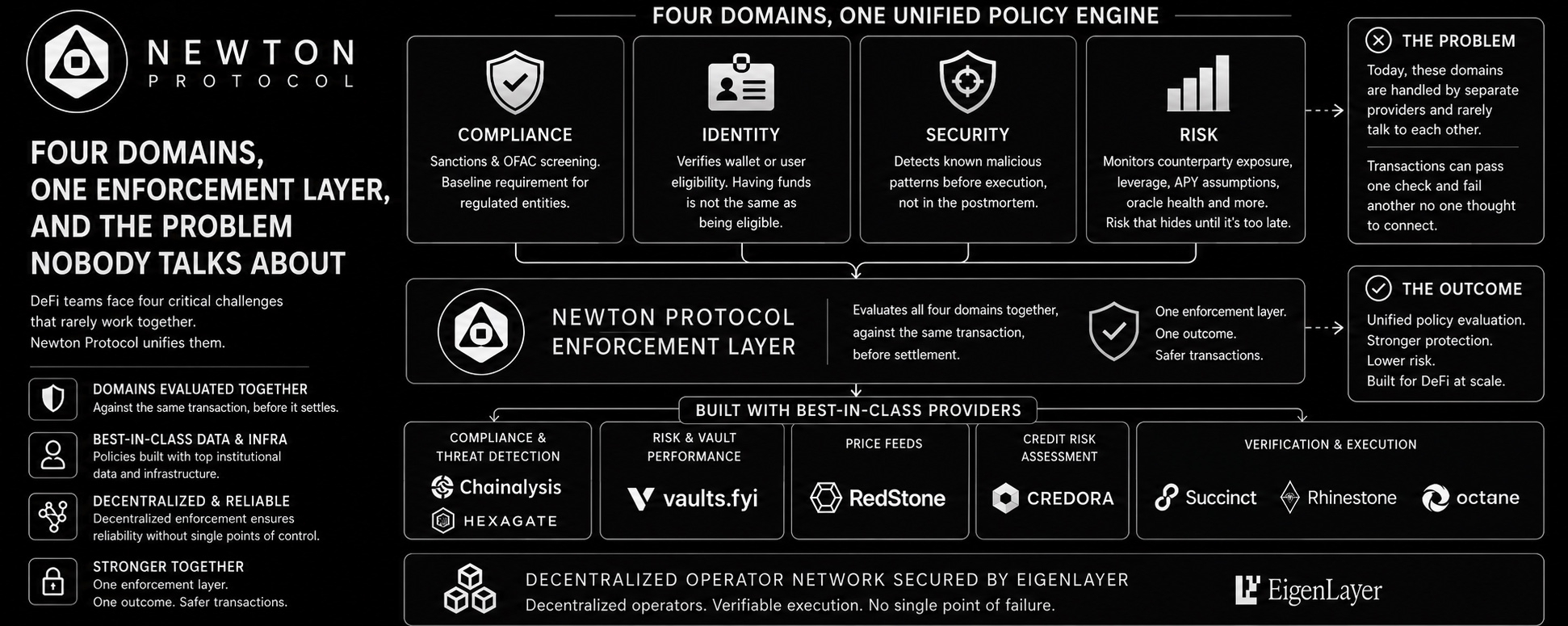
Compliance, identity, security, and risk are usually handled as four separate problems in DeFi, if they’re handled at all. A team might bolt on sanctions screening through one provider, identity verification through another, security monitoring through a third, and risk management as an internal spreadsheet nobody outside the team can audit. Each piece works in isolation. None of them talk to each other, and a transaction can pass one check while completely failing another that nobody thought to connect. Newton Protocol’s policy engine treats these as four domains that get evaluated together, against the same transaction, before it settles, rather than as separate tools a team has to stitch together themselves. Compliance covers sanctions and OFAC screening, the baseline check most regulated entities require before allowing a counterparty to transact. Identity covers verification and eligibility, confirming a wallet or user actually qualifies to take the action they’re attempting, not just that they have the funds to attempt it. Security focuses on real-time threat blocking, catching known malicious patterns before execution rather than flagging them in a postmortem. Risk covers counterparty exposure, leverage, APY assumptions, and oracle health, the category most likely to quietly degrade a vault’s safety without anyone noticing until conditions turn. What makes this structurally different from a single company trying to build all four domains in house is that Newton’s policies are built using data from specialized institutional providers rather than reinventing each wheel internally. Chainalysis and Hexagate cover compliance and threat detection. Vaults.fyi supplies real vault performance data for risk policies. RedStone and Credora bring price feeds and credit risk assessment. The enforcement itself runs through a decentralized operator network secured by EigenLayer, with additional infrastructure from Succinct, Rhinestone, and Octane handling verification and execution. This is a composability bet as much as a technical one. Rather than one company owning the entire stack, Newton treats each domain as a slot that established, already trusted providers plug into, with the enforcement layer responsible for making sure the check actually happens before settlement, regardless of which provider’s data is being checked. The risk worth watching is concentration. If a policy leans too heavily on a single provider in any one domain, that provider becomes a single point of failure for every transaction depending on it, no matter how decentralized the enforcement layer underneath remains.
