

This article will provide an in-depth review of the crypto legislation and policy measures that have been passed or are being implemented in the United States in 2025, analyze the market performance before and after the implementation of these measures, and look ahead to the regulatory trends and industry impact in 2026.
Article author: Hotcoin Research
Article source: TechFlow Deep Dive

I. Introduction
2025 is considered a watershed year for cryptocurrency regulation in the United States. Prior to this, US regulators' attitudes towards crypto assets were inconsistent, and the lack of a clear regulatory framework led to rampant "enforcement-style regulation," making the industry struggle. However, in 2025, the US federal government and Congress made a series of breakthroughs in crypto legislation and policy: Congress passed the first federal stablecoin bill (GENIUS Stablecoin Act), the House of Representatives pushed through the Digital Asset Market Structure Act (CLARITY Act), and successfully repealed inappropriate tax regulations targeting DeFi. These measures, while clarifying industry rules and boosting market confidence, also triggered significant market price volatility and structural changes.
The changing political environment in the United States paved the way for crypto-friendly policies: Trump's return to the White House made it clear that he wanted to make the US the "global crypto capital," and he issued executive orders elevating digital assets to a national financial strategic priority. He also appointed several officials supporting crypto innovation to key positions. With improved legislation and regulatory conditions, mainstream crypto assets such as Bitcoin ushered in a new bull market in 2024, even reaching historical highs in early 2025. Although the market retreated somewhat at the end of the year due to macroeconomic fluctuations, it can be said that favorable regulatory policies were a crucial pillar of this market recovery.
This article will provide an in-depth review of the crypto legislation and policy measures already passed or underway in the US in 2025, analyze market performance before and after their implementation, and forecast regulatory trends and industry impacts for 2026. We will see that, bolstered by policy clarity, the US crypto market has undergone profound changes in both short-term sentiment and long-term structure: in the short term, prices react quickly to policy news; in the long term, the compliance ecosystem is gradually improving, institutional funds are accelerating their entry, and the industry is regaining momentum. By analyzing these events, investors can gain a clearer understanding of the far-reaching impact of regulatory trends on the market.
II. The first federal stablecoin law: GENIUS Act
Source: https://www.congress.gov/bill/119th-congress/senate-bill/1582/text
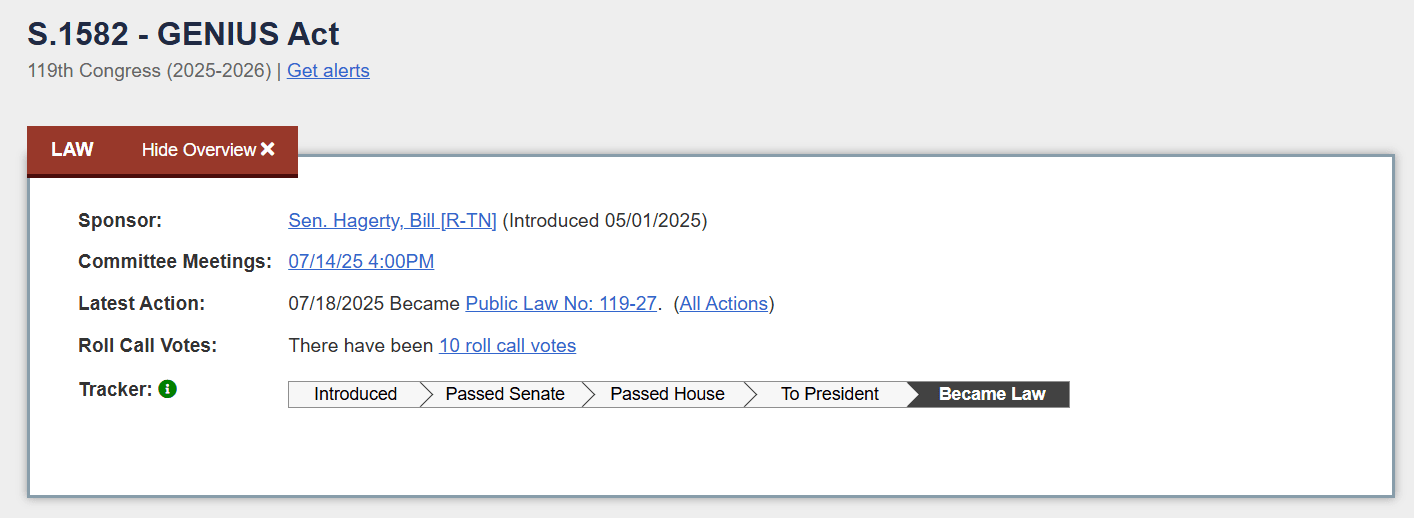
In June 2025, the U.S. Senate overwhelmingly passed the Guiding and Establishing National Innovation for U.S. Stablecoins Act of 2025 (GENIUS). This was the first federal-level stablecoin regulatory bill in the United States and the first major crypto legislation passed by Congress. On July 17, the House of Representatives passed the bill by an overwhelming vote of 308 to 122. The following day, President Trump signed the GENIUS Act into law. This series of rapid legislative actions reflects a bipartisan consensus on stablecoin regulation, marking a shift in the U.S. attitude towards digital dollar stablecoins from a wait-and-see approach to active regulation.
1. Main contents of the bill
The GENIUS Act established a new federal regulatory framework for payment stablecoins. According to the Act, "payment stablecoins" are defined as digital assets pegged to fiat currency values that can be used for payments and settlements, with issuers promising redemption at a fixed face value and claiming to maintain value stability.
Issuance requirements: Only qualified regulated entities can issue such stablecoins, including federally insured bank subsidiaries, non-bank institutions approved by the Office of the Comptroller of the Currency (OCC), and entities authorized by certified state regulatory agencies. This qualification review ensures that issuers possess sufficient financial strength and compliance capabilities. This means that mainstream compliant companies like Circle will have a clear path to obtaining federal approval, while ineligible companies will be prohibited from issuing stablecoins, preventing risks from disorderly innovation at the source.
Stablecoins must be 100% backed by safe, highly liquid assets at a minimum 1:1 ratio. Eligible reserve assets include: U.S. fiat currency (including Federal Reserve deposits), short-term U.S. Treasury securities, high-credit-rating short-term repurchase agreements, and regulated deposits. The bill also allows for the inclusion of these assets in a "tokenized form" in the reserves; that is, as long as the reserve assets themselves meet regulatory requirements, their blockchain token form is acceptable. This provision reserves space for the future on-chain transfer of traditional financial assets. Furthermore, the bill explicitly prohibits stablecoin holders from paying interest to prevent the risk of "shadow banking" similar to deposits. Issuers must disclose the amount of stablecoins in circulation and the corresponding reserve composition on their official websites monthly, and the reports must be audited by an independent accounting firm. The issuer's CEO/CFO must personally sign to guarantee the accuracy of the reports.
Regulatory division of labor and balance: The GENIUS Act is implemented through cooperation between federal and state regulators. Non-bank issuers need to obtain OCC approval and be subject to federal regulation, while smaller issuers choosing to operate under state regulation must also meet similar requirements to those at the federal level. Simultaneously, the Federal Reserve is authorized to take enforcement action against state-regulated stablecoin issuers in "special emergency situations" to prevent systemic risk. This "two-tiered regulatory" model ensures that the potential impact of large stablecoin issuances on the financial system is directly controlled by the central regulatory agency, while smaller innovations can develop in state regulatory sandboxes, thus both safeguarding financial stability and encouraging innovation.
Commercial Company Prohibitions: The bill also specifically prohibits certain types of companies from issuing stablecoins. For example, non-financial commercial companies (especially large technology companies) are prohibited from issuing payment stablecoins. This move aims to prevent platform technology companies with billions of users from bypassing financial regulations to directly issue currencies, thereby preventing the impact of "digital monopoly currencies" on financial sovereignty and competition. This provision can be seen as a response to Facebook's Libra (later renamed Diem) plan, clearly defining the boundaries for tech giants in the digital currency field.
It is clarified that stablecoins are not classified as securities or commodities: they are not regulated by the SEC or CFTC, but rather fall under the banking regulatory system. This provides an answer to the long-standing regulatory question that has plagued the market: mainstream USD stablecoins such as USDC and USDT will be considered similar to prepayment instruments rather than securities, thus avoiding the inappropriate application of the complex requirements of securities laws.
2. Market impact of the GENIUS Act
Source: https://defillama.com/stablecoins
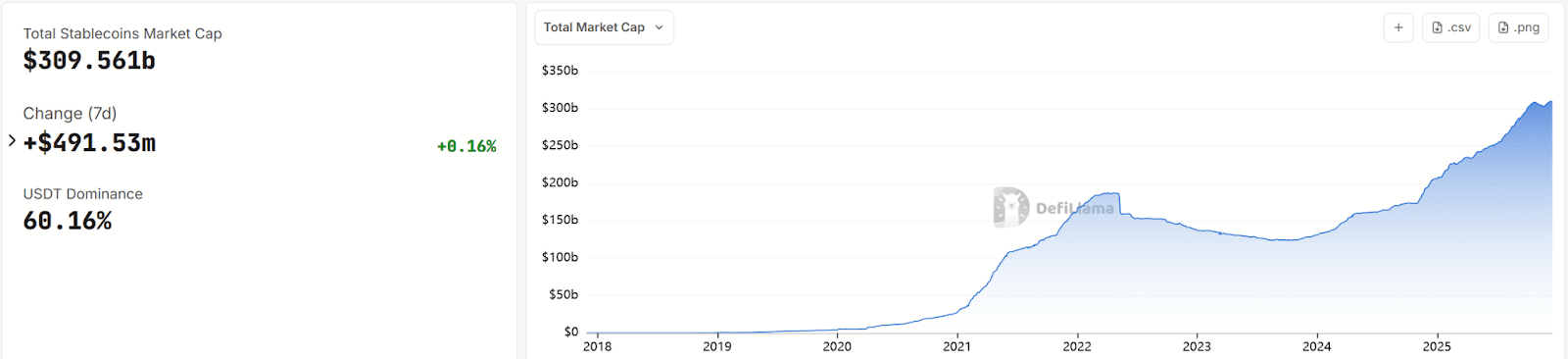
The introduction of the GENIUS Act is considered to have significantly boosted market confidence in stablecoins. Following the announcement of the legislation, the stablecoin market reacted positively: as of December 2025, the total global market capitalization of stablecoins had exceeded $300 billion. This growth is partly attributed to the overall recovery of the crypto market, but more directly to investors' expectations that the legislation would legitimize stablecoins. Institutional investors are beginning to use and hold stablecoins with greater confidence for transactions and payments, and some traditional financial institutions are also considering entering the stablecoin business.
JPMorgan Research predicts that the global stablecoin market capitalization could reach $500 billion to $750 billion in the next few years. Some media outlets have called 2025 "the true year of stablecoins." With regulatory support, dollar-denominated stablecoins will accelerate their integration into mainstream finance. For example, payment giants such as Visa and Mastercard have begun piloting the use of stablecoins to clear cross-border transactions; some banks are considering issuing their own branded stablecoins or partnering with existing issuers to provide compliant digital dollar services to their customers.
III. Digital Asset Market Structure Act: CLARITY Act
Source: https://www.congress.gov/bill/119th-congress/house-bill/3633/text
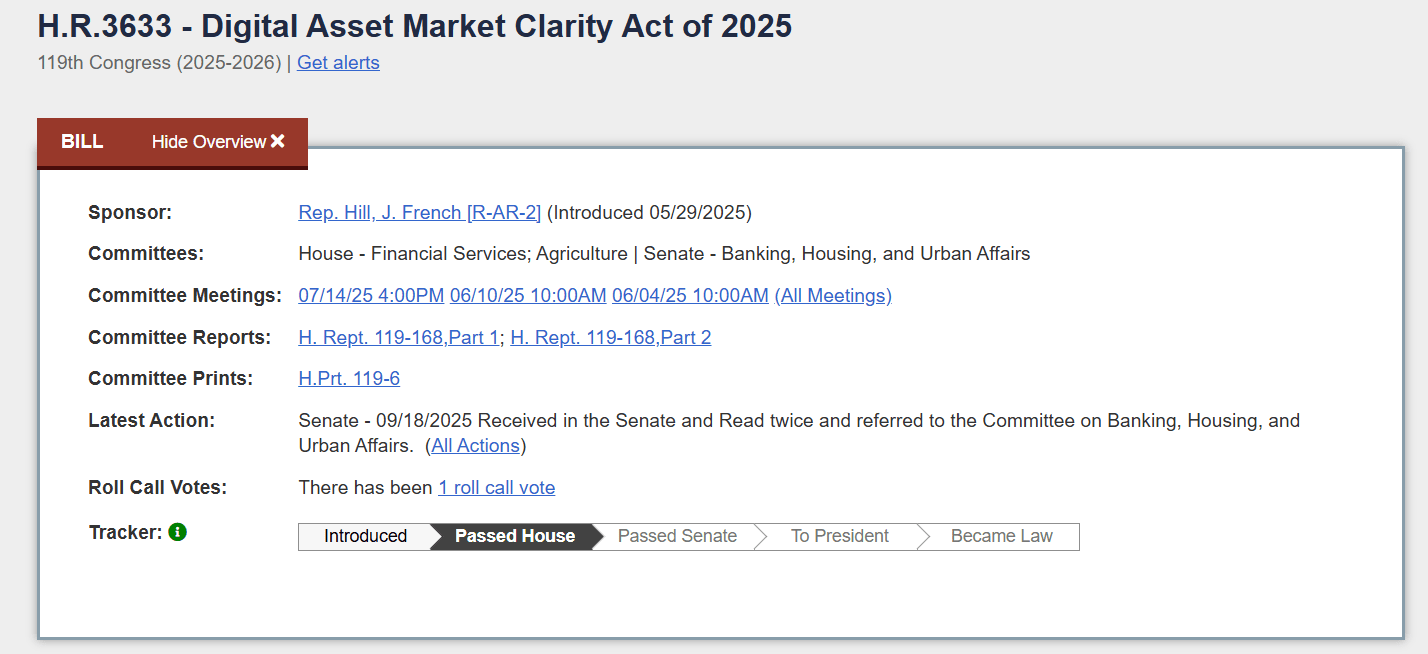
Following stablecoin legislation, Congress is rapidly advancing legislation concerning the broader structure of the crypto asset market. A key focus is the Digital Asset Market Clarity Act of 2025 (CLARITY Act), introduced and passed by the House of Representatives. Drafted jointly by the House Agriculture Committee and the Financial Services Committee, this bill is seen as a comprehensive solution to clarify the regulatory boundaries of digital assets.
On July 17, 2025, the CLARITY Act passed the House of Representatives with 294 votes in favor and 134 against. The bill was then sent to the Senate for consideration. However, just days after its House passage, the Senate Banking Committee introduced a draft bill for a parallel and competing crypto market with CLARITY. The Senate Agriculture Committee and Banking Committee held separate discussions and public consultations on digital asset legislation within their respective jurisdictions, planning to merge the two proposals into a unified Senate bill for a vote in 2026.
1. Core of the bill: A three-tiered regulatory system
The Clarity Act attempts to fundamentally address a long-standing industry problem—who should regulate crypto assets? To this end, the act proposes a three-tiered framework, dividing digital assets into three categories and clearly defining the responsibilities of the SEC (Securities and Exchange Commission) and CFTC (Commodity Futures Trading Commission) accordingly.
Digital goods refer to digital assets that are "inherently linked to the blockchain system itself, and whose value directly depends on the chain's functions or services." Simply put, these are utility tokens that rely on the blockchain network itself and are used for payments, governance, access to services, or as incentives, such as Bitcoin and Ethereum. The bill explicitly excludes several categories that do not qualify as digital goods, including securities and their derivatives, stablecoins, bank deposits, fund units, and collectibles. This classification corresponds to decentralized, non-profit-generating tokens, aiming to recognize their commodity attributes.
Investment contract assets: This is a new concept created by the bill, referring to "digital goods issued or sold through investment contracts." In simpler terms, these are tokens sold in a fundraising context—for example, tokens sold to investors by a project through an Initial Coin Offering (ICO). Furthermore, the bill establishes a "chain maturity" certification mechanism, allowing project teams or decentralized communities to apply to regulatory agencies for certification that a blockchain network is mature, thereby formally confirming that their tokens no longer fall under the category of securities. Criteria for network maturity include: the blockchain possesses practically usable functions and services; the core code is open source; the rules are transparent and predetermined and cannot be unilaterally tampered with; and no single entity controls more than 20% of the token supply. This design is similar to the lock-up period after a traditional IPO—projects are subject to securities regulation to protect investors in the early stages, but once the network is fully decentralized, the project team can withdraw from strict regulation, and the tokens become freely tradable commodities.
Permitted Payment Stablecoins: Similar to the definition in the GENIUS Act, the CLARITY Act classifies stablecoins pegged to fiat currencies and used for payments as a separate category. These assets must be pegged to some fiat currency, issued by state or federal agencies, and redeemable at a fixed value. Under the CLARITY framework, stablecoins are not classified as securities or commodities, but rather as regulated payment instruments.
Through the above classification, the CLARITY Act attempts to clarify the regulatory boundaries between the SEC and CFTC. Specifically: the digital goods sector is primarily under the jurisdiction of the CFTC, the issuance of investment contract assets is regulated by the SEC, and stablecoins are supervised by banking regulators. This arrangement ensures that each department fulfills its specific responsibilities: the SEC no longer treats almost all tokens as securities, but focuses on combating violations in the financing and issuance process; the CFTC fills the gap in direct jurisdiction over the cryptocurrency spot market and can actively address issues such as market manipulation.
2. Compliance Path for Exchanges and Practitioners
In addition to defining asset attributes, the CLARITY Act also provides clear compliance guidelines for market intermediaries and participants.
Cryptocurrency Exchanges: The bill requires digital commodity trading platforms to register as "digital commodity exchanges" with the CFTC and adhere to a series of core principles, including: establishing listing standards (ensuring that listed token issuers have fulfilled necessary information disclosure requirements, such as publicly disclosing source code, issuance volume, and economic models), implementing transaction monitoring, preventing conflicts of interest, and ensuring fund and system security. Exchanges must segregate client assets from their own assets, ensure client funds are held in qualified digital asset custody institutions, provide full risk disclosure, and join futures industry associations for self-regulation. The bill even restricts innovative business practices for exchanges, such as allowing exchanges to offer staking services to enhance blockchain network security, but prohibiting forced user participation or mixing of staking with their own trading activities to prevent conflicts of interest.
Brokers/Dealers: The bill breaks down the existing barriers between digital asset and securities businesses, encouraging compliant brokers and exchanges to include digital assets in their operations. The bill requires all entities engaged in digital commodity brokerage to register with the CFTC as digital commodity brokers and meet relevant capital, reporting, and customer protection requirements. The SEC is required to allow its registered brokers, exchanges, or alternative trading systems (ATS) to handle trading and custody of digital commodities and stablecoins, and cannot reject registration or exemption applications simply because a platform offers both securities and digital asset trading. The SEC is also granted the discretion to use existing exemptions to grant special exemptions to certain decentralized finance activities to avoid inappropriate regulation stifling new developments.
Technology developers: It is claimed that the final text of the CLARITY Act explicitly states that individuals engaged in non-custodial activities such as blockchain development, node operation, and wallet development do not need to obtain state or federal licenses. This provision is crucial to the US blockchain technology development ecosystem, meaning that pure technology providers will not bear heavy regulatory obligations due to users' financial activities on the chain, thus clearing away the legal uncertainty that previously loomed over miners, nodes, and smart contract developers.
3. Market Impact: Expected positive factors and increased volatility
Source: https://coinmarketcap.com/currencies/bitcoin/
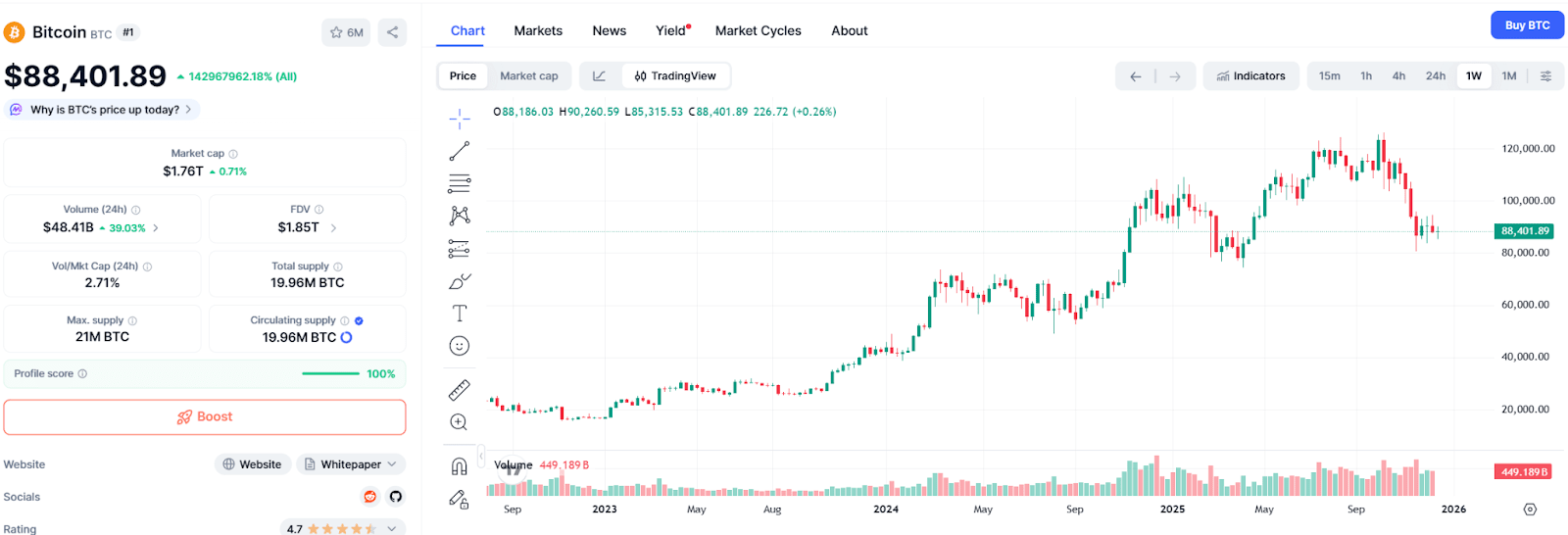
As the House of Representatives declared mid-July 2025 "Crypto Week" in preparation for voting on the CLARITY bill, anti-CBDC provisions, and stablecoin legislation, market sentiment turned bullish. In fact, this series of positive news was a key catalyst for the strong performance of the crypto market in the middle of the year: Bitcoin prices hit their then-rebound high in July, its market capitalization share increased, and many US-listed blockchain stocks also recorded gains. Following the passage of the legislation, industry insiders generally believe that the long-standing problems of the US crypto industry have finally seen a glimmer of hope for resolution, and traditional institutions are increasingly willing to enter the market. Digital asset trading or custody plans previously shelved by exchanges such as the New York Stock Exchange and Nasdaq due to regulatory uncertainty are beginning to reassess their feasibility.
However, due to the slow pace and uncertainty of policy implementation, the market has experienced news-driven fluctuations. For example, after the House of Representatives passed the Clarity Bill and sent it to the Senate, investors initially anticipated a swift Senate approval process to bring the bill into effect before the end of the year, pushing Bitcoin prices to a record high of approximately $126,000 in early October. However, in mid-October, the president's sudden announcement of a new round of tariffs on China triggered a surge in risk aversion in global markets, causing Bitcoin to plummet along with the stock market. The largest single-day liquidation in crypto history that day (US$19 billion) saw leveraged positions liquidated. Subsequently, the negative impact of macroeconomic factors made it difficult for the crypto market to remain unaffected. Bitcoin prices recorded their largest monthly drop since 2021 in November and currently remain below $90,000. This demonstrates that crypto assets, as risk assets, are heavily influenced by macroeconomic conditions and market sentiment. The correlation coefficient between Bitcoin and the S&P 500 index is projected to rise to 0.5 in 2025, significantly higher than the 0.29 in 2024.
IV. Other Representative Encryption Policies
In addition to major legislative projects, the US government also took significant actions on some crypto-related policies in 2025, further improving the compliance environment for the crypto ecosystem.
1. Anti-CBDC Act: Protecting Financial Privacy
After the Trump administration took office, its attitude towards central bank digital currencies (CBDCs) underwent a 180-degree shift. In January 2025, President Trump signed an executive order directly prohibiting any federal agency from promoting, issuing, or advocating for CBDCs. This stance was later further solidified by the legislature: the House of Representatives attached Title VI, the "Anti-CBDC Surveillance State Act," to the Claritical Act. The core of this act is to legally prevent the Federal Reserve from launching CBDC accounts or products for individual consumers, emphasizing the importance of privacy and freedom, and preventing the government from using CBDCs to obtain citizens' transaction data. The House of Representatives voted on and passed this bill separately during "Crypto Week" in 2025. Although the Senate has not yet completed its review of the bill, given the strong opposition from the new administration and the House leadership, the door to the introduction of CBDCs in the United States is effectively closed.
Supporters argue that banning CBDCs helps protect citizens' financial privacy and private sector innovation. They point out that once a CBDC is issued, the government could monitor and even restrict individuals' use of funds in real time, contradicting the US's emphasis on free markets and privacy. In this context, the Federal Reserve significantly slowed its research into a digital dollar in 2025, focusing instead on wholesale (interbank settlement) CBDCs. This implies that private sector stablecoins will dominate the digital dollar process, aligning with the GENIUS Act's policy direction of encouraging banks and compliant institutions to issue stablecoins.
2. Abolish the stringent reporting rules for DeFi.
Back in 2021, the U.S. Infrastructure Investment and Jobs Act (IIJA) included a controversial provision requiring broadly defined "digital asset brokers" to report user transaction information to the IRS. This definition was overly broad, potentially classifying miners, nodes, and smart contract developers in the decentralized finance (DeFi) sector as "brokers," forcing them to undertake burdensome Know Your Customer (KYC) and tax reporting obligations. In 2025, both houses of the U.S. Congress passed Joint Resolution 25 (H.J. Res. 25), which was signed into law by President Trump on April 10, 2025 (Public Law 119-5). This act formally repealed the Treasury Department's implementing rule for Section 80603 of the IIJA (Reporting of Digital Asset Broker Information).
Following the repeal of the rule, the IRS clarified that DeFi platforms operating purely on the blockchain without providing fiat currency exchange are not required to file 1099-DA transaction reports with the tax authorities, nor are they required to collect user identity information. Centralized exchanges and service providers (holding customer assets and providing fiat currency exchange) will still be obligated to report: they will begin recording user digital asset transactions from January 1, 2025, and submit the new 1099-DA form to users and the IRS in early 2026. This means that licensed US exchanges such as Coinbase and Kraken will still need to file reports on time, but decentralized protocols such as Uniswap are exempt. Furthermore, payment processors and institutions that frequently issue or redeem their own tokens will continue to be considered "brokers" and required to report, primarily targeting stablecoin issuers with centralized entities.
3. Shift in personnel and enforcement by regulatory agencies
Beyond legislation and macro policies, the significant improvement in the US crypto regulatory environment in 2025 is also reflected in personnel changes within regulatory agencies and a shift in enforcement style. The new administration appointed a number of officials with an open attitude towards crypto to key positions. Most importantly, former SEC Commissioner Paul S. Atkins was appointed Chairman of the Securities and Exchange Commission. Upon taking office, Atkins immediately launched an internal project codenamed "Project Crypto," aiming to establish formal token classification standards and guidelines for digital assets, and established the "Crypto 2.0" task force. The task force's mission is to assist the Commission in developing a "comprehensive and clear regulatory framework" and to use enforcement resources more prudently.
Accompanying the personnel changes was a rapid shift in the SEC's enforcement approach. Since Trump took office in early 2025, the SEC has suspended or dropped approximately 60% of its investigations and lawsuits related to cryptocurrencies. Some high-profile cases, such as the lawsuit against Ripple and enforcement actions against the Binance exchange, have shown significant signs of easing. For example, the SEC reached a settlement with Ripple in July 2025, dropping charges against its executives; the investigation into Binance is reportedly no longer being actively pursued. It even ended its four-year investigation into the decentralized lending platform Aave without imposing any penalties. The SEC's changes have greatly alleviated industry pressure, allowing them to shift their focus from litigation back to business operations. This has contributed to the market recovery in 2025 and a decrease in the large-scale exodus of US projects.
Meanwhile, banking regulators who had previously taken a hard line against banks' involvement in crypto businesses have begun to loosen restrictions. Newly appointed Treasury Secretary Scott Bessent has welcomed digital assets. Acting Chairman Travis Hill of the Federal Deposit Insurance Corporation (FDIC) issued a public statement in January pledging a “more transparent approach to fintech partnerships and digital asset tokenization” and considering issuing additional guidance to clarify the compliance path for banks' participation in digital asset businesses. In 2025, the Federal Reserve, the OCC, and other agencies withdrew some of their previous restrictive statements on banks' involvement in crypto businesses, adopting a case-by-case review approach. As a result, some small and medium-sized U.S. banks are reconsidering providing account services to crypto companies, and cooperation between banks and crypto enterprises is beginning to recover. After the collapse of several “crypto-friendly banks,” including Signature and Silvergate, crypto companies faced difficulties accessing basic banking services, but this situation is expected to improve.
4. Executive Orders and the Exploration of Bitcoin Reserves
On January 23, President Trump signed an executive order entitled "Strengthening U.S. Leadership in Digital Financial Technology," declaring "supporting the responsible growth and use of digital assets, blockchain technology, and related technologies across the economy" as a national policy. The order established the Presidential Task Force on Digital Asset Markets, comprised of more than ten high-ranking officials including the Chairman of the SEC, the Chairman of the CFTC, the Secretary of the Treasury, the Secretary of Commerce, and the Attorney General, and may invite private sector digital asset leaders to participate in consultations. The President required the task force to submit a report within 180 days, proposing a comprehensive federal regulatory framework for digital assets and assessing the feasibility of establishing a national "digital asset reserve."
Trump himself has shown strong interest in establishing a national Bitcoin reserve, hoping to use the government's existing Bitcoin holdings (obtained through law enforcement seizures) as a foundation to explore diversifying a portion of the national reserves into digital assets. On March 6, he further issued Executive Order 14233, directing the establishment of a strategic Bitcoin reserve and a U.S. digital asset inventory.
It can be said that the US government's formal embrace of Bitcoin is less of an economic decision and more of a geostrategic consideration: to ensure the dollar's dominance in the future digital economy and prevent other countries' digital currencies or gold from gaining prominence. Although this idea is quite controversial among traditional financial officials, at least by 2025, it has moved from science fiction to reality.
In summary, these policy initiatives in 2025 demonstrate the US government's comprehensive embrace of crypto innovation: establishing rules through legislation, changing regulatory tone through personnel adjustments, and setting strategic direction through executive orders. This top-level design and strong execution send a clear signal to the global crypto industry: the US intends to actively participate in and lead this financial revolution. While a more regulated market will reduce some speculative bubbles, in the long run it will attract larger-scale and more rational capital inflows, and crypto assets are expected to gradually become a regular part of global asset allocation, rather than an alternative asset operating in a gray area.
V. Outlook for 2026: New Regulations and Industry Changes
Looking ahead to 2026, US crypto regulation will continue to deepen and improve along the lines laid out in 2025. Here are a few areas to watch:
1. Legislative implementation and rule refinement
Legislation on the structure of the digital asset market is expected to be finalized in 2026. Two Senate committees have planned to consolidate their respective draft bills by the end of the year and push for a full Senate vote in early 2026. Given the large majority of support for the House version and the cooperation of the executive branch, industry experts predict a high chance of the Senate bill passing.
Once the House and Senate reach an agreement on the final text, the CLARITY Act and related provisions (such as anti-CBDC) could be formally signed into law in the first half of 2026. Following this, the SEC and CFTC will enter a busy period of rulemaking. During this process, industry associations and large corporations will participate in the negotiation, vying for provisions that benefit themselves.
The final details of the new regulations will determine the specific direction in which market participants adjust their business models. For example, if the exchange registration process and requirements are relatively lenient and transparent, we may see US exchanges like Coinbase be among the first to apply for CFTC registration, and even overseas exchanges considering applying for US licenses.
2. A compliant ecosystem is taking shape, and institutions are accelerating their entry into the market.
Once the regulatory framework is clear and supporting rules are gradually implemented, the US crypto compliance ecosystem will begin to take shape. Legitimate exchanges, custodians, brokerages, and stablecoin issuers will successively obtain formal registration or licenses from regulatory authorities, and institutional investor participation will rapidly increase.
Large asset management companies (such as BlackRock and Fidelity) have already brought some traditional funds into the market through products like ETFs. As regulations become clearer in 2026, these institutions may diversify their businesses, such as establishing crypto hedge funds, providing custody, and derivatives trading. For example, Wall Street banks like Goldman Sachs may launch digital asset trading and custody services. In the stablecoin sector, qualified bank subsidiaries like JPMorgan Chase can issue payment stablecoins, and this also provides a pathway for non-bank institutions like PayPal to issue stablecoins through OCC approval.
The large-scale entry of traditional institutions will bring incremental funds and more mature risk management, which will help reduce the volatility of the crypto market and improve market depth and pricing efficiency in the long run.
3. Industry Competition and Reshuffling
The arrival of the compliance era also means a reshuffling of the industry. Those companies willing and able to meet regulatory requirements will prevail, while those resisting regulation or failing to meet standards will be eliminated. For example, compliance pioneers like Coinbase are expected to further expand their market share; while some unlicensed trading platforms with gray-area business models will find it difficult to continue serving US customers.
Similarly, regarding crypto projects, high-quality projects are more willing to issue tokens compliantly in the United States. If the SEC successfully establishes a token registration exemption regime in 2026, we may see the first token offerings registered with the SEC, sold to the public, and monitored by regulatory agencies. This would be a revolutionary change, meaning that crypto startups can raise funds compliantly like publicly traded companies through IPOs, while investors enjoy corresponding information transparency and legal protection.
At the same time, some emerging models in the decentralized space will further develop and grow, as safe harbor provisions protect developers. For example, decentralized exchanges, lending, and derivatives platforms may flourish after gaining clear exemptions and gradually connect with traditional finance.
4. Government Strategy and International Competition
From a governmental perspective, the Trump administration will continue to push forward with its strategic goal of "making the United States a global leader in crypto and blockchain innovation," ensuring its voice in international standard-setting, including setting FATF digital asset regulatory standards and cross-border payment frameworks. In 2026, the United States may seek to strengthen dialogue and cooperation with regulatoryally advanced economies such as Europe, the UK, and Japan, achieving a degree of regulatory equivalence or mutual recognition. This will facilitate cross-border business operations, allowing legitimate and compliant crypto companies to operate freely in major markets.
Meanwhile, the US may increasingly incorporate crypto into its financial diplomacy agenda, promoting the use of dollar-denominated stablecoins in developing countries to solidify the dollar's position. In late 2025, newly appointed Treasury Secretary Bessant praised the liquidity of the US Treasury market, noting that stablecoin growth is expanding demand for US Treasuries. This indicates that the government is beginning to recognize the potential benefits of stablecoins and other crypto products for the US financial market.
5. Risks and Challenges
Of course, even with a bright outlook, 2026 is not without risks. On the macro level, the US economy may face new uncertainties, such as changes in the interest rate cycle and geopolitical conflicts, which will still pose external shocks to the crypto market.
At the same time, regulatory goodwill does not mean letting down our guard. If a major crypto security incident occurs in 2026, regulators may quickly tighten policies and severely punish those involved as a deterrent. This places higher demands on industry self-regulation: companies must effectively strengthen security and risk control while enjoying policy benefits.
Furthermore, the US political cycle is also worth noting. 2026 is a midterm election year, and it's difficult to say whether the current crypto-friendly stance will reverse should the political situation change again. However, at least within the 2025-2026 cycle, both parties have reached a consensus on supporting reasonable regulation and encouraging innovation.
VI. Conclusion
Looking back at 2025, the United States experienced a dramatic shift in cryptocurrency regulation, moving from chaos to clarity and from a passive to a proactive approach. That year, Congress and the government jointly introduced a series of landmark initiatives, including the Stablecoin Act and the Market Structure Act. In the short term, these policy announcements significantly impacted market sentiment and price movements. Even with the addition of macroeconomic headwinds, the market remained highly volatile. However, the more profound impact lay in the changing industry ecosystem and landscape: clear rules cleared obstacles to compliant operations, allowing traditional financial institutions to enter the market with confidence, and enabling innovators to move forward without being deterred by regulatory uncertainty. The United States once again became a hotbed for crypto startups and funding.
While regulatory clarity is increasing, the industry itself must place greater emphasis on compliance and risk control to match the regulators' trust. Only through a positive interaction between regulation and the industry can crypto technology truly integrate into the socio-economic landscape and unleash its transformative potential. For investors, it is crucial to closely monitor policy trends, as regulation is becoming a significant driver of the crypto market. Favorable policies not only lead to price increases but, more importantly, reduce long-term risk premiums, enhancing the intrinsic value and sustainability of assets.
Looking ahead, the US's regulatory exploration will provide a valuable example for the world: how to maximize the vitality of digital financial innovation while maintaining financial stability and security. It is foreseeable that in 2026, the crypto industry will continue to move forward on a more solid legal foundation, and the US is expected to consolidate its position as a global center for crypto capital and technology. There may still be setbacks, but the direction is clear: crypto assets will emerge from the gray area and openly participate in shaping the future financial landscape.
about Us
Hotcoin Research, as the core research arm of the Hotcoin exchange, is dedicated to transforming professional analysis into practical tools for your investment decisions. We analyze market trends for you through weekly insights and in-depth reports; and with our exclusive column, Hotcoin Selection (AI + expert dual screening), we help you identify potential assets and reduce trial-and-error costs. Every week, our researchers also host live streams to discuss hot topics and predict trends. We believe that warm support and professional guidance can help more investors navigate market cycles and seize the value opportunities of Web3.

