
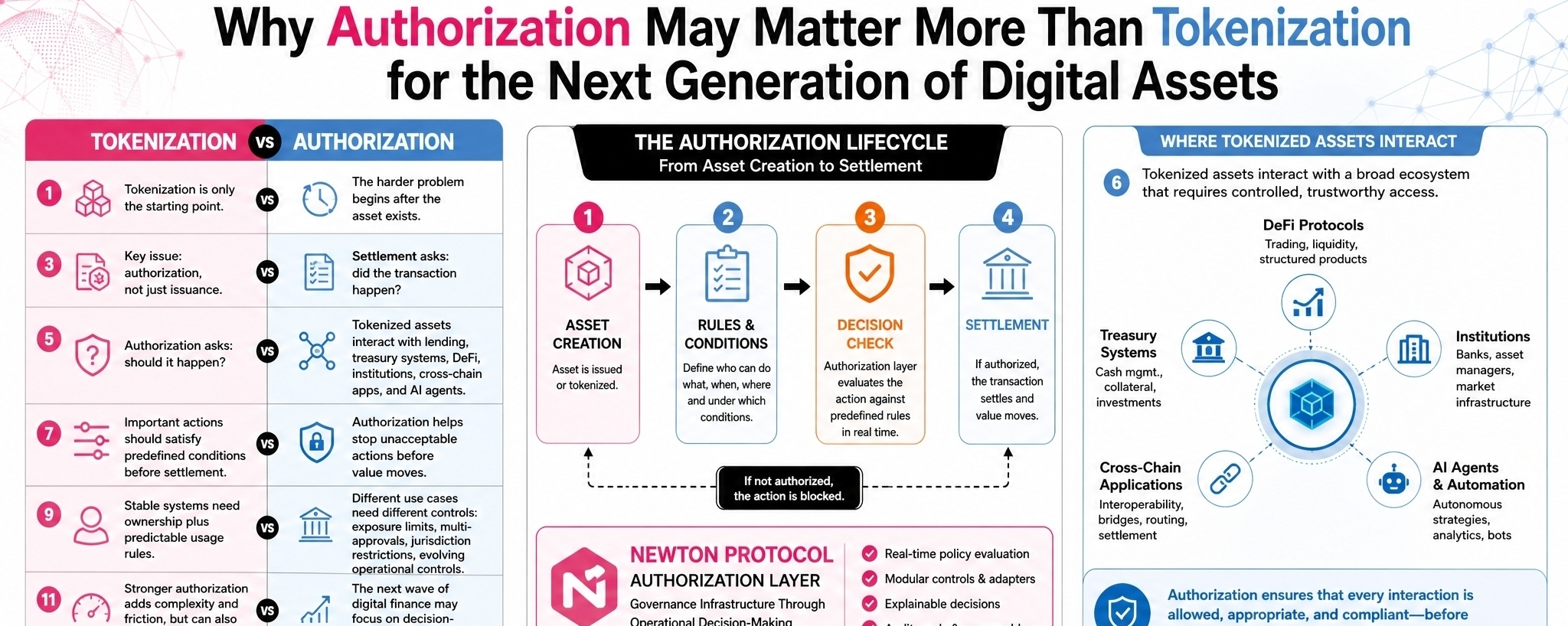

Why Authorization May Matter More Than Tokenization for the Next Generation of Digital Assets
When people talk about tokenized assets, the conversation almost always begins with issuance.
How quickly can an asset be tokenized?
Which blockchain supports it?
How much value has already moved on-chain?
Those questions matter, but after spending time studying Newton Protocol, I found myself paying attention to a different layer entirely.
The asset itself is rarely the difficult part.
The difficult part begins after the asset already exists.
Imagine a tokenized treasury bill, a real estate share, or a revenue-producing asset. Representing ownership on-chain is only the starting point. The larger challenge appears once thousands of people / applications / institutions or autonomous systems begin interacting with that asset simultaneously.
Every action creates another decision.
Who should be allowed to execute it?
Under what conditions?
Should the same rule apply to every participant?
When does automation become excessive rathers than helpful?
Those questions are not really about tokenization.
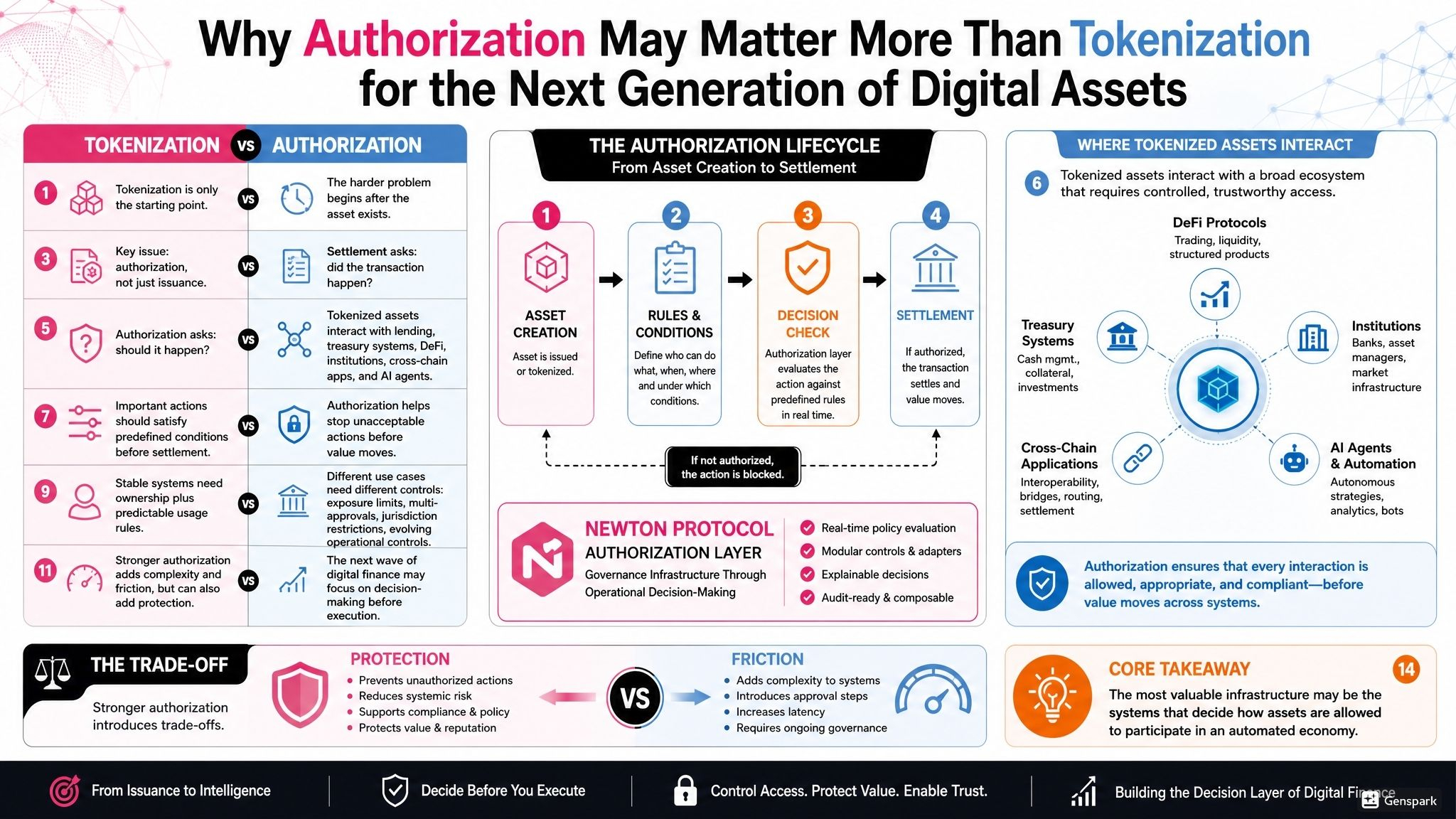
They are questions about authorization.
That distinction changed how I started thinking about infrastructure.
For years, blockchain development focused on making settlement faster & cheaper. Once a valid transaction reached the network, execution became the priority. That approach solved 1 of the industrys biggest technical problems, but it quietly left another one behind.
Settlement answers whether a transaction happened.
Authorization decides whether it deserved to happen.
As decentralized finance becomes more sophisticated that 2nd question feel increasingly important.
A tokenized asset rarely operates in isolation. It sits inside lending markets / treasury systems / automated investment strategies / cross-chain applications / institutional workflows & increasingly AI-driven software capable of acting without constant human supervision.
Those environments generate decisions continuously.
Some decisions are harmless.
Others carry significant financial consequences.
The challenge isn0t preventing activity.
The challenge is distinguishing between activity that should proceed and activity that should stop before value moves.
That is where Newton Protocol became interesting to me.
Rather than viewing authorization as paperwork wrapped around blockchain infrastructure, it treat authorization as infrastructure itself.
I think that subtle shift matters.
Instead of assuming execution is the default outcome, the architecture encourages every important action to satisfy predefined conditions before settlement takes place.
Viewed another way, the protocol introduces an admission process rather than relying entirely on correction after execution.
That philosophy changes where operational risk lives.
Traditional blockchain systems often discover mistakes after assets have already moved.
Authorization attempts to identify unacceptable actions before those state changes occur.
Neither approach removes risk.
They simply place it in different parts of the system.
I kept thinking about autonomous software while exploring this idea.
Humans naturally slow down after repeated failures.
Applications do not.
An automated strategy can continue retrying the same operation hundreds of times unless something tells it to stop.
Without meaningful authorization, failed assumptions can quietly become repeated behaviour.
At scale, repeated behaviour becomes operational risk.
This is where tokenized assets become especially interesting.
Ownership alone does not create stability.
Stable systems emerge when ownership is combined with predictable rules governing how assets may be used.
A lending protocol may require exposure limits.
A treasury may require multiple approvals.
An institutional product may need jurisdiction-specific restrictions.
A real-world asset platform may need operational controls that evolve over time.
The asset remains the same.
Only the authorization changes.
That observation made me rethink what infrastructure actually means.
Infrastructure is often described as the technology responsible for moving value.
Increasingly, I think another responsibility deserves equal attention.
Determining when value should move at all.
Of course, stronger authorization introduces trade-offs.
Every additional policy adds another evaluation.
Every evaluation adds complexity.
Some users will experience that as unnecessary friction.
Others will view it as protection.
Neither perspective is completely wrong.
Systems capable of enforcing more conditions inevitably ask participants to tolerate more process.
Whether that exchange feels worthwhile depends almost entirely on the application.
That uncertainty is healthy.
Authorization should not become an excuse for unnecessary restriction.
Likewise, complete openness should not become an excuse for avoiding responsibility.
Finding the balance between those extremes may become one of the defining design challenges for tokenized finance.
Another question stayed with me throughout this research.
Suppose tokenized assets become ordinary financial infrastructure rather than experimental technology.
Millions of automated actions occur every day.
Thousands of independent organizations interact across multiple networks.
AI agents negotiate, allocate capital, & manage portfolios with minimal human supervision.
At that point, which layer becomes harder to scale?
Creating another tokenized asset?
Or coordinating millions of decisions surrounding that asset consistently?
My instinct increasingly points toward the second answer.
Asset creation benefits from standardization.
Decision-making rarely does.
Different organizations define risk differently.
Different jurisdictions impose different obligations.
Different users expect different protections.
Authorization becomes valuable precisely because it allows those differences to exist without redesigning settlement itself.
That is why Newton Protocol feels less like another blockchain application & more like an experiment in governance infrastructure.
Not governance through voting.
Governance through operational decision-making.
Whether that vision succeeds remains uncertain.
Infrastructure projects rarely succeed simply because the architecture look elegant.
Developers must adopt them.
Organizations must trust them.
Applications must discover that the additional complexity creates enough value to justify integration.
Those outcomes cann0t be assumed.
Still, I think the conversation around tokenized assets is beginning to evolve.
The 1st wave asked whether assets could exist on-chain.
The 2nd asked whether markets could trade them efficiently.
The next wave may ask something different.
Can increasingly autonomous financial systems decide, transparently and consistently, which actions deserve execution before value moves?
If that question becomes central to digital finance, authorization may eventually matter just as much as tokenization itself.
& if that happens, the most valuable infrastructure may not be the networks that create digital assets.
It may be the networks that quietly decide how those assets are allowed to participate in an increasingly automated economy.
Note:- NFA~DYOR
