On one side is a 'god-level' swing trader who made $24 million in a single month with a win rate of over 94%, while on the other side is a 'tragic' long position struggling on the brink of forced liquidation, with floating losses totaling tens of millions of dollars—this is the true portrayal of whales in the current cryptocurrency derivatives battlefield.
Recently, an address named 'pension-usdt.eth' has caused a sensation on the on-chain data platform. This address has achieved profits exceeding $24 million in the past month, with a trading win rate of 94.1% since December.
Meanwhile, another whale address on the Hyperliquid platform, '0xb317..ae', is facing an unrealized loss of nearly $39.18 million due to a 5x leveraged long position in Ethereum (ETH).
 1. The Short-Term Art of Pension Whales
● In the crypto world, 'pension-usdt.eth' is humorously referred to as the 'pension whale' due to its name. It is not a whale in the traditional sense of holding assets long-term, but rather an extremely active high-frequency trader.
● Its trading strategy is clear and sharp: it almost exclusively focuses on the two major assets, Bitcoin (BTC) and Ethereum (ETH), using relatively low leverage of 2 to 3 times for ultra-short-term operations.
● Data reveals this address's astonishing efficiency: its average holding period is only about 20 hours. This means it usually completes a full cycle of opening and closing positions within a day, accurately capturing market fluctuations.
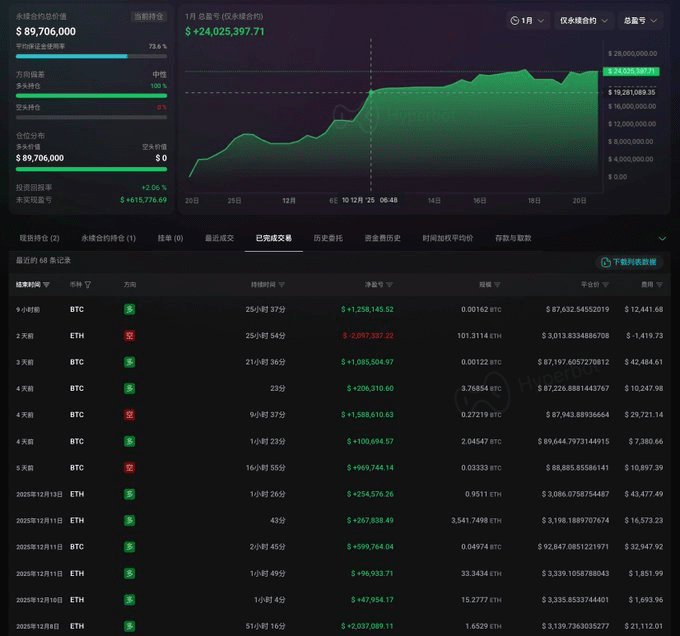
The outstanding operations of this address began recently in December. As of December 20, out of the 17 trades it made in December, 16 ended in profit.
● One typical victory occurred on December 16, when this address established a long position in BTC with 3x leverage worth approximately $85.76 million, temporarily becoming one of the largest BTC long positions on the Hyperliquid platform.
● However, even top traders cannot avoid mistakes. After taking profits on a BTC long position on December 17, it opened a short position in ETH. This trade ultimately ended with a loss of about $2.09 million, breaking its record of 13 consecutive winning trades.
● What truly reflects its professionalism is the speed of responding to mistakes. After closing its short position in ETH, it swiftly turned around, simultaneously establishing long positions in BTC and ETH with 3x leverage, not only recovering some losses but also continuing to expand its gains in subsequent market movements.
2. Whale Battleground on Hyperliquid
● 'pension-usdt.eth' is not an isolated case; the Hyperliquid platform it is on is currently one of the main battlegrounds for whale long-short battles. As of December 19, the total positions of whales on this platform reached $5.203 billion.
● A silent yet fierce confrontation is unfolding here. The long positions of whales amount to $2.523 billion, while short positions are slightly higher at $2.68 billion, resulting in a long-short position ratio of 0.94.
● The profit and loss situation vividly reflects the brutality of this confrontation: the overall floating loss of whale long positions is $251 million, while the overall floating profit of short positions is $350 million. This data profoundly reveals the immense pressure the recent market adjustment has brought to the long camp.
● The situation of whale '0xb317..ae' is an extreme embodiment of this pressure. This address went long with 5x leverage when the ETH price was $3147.39, and now it faces a paper loss of nearly $40 million. This trade has become a typical case for observing market sentiment and risk control.
● The subtle balance of long and short forces is reflected not only in the size of positions but also in the flow of funds. On December 17, a whale withdrew 775 BTC and 5,767 ETH from Binance, with a total value exceeding $84 million.
This behavior of large assets flowing from exchanges to private wallets is often interpreted by the market as a signal that selling pressure may ease, as it means these assets will not be easily sold on exchanges in the short term.
3. Withdrawals from Exchanges and Major Asset Rotations
● On-chain data acts like a mirror, reflecting the complex strategy layouts of whales. In addition to the long-short battles in the derivatives market, the large fund flows in the spot market are also worth paying attention to. The massive withdrawals on December 17 are just the tip of the iceberg. Such behavior often indicates that whales may be making adjustments to long-term asset allocations or preparing to participate in decentralized finance (DeFi) activities.
A larger rotation of assets is also quietly occurring. A whale address that has been dormant for seven years recently began to make large-scale adjustments, shifting its holdings from Bitcoin to Ethereum.
● This address previously held 10,606 BTC for seven years and has realized a profit of $1.12 billion. Recently, it sold 3,100 BTC, valued at approximately $348 million, while purchasing 50,522 ETH in spot and opening high-leverage long positions in ETH. This series of operations brought this address's total long exposure to ETH to about $784 million, demonstrating its strong confidence in Ethereum's future performance relative to Bitcoin.
● Asset rotation is happening not only between mainstream coins but also extending to platform tokens. On September 25, a whale deposited 6 million USDC into Hyperliquid and bought a large amount of the platform's native token HYPE, currently realizing a floating profit of $7.16 million.
4. The Truth and Misconceptions Behind Whale Behavior
Every move of whales stirs the nerves of the market, but their true intentions are often more complex than they appear. The latest analysis from Cointelegraph indicates that the behavior patterns of whales changed significantly in 2025.
A key turning point is considered to be October 10, 2025, a date viewed by many market participants as the 'unofficial end date' of the recent crypto bull market. On-chain data shows that when retail positions were largely cleared that day, an early Bitcoin whale successfully made about $200 million in profit.
Analysis indicates that early this year, 'veteran' whales significantly reduced their holdings, while institutional investors absorbed these sell-off chips. This exchange of new and old capital is reshaping the market structure of Bitcoin.
However, retail traders often misinterpret the signals of whale activities. Many investors blindly follow the large trades of whales, ignoring the complex strategies and unique circumstances behind those trades.
For example, some whale trades may be part of complex hedging strategies or to meet institutional liquidity needs, rather than simple directional bets. In 2025, as mainstream quantitative trading firms like Renaissance Technologies and Two Sigma deploy complex crypto algorithm strategies, the market structure becomes even more complicated.
Professional research reports indicate that the increase in position concentration is highly correlated with declining market liquidity and increased price volatility. When whales establish high-leverage positions in mainstream assets like Ethereum, it may trigger a chain liquidation, exacerbating market fragility.
5. The Survival Strategy Under the Shadow of Whales
In the face of a market dominated by whales, ordinary investors need rational strategies rather than blindly following trends. On-chain data should serve as one of the reference factors for decision-making, rather than the sole basis. For investors hoping to find signals from whale activities, they should focus on more persistent trends rather than individual trades.
● Understanding the limitations of whale behavior is crucial. First, the data is lagging; when retail investors see public whale trading information, the whales may have already started operating in the opposite direction.
● Secondly, the scale of whale funds and their risk tolerance are completely different from retail investors. They can withstand significant short-term fluctuations and even profit from them, which is often something retail investors cannot do.
● The high win-rate trades of 'pension-usdt.eth' provide a valuable observation window, but directly mimicking its operations carries significant risk. Although the address uses relatively low leverage of 2-3 times, its trading frequency and precise timing are difficult for ordinary investors to replicate.
When the 30,000 ETH long position of the 'pension-usdt.eth' address shines on the Hyperliquid leaderboard, another whale on the same platform suffers nearly $40 million in paper losses due to going long on ETH with 5x leverage.
These numbers record the brutality and opportunities of the crypto market. Bitcoin whales withdrew assets worth tens of millions of dollars from exchanges, and an address that had been dormant for seven years suddenly began to exchange Bitcoin for Ethereum; these on-chain traces weave together the complex expectations of institutions and large players for the future market.
In this long-short battle dominated by whales, the best strategy for ordinary investors may be to: keep observing, think independently, and consider on-chain signals as part of the puzzle rather than the only map to wealth.
Join our community to discuss and grow stronger together!
Official Telegram community: https://t.me/aicoincn
AiCoin Chinese Twitter: https://x.com/AiCoinzh
OKX Welfare Group: https://aicoin.com/link/chat?cid=l61eM4owQ
Binance Welfare Group: https://aicoin.com/link/chat?cid=ynr7d1P6Z