


Recently, a view has begun to emerge in the market suggesting that the four-year cycle pattern of Bitcoin and its inevitable rise and fall might be outdated. However, an executive from Fidelity, a large asset management company, pointed out that so far, the current trend of Bitcoin still aligns with the four-year cycle pattern, and the current bear market may continue into 2026.
The so-called four-year cycle is a price trend pattern related to the Bitcoin halving event (which occurs every four years). Each halving reduces the Bitcoin reward that miners can obtain for mining a block by 50%. The market generally believes that such a reduction will trigger a supply shock, thereby driving Bitcoin prices to see a significant surge, followed by a subsequent drop of about 80%, after which the market will slowly rise again until the next halving occurs.
Supporters of this view believe that this cycle is repeating the same pattern as the past three cycles: Bitcoin's price will surge significantly around the halving event in 2024, ultimately peaking at about $126,000 in October 2025, before entering a bear market— and the market is currently in this phase.
However, in the past few weeks, many well-known analysts have successively expressed support for the view that "the four-year cycle of Bitcoin is no longer applicable," including Grayscale, Bitwise's Chief Investment Officer Matt Hougan, and Ark Invest founder Cathie Wood. They believe that with the launch of Bitcoin ETFs, along with the gradual acceptance by regulatory environments and institutional investors, Bitcoin has been incorporated into the traditional financial system. Bitcoin is no longer a fringe asset, and therefore there is no reason to continue using price operating models from years ago.
Fidelity executive's perspective
Jurrien Timmer, the global macro head at asset management giant Fidelity, expressed a different view, stating that from various charts, there are no signs indicating that Bitcoin's four-year cycle has become ineffective. Timmer is one of the earlier proponents of Bitcoin within the traditional financial circle.
Timmer stated in a tweet released on December 19:
"Although I still hold a long-term bullish view on Bitcoin, my concern is that Bitcoin may have ended yet another four-year cycle in both price trend and timing. If we visually align and compare past bull markets (marked in green in the image below), we find that the $125,000 peak occurring in October after a 145-week rise aligns quite well with people's expectations for this situation."
Timmer then pointed out that a "Bitcoin winter" typically lasts about a year, leading him to conclude that 2026 could be a "year of consolidation" for Bitcoin. Regarding prices, he believes the support zone falls between $65,000 and $75,000.
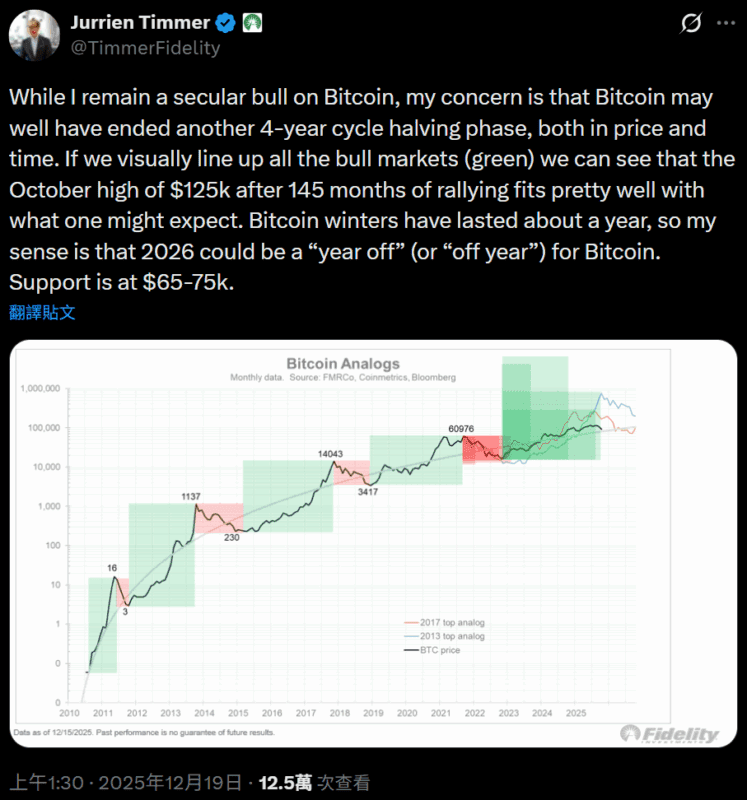 Source: Jurrien Timmer
Source
