
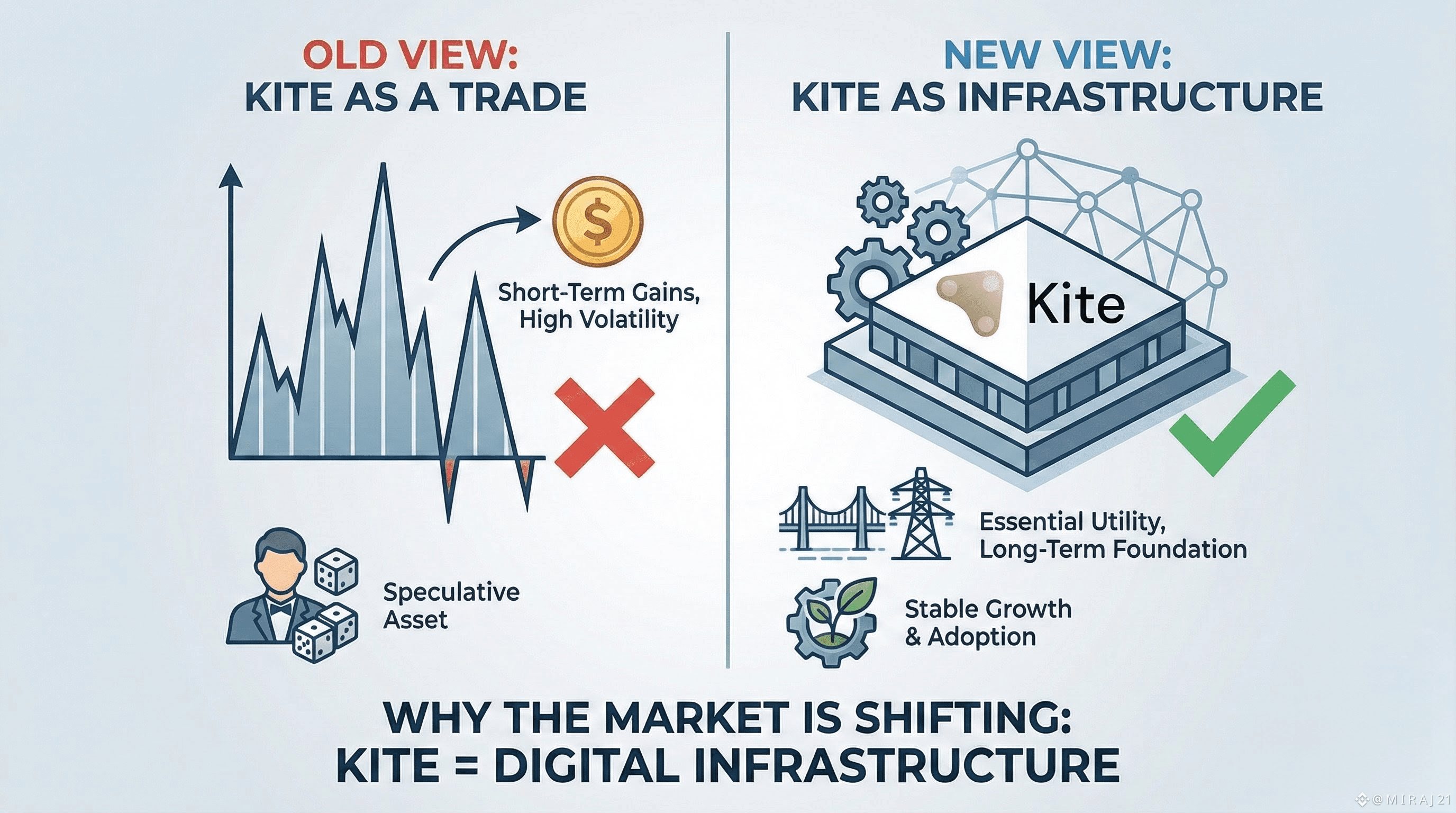
 There’s a subtle change happening around KITE, and it doesn’t show up clearly on short-term charts. It shows up in behavior. The way people talk about it has changed. The way builders reference it has changed. Even the way capital interacts with it feels different. KITE is slowly moving out of the category of “something to trade” and into the category of “something to rely on,” and that distinction matters more than most price movements ever will.
When an asset is treated like a trade, everything around it feels urgent. Entries, exits, timing, narratives they all revolve around short windows and fast reactions. But infrastructure doesn’t live in that world. Infrastructure lives in the background. It gets evaluated less on excitement and more on whether it continues working when no one is paying attention. And that’s exactly the shift KITE seems to be undergoing.
Part of this comes from what KITE is actually being used for. As autonomous agents become more common, the conversation is no longer about whether they’re impressive, but whether they can operate safely. Payments, permissions, and accountability are suddenly the bottlenecks. Builders aren’t asking how fast an agent can think they’re asking how it pays, how it stays within limits, and how its actions can be audited later. KITE sits directly in that problem space. And when something sits at the center of a real operational problem, it naturally stops being treated like a speculative bet.
Another signal is how patience has crept into the conversation. Traders talk in days and weeks. Infrastructure gets discussed in terms of roadmaps, reliability, and long-term fit. With KITE, more people seem willing to wait. Not because they expect a sudden breakout, but because they’re watching adoption take shape. They’re paying attention to integrations, tooling maturity, and whether the network continues to behave predictably under load. That kind of attention isn’t driven by hype it’s driven by evaluation.
There’s also less obsession with storytelling and more focus on mechanics. That’s a tell. When markets stop asking “what’s the narrative?” and start asking “does this actually solve the problem?”, something has shifted. KITE’s design identity layers, constrained autonomy, machine-native payments doesn’t lend itself to quick slogans. It lends itself to systems that need to keep working quietly. And markets tend to treat those systems differently, even if they don’t say it outright.
What’s especially interesting is that this shift doesn’t come with loud validation. No single announcement marks the moment. No big endorsement flips the switch. Instead, KITE is becoming infrastructure by being used as infrastructure. By showing up in conversations where failure is unacceptable. By being considered in designs where shortcuts aren’t an option. That kind of credibility accumulates slowly, and once it does, it’s hard to unwind.
This doesn’t mean volatility disappears or that speculation vanishes. Markets are still markets. But it does mean that a growing segment of participants no longer view KITE primarily through the lens of timing. They view it through the lens of dependency. And dependency changes behavior. People don’t flip in and out of infrastructure lightly. They build around it. They assume it will still be there tomorrow.
In crypto, this transition is rare. Many projects want to be infrastructure, but few are treated like it. The difference is whether the system solves a problem that doesn’t go away when the market cools. Autonomous agents aren’t going away. Machine-driven payments aren’t going away. The need for control, predictability, and accountability inside those systems isn’t going away either. KITE lives in that reality, not in a cycle.
That’s why the market’s behavior around it feels different now. Less noise. More observation. Less urgency. More consideration. It’s the kind of shift you only notice if you’re paying attention and once you notice it, it’s hard to unsee.
KITE isn’t being priced like infrastructure yet in every sense. But it’s starting to be treated like one. And in crypto, that change in mindset usually happens long before the charts catch up.

