
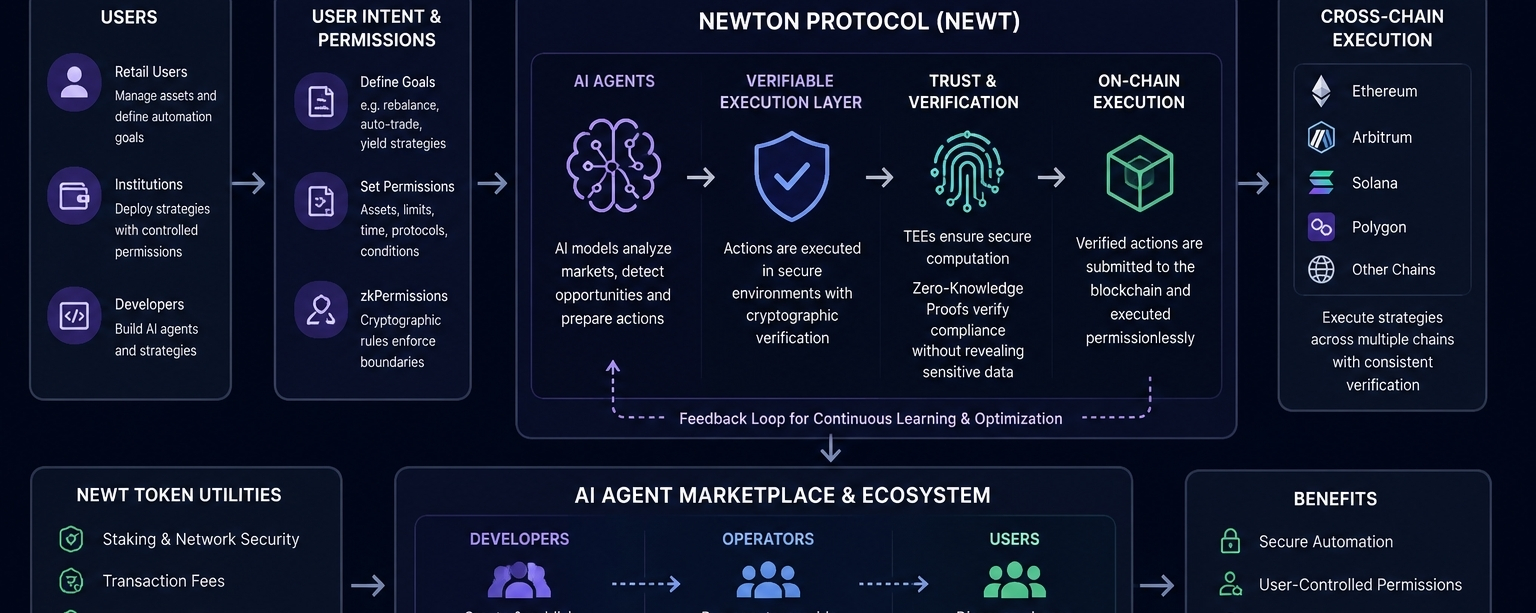

Artificial intelligence is becoming a bigger part of the crypto ecosystem, but one problem keeps appearing: trust. An AI agent can analyze markets, rebalance a portfolio, or execute trades around the clock, yet users still need confidence that it will only do what they actually authorized. That challenge sits at the center of Newton Protocol (NEWT), a project focused on creating infrastructure for secure, verifiable automation rather than simply adding AI to blockchain.
Instead of treating AI as another trading bot, Newton Protocol approaches the problem from the perspective of permissions, verification, and accountability. Its goal is to make automated on-chain actions possible without forcing users to hand over complete control of their wallets or private keys. This idea has become increasingly relevant as decentralized finance grows more complex and cross-chain activity becomes common.
One of the most interesting aspects of Newton Protocol is that it is designed as a verifiable automation layer. Rather than asking users to trust an AI model blindly, the protocol attempts to verify that every action follows rules established beforehand. These rules define what an agent can do, which assets it can access, when it can act, and under what conditions its permissions expire. This creates a framework where automation is limited by predefined boundaries instead of unrestricted authority.
This design addresses a common weakness found in many automated crypto tools. Traditional bots often require broad wallet permissions or even direct access to private keys. While convenient, those approaches introduce obvious security risks. Newton Protocol seeks to replace trust in centralized bot operators with cryptographic verification, allowing automated execution while keeping users in control of their assets.
Another notable element is its focus on AI-driven strategies. Markets operate continuously, making them difficult for individual traders to monitor every minute of the day. AI agents can potentially react faster to market changes, rebalance portfolios, execute recurring purchases, manage liquidity positions, or carry out predefined trading strategies automatically. Newton Protocol aims to provide the infrastructure where these automated decisions happen within strict security guardrails instead of open-ended permissions.
Security is supported through a combination of Trusted Execution Environments (TEEs) and zero-knowledge proofs. TEEs create protected environments where sensitive computations can occur securely, while zero-knowledge proofs provide mathematical evidence that an action followed approved rules without revealing unnecessary private information. Together, these technologies attempt to balance automation, privacy, and transparency—a combination that has historically been difficult to achieve in decentralized systems.
The protocol also introduces the idea of programmable permissions, sometimes described as zkPermissions. Instead of granting unlimited wallet access, users specify detailed conditions that define exactly what an AI agent may do. Permissions can include transaction limits, approved assets, expiration times, or specific protocols that an agent may interact with. If the requested action falls outside those rules, it should not be executed. This permission-based model could make AI automation more acceptable for users who remain cautious about delegating financial decisions.
Beyond automation itself, Newton Protocol proposes a marketplace for AI developers. This is an important part of its broader vision because successful AI ecosystems often depend on open participation rather than closed development. Developers can create specialized agents for different use cases, while operators run those agents and users select the ones that best match their objectives. Instead of relying on a single company to build every tool, the protocol encourages an ecosystem where many contributors can participate.
The marketplace concept also introduces economic incentives. Developers can register their models, operators provide collateral using NEWT tokens to offer automation services, and successful execution generates fees. At the same time, poor or dishonest behavior may result in penalties through slashing mechanisms, creating incentives for reliable service rather than unchecked automation.
The NEWT token itself is intended to play several roles inside the ecosystem. According to the project's documentation, it is designed for network staking, transaction fees, collateral for agent operators, participation in the model registry, and eventually governance as the protocol decentralizes. Rather than functioning only as a payment token, NEWT is meant to support both the technical operation and economic security of the network.
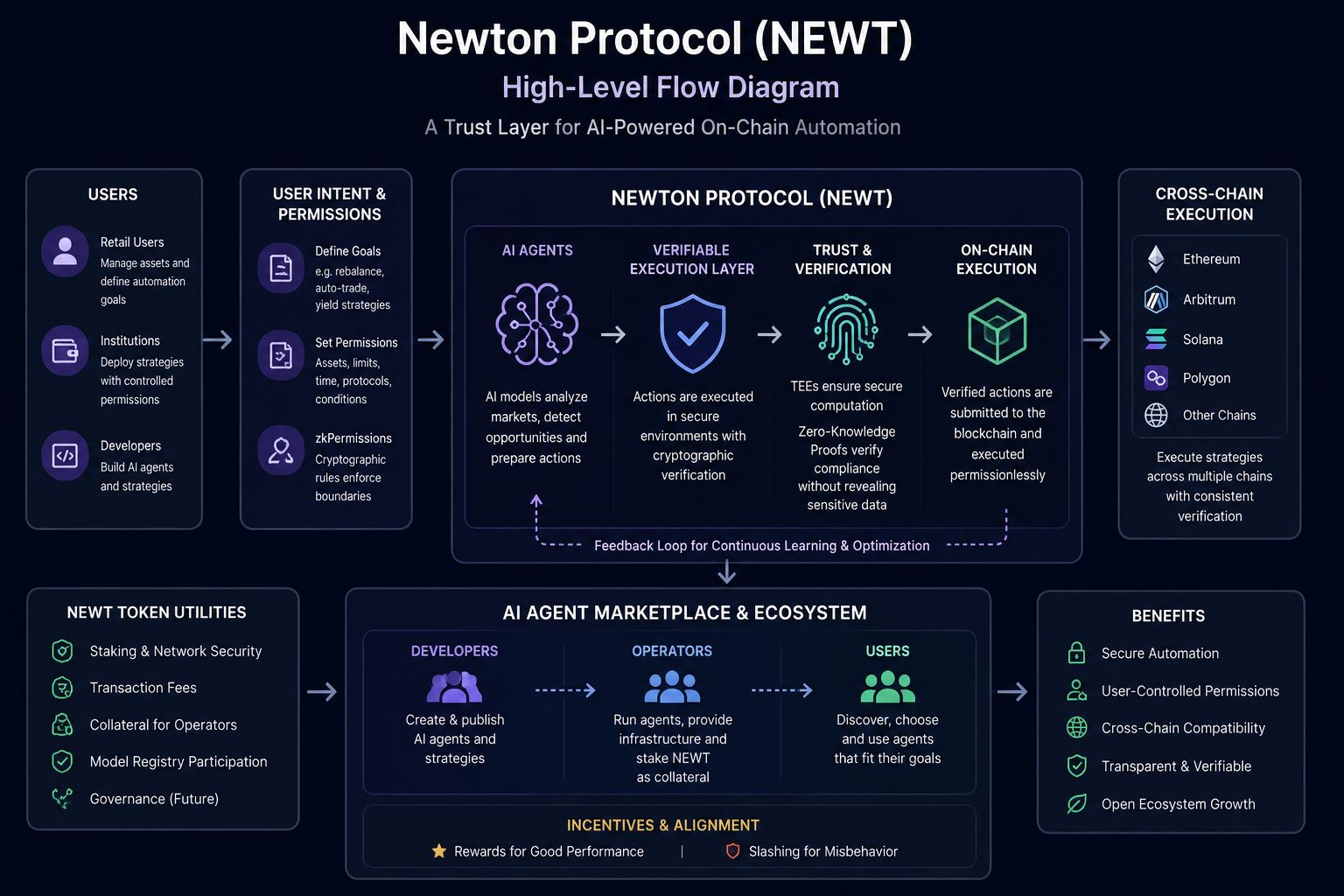
Cross-chain compatibility is another practical objective. Crypto users increasingly move assets between different blockchain networks, making manual management more complicated than it was only a few years ago. Newton Protocol aims to allow AI agents to execute strategies across multiple supported chains while maintaining the same verification standards regardless of where the transaction occurs. If successful, this could reduce much of the operational friction associated with managing assets across fragmented ecosystems.
Still, it is important to view the project with balanced expectations. AI-assisted finance remains an evolving field. Sophisticated automation does not guarantee profitable trading, and even advanced AI models can make incorrect decisions when markets behave unpredictably. Secure infrastructure can reduce operational risks, but it cannot eliminate investment risk or market volatility. As with any emerging blockchain project, long-term adoption will depend not only on technology but also on developer participation, user confidence, ecosystem growth, and real-world utility.
What makes Newton Protocol particularly interesting is that it focuses less on claiming AI will outperform human traders and more on building the infrastructure needed for trustworthy automation. The distinction matters. Many projects promise smarter algorithms, but relatively few concentrate on proving that automated actions actually follow user-defined rules. That emphasis on verification could become increasingly valuable as AI agents take on more responsibility in decentralized finance.
The broader crypto industry is gradually moving toward intent-based interactions, where users describe what they want to achieve instead of manually executing every transaction themselves. Newton Protocol appears to fit within that direction by attempting to combine automation, cryptographic verification, decentralized incentives, and developer participation into a single framework. Whether it ultimately becomes a foundational layer for AI-powered finance will depend on adoption and execution, but it represents an interesting attempt to solve one of the industry's most practical challenges: enabling intelligent automation without sacrificing security or user control.