
Michael Saylor's bitcoin treasury company, Strategy, did not acquire any additional bitcoin last week, ending a two-week streak of steady accumulation. Instead, the firm added $748 million to its USD reserve, bringing the fund’s total from an initial $1.44 billion cash buffer to $2.19 billion, according to a disclosure filed with the U.S. Securities and Exchange Commission on Monday.
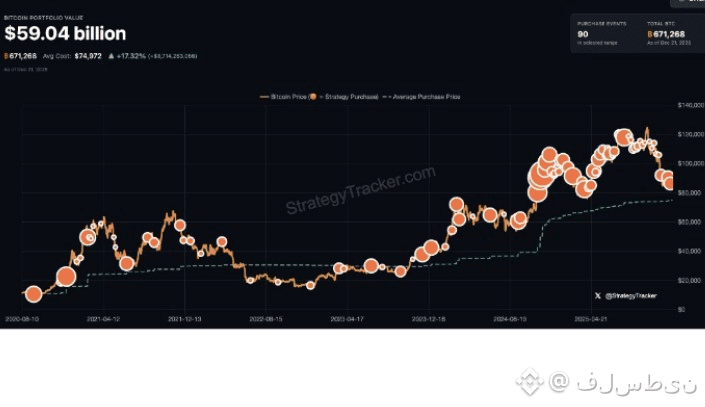
Established in early December as part of Strategy’s new capital structure, the USD reserve is intended to support future dividend payments and provide flexible liquidity as Saylor's DAT expands its hybrid cash-and-bitcoin treasury model. Strategy continues to hold 671,268 BTC, its largest-ever BTC balance, unchanged from the prior week.
The pause marks a brief shift in the firm’s aggressive cadence of BTC acquisitions. Over the last two weeks alone, Strategy purchased more than 21,000 BTC for roughly $1.9 billion, including last week's 10,645 bitcoin buy for about $980 million
Saylor posted the phrase “Green dots ₿eget orange dots” on Sunday, when he typically telegraphs imminent bitcoin purchases. But unlike previous weeks, the update did not precede a new accumulation filing.
The divergence suggests last week’s cash buildup was prioritized over BTC buys, though Strategy’s overarching playbook still centers on long-term acquisition. The firm has repeatedly said that bitcoin remains its primary treasury asset and capital-raising engine, with USD reserves designed to stabilize dividends and operational liquidity.
Last Monday, Strategy announced it had acquired 10,645 BTC for about $980.3 million at an average price of $92,098 per bitcoin — its second consecutive week of five-figure purchases. That pushed its treasury to 671,268 BTC, marking its largest acquisition since the summer and narrowly topping the prior week's 10,624 BTC addition.
The company also remains locked in a dispute with MSCI over a proposed rule that would exclude firms whose digital-asset holdings exceed 50% of total assets from core global equity benchmarks. Strategy has argued the framework would cause "whiplash" in index composition, pushing bitcoin-treasury companies on and off major indexes whenever BTC price volatility shifts their balance-sheet ratios.
In a 12-page submission last week, the firm said MSCI's threshold contradicts the U.S. government's broader digital-asset innovation agenda and would inject unnecessary instability into index methodologies. MSCI maintains that digital-asset treasury firms are more akin to investment vehicles than operating companies, creating classification issues for flagship equity families. A final decision is due Jan. 15 ahead of February's rebalance.
Strategy retained its place in the Nasdaq 100 on Friday despite the mounting scrutiny of its bitcoin-dominant model.
Crypto treasury pressure persists
Bitcoin Treasuries data shows that 192 public companies now hold bitcoin in some capacity, including Marathon Digital, Twenty One, BitMine, Metaplanet, Blockstream founder Adam Back's vehicle, Bitcoin Standard Treasury Company, Bullish, Riot Platforms, Coinbase, Hut 8, and CleanSpark, with holdings ranging from above 53,000 BTC to just over 13,000 BTC.
But despite an accumulation spree seen in 2025, shares of digital asset treasury firms remain under pressure. Many are well below their summer peaks, with market cap-to-net asset value ratios compressed across the cohort.
Strategy's mNAV currently sits just under parity — with its basic mNAV around 0.80 — reflecting the broader sector retracement.
Strategy’s common stock closed at $164.82 on Dec. 19 and remains deeply underwater for the year, down about 43% year to date, compared with bitcoin’s roughly 4–5% decline in 2025, according to The Block's price and stock pages.
