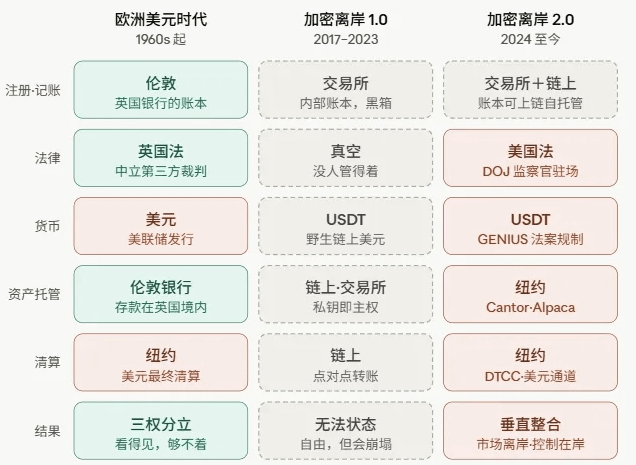
How the United States uses three reins to tame crypto wild ones into an overseas arm of the dollar empire
When you put these two things together, it’s quite interesting:
I. With EU MiCA taking effect, Binance withdrew its application and exited Europe.
II. On the same day, Binance stock trading went live for 30 days, AUM surpassed $1 billion, and 73% of users came from emerging markets.
This isn’t a coincidence; it’s a watershed between two eras.
Europe is still chasing people all over the world with licenses in hand, while the U.S. has already changed the game—no need to regulate the market; you only need to own the pipeline.
Three reins:
Custody—Binance’s $1 billion in stock assets are held in custody by Alpaca, which is in the United States.
Clearing—through DTCC, the dollar’s ultimate clearing channel, in the United States.
Law—Binance pleaded guilty to the U.S. Department of Justice in 2023. Besides the $4.3 billion fine, American compliance supervisors moved directly into Binance.
It doesn’t matter where you registered, and it doesn’t matter who you serve. If you hold these three reins, you are the overseas node of the U.S. financial system.
Now look at Tether.
Every extra USDT issued worldwide means an additional $1 of U.S. Treasury purchase. On Tether’s balance sheet, there are over $100 billion worth of Treasuries held at Cantor in New York. With the GENIUS Act taking effect, what counts as a legal on-chain dollar is determined in Washington. Tether didn’t resist; it just rebuilt itself to comply with the standard.
This isn’t regulation—it’s incorporation.
The former lawless renegades are turning into licensed offshore dollars and offshore brokers.
Compare the Eurodollar era (since the 1960s): when the dollar ran to London, the money was recorded in British banks’ accounts, and contracts were governed by English law. The U.S. could see it—but couldn’t reach it. That was a loophole in the dollar system.
So what now? Crypto offshore 2.0: ledgers can be put on-chain for self-custody, but custody is in New York; clearing goes through DTCC; and the law belongs to the U.S. DOJ. It’s visible—and reachable.
The U.S. has closed that old loophole.
And this deal is too good for the U.S.:
Now, with billions of people worldwide, U.S. banks are too lazy to open accounts for them, and U.S. brokers can’t access their markets. Now Binance sells U.S. stocks to Jakarta and Lagos for the U.S., and Tether puts dollars into every smartphone for the U.S.
They sell U.S. assets, receive dollars, and Tether takes the money and turns around to buy U.S. Treasuries. The customers are someone else’s, the risks are someone else’s, the regulatory costs are zero, and the demand for Treasuries plus the seigniorage accrues to the U.S.
What about Europe? MiCA pushes Binance and Tether away. The auto market is being eaten away by China; AI is nearly out of the picture; even the crypto market is handed over to others.
A set of facts on the ground is being written into law.
GENIUS is already in place; CLARITY is on the way.
The picture of the future is already clear:
USDT is a licensed offshore dollar, and Binance is a licensed offshore broker.
Crypto is no longer a place beyond the law. It’s the new frontier of the dollar empire.