

I've spent enough time watching crypto trends come and go that I don't get excited just because a project throws AI into its pitch. Honestly, that's been the easiest way to grab attention for the past couple of years. Every week there's another protocol claiming it's building the future with AI, another token promising autonomous agents, another thread filled with impossible charts and buzzwords that don't really explain anything. After a while you stop listening. You almost have to. But Newton Protocol caught my attention for a different reason, and it wasn't because it promised smarter trading bots or some magical AI that never loses money. It was because it started with infrastructure instead of fantasy. That sounds boring, I know, but infrastructure is usually where the real value hides.
Let's be honest here, AI has become ridiculously capable over the last couple of years. By January 2026, people aren't just asking chatbots random questions anymore. They're building agents that write code, manage workflows, analyze financial markets, book meetings, monitor portfolios, and basically act like digital employees. That's cool until those agents have permission to move real money. Then things get messy really fast. A language model making a typo in an email isn't the end of the world. An AI making the wrong trade with your entire portfolio? Different story. That's where I think a lot of projects still don't have a convincing answer.
Newton Protocol seems to start from that uncomfortable question instead of pretending it doesn't exist. If AI is eventually going to control assets, execute trades, interact with smart contracts, and make financial decisions without someone clicking every button manually, then where exactly should all that happen? Existing blockchains weren't really designed with autonomous AI agents in mind. They can run smart contracts just fine, but AI isn't a normal smart contract. It's constantly processing information, adjusting strategies, responding to changing markets, and generating decisions that aren't fixed months in advance.
Actually, wait...that's probably the biggest misunderstanding I keep seeing online. People still compare AI agents to old trading bots. They're not the same thing. Traditional bots follow instructions. If this happens, do that. End of story. AI agents can adjust based on context, recognize patterns they've seen before, and sometimes even surprise their own developers. That flexibility is powerful, but it's also exactly why secure execution matters so much.
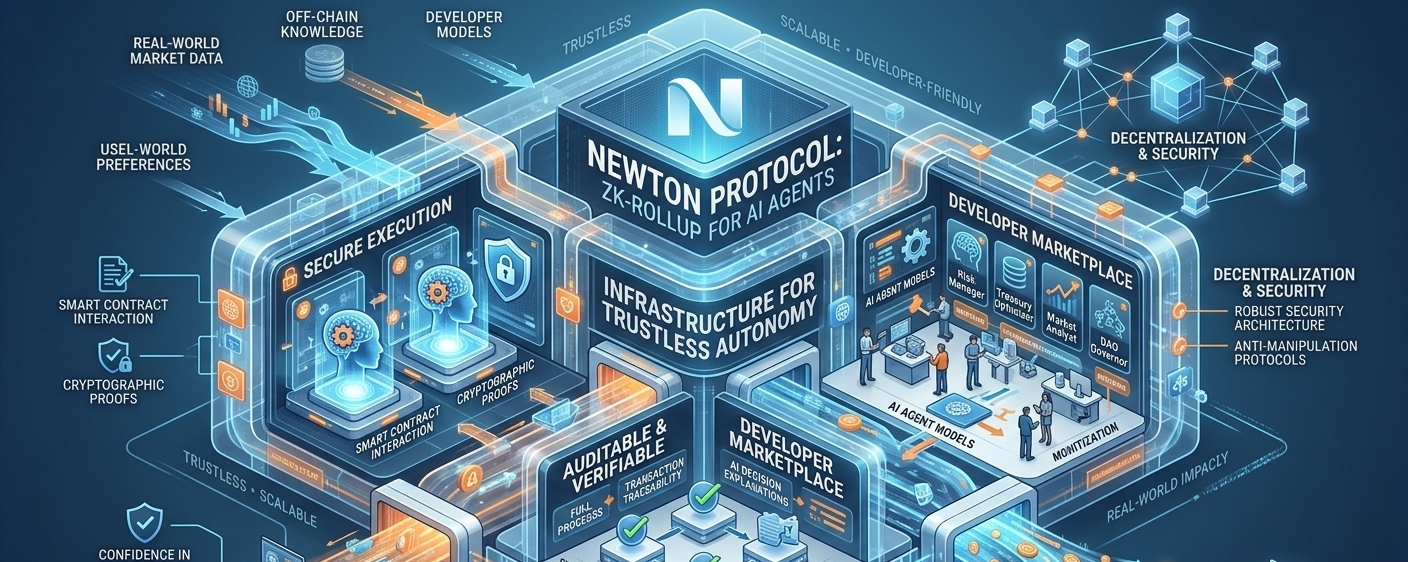
I almost forgot to mention something that really stands out to me. Newton isn't just talking about AI trading. Everyone focuses on trading because that's what gets attention on Crypto Twitter, but there's a bigger picture here. Imagine developers building specialized AI agents for research, risk analysis, portfolio balancing, treasury management, liquidity optimization, or even DAO governance. Suddenly you're not talking about one product anymore. You're talking about an ecosystem where developers create useful tools and users choose the ones they trust.
That marketplace idea actually feels underrated. Most talented AI developers aren't marketing experts. They build incredible models, then struggle to reach users. On the other side, most users have absolutely no clue how to train or deploy advanced AI systems themselves. Newton is basically trying to connect those two groups through blockchain infrastructure instead of another centralized platform deciding who gets visibility.
Now, does that automatically mean it'll succeed? No. Absolutely not. Crypto has a habit of making difficult problems sound simple. Security isn't simple. Decentralization isn't simple. AI definitely isn't simple. Combine all three and you've probably created one of the hardest engineering challenges imaginable.
That's actually why I don't mind when a project admits complexity instead of pretending everything is solved. Too many whitepapers read like someone discovered perfection. Reality doesn't work like that. Markets break. Networks get congested. Smart contracts contain bugs. AI models hallucinate. Developers make mistakes. Humans panic. Every serious protocol has to assume failure is possible and design around it.
One thing I keep thinking about is trust. People love saying blockchain removes trust, but that's only half true. You still trust the code. You trust developers. You trust security audits. You trust validators. Now you're adding AI into that equation, which introduces another layer entirely. Can users understand why an AI made a certain financial decision? Can they verify it wasn't manipulated? Can they inspect its activity afterward? Those questions matter a lot more than whether an agent made 18% or 22% returns last month.
The rollup approach makes sense from that perspective. Processing everything directly on a major blockchain would become expensive and slow if AI agents are constantly interacting with decentralized applications. Rollups already proved themselves as scaling solutions, so adapting that idea specifically for AI feels logical rather than forced. It's not flashy, but honestly, boring architecture usually outlasts exciting marketing.
Something else people rarely talk about is developer experience. Crypto loves users, investors, influencers, and traders. Developers sometimes feel like an afterthought even though they're the people building everything everyone else uses. If Newton creates an environment where AI developers actually want to launch products because deployment is easier, monetization is fair, and security tools are already available, that alone could become one of its strongest advantages.
Anyway, I think we're entering a weird phase where AI agents stop being experiments and start becoming infrastructure themselves. That's a strange sentence to say out loud, but I think it's true. Five years ago people wanted AI assistants. Today people want AI workers. The next step is AI systems cooperating with other AI systems while humans mostly supervise the results instead of handling every tiny decision.
That shift changes blockchain too. Smart contracts suddenly aren't enough by themselves. Static code doesn't adapt to market sentiment or changing volatility. AI agents do. But they also introduce unpredictability, and unpredictability inside financial systems isn't something you ignore because everyone's excited about the latest demo.
Here's my hot take. I think the next crypto cycle won't be won by whoever has the flashiest AI model. It'll probably be won by whoever builds the safest environment for AI to operate. That's less exciting than showing screenshots of an agent making profitable trades, but it's probably where lasting value gets created.
People also underestimate how much institutions care about auditability. Retail users sometimes just want something that works. Larger firms usually want explanations, records, compliance, and accountability. If an autonomous system is managing millions of dollars, someone eventually asks why it made Decision A instead of Decision B. That's where transparent execution suddenly becomes incredibly important.
Of course, there are still risks everywhere. Regulations keep changing depending on where you look. Security threats never disappear. AI models still produce unexpected outputs under certain conditions. Competition is getting tougher because almost every serious blockchain project now has some kind of AI strategy. Newton doesn't get a free pass just because the idea sounds interesting. It'll have to execute consistently, attract developers, keep users interested, and prove the infrastructure can actually handle real workloads instead of controlled demonstrations.
Still, I can't shake the feeling that this is one of those projects where the boring parts deserve more attention than the flashy parts. Everyone tweets about autonomous trading because it's exciting. Almost nobody tweets about execution layers, verification, secure rollups, or infrastructure architecture because they're harder to explain. Ironically, those boring pieces are probably the reason any serious AI economy works at all. Without them, everything else starts feeling clunky, fragile, and built on hype instead of something people would actually trust with real assets.
