

In crypto, technology and demand rarely arrive together.
Sometimes a solution appears exactly when users need it. Other times, it addresses a problem that only becomes obvious much later. Those second-type ideas are harder to judge because they can be strong technically while adoption stays slow simply because the market isn’t ready yet.
Newton Protocol feels like it sits in that category.
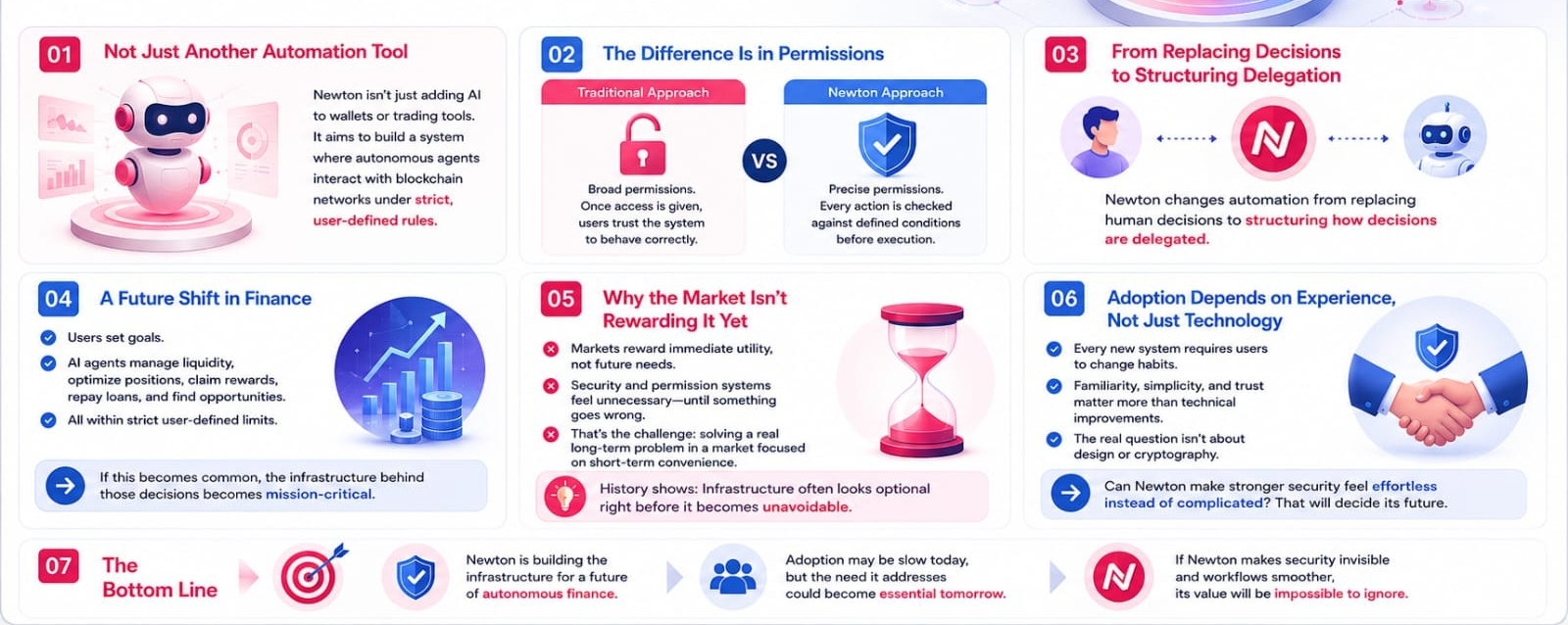
Instead of treating AI as a simple feature inside wallets or trading tools, it aims to create a system where autonomous agents can interact with blockchain networks under strict, user-defined rules. Rather than giving full control to an AI, users set clear boundaries, and every action is verified before execution.
The interesting part isn’t automation itself — that already exists.
We already have trading bots, yield optimizers, and portfolio managers running across DeFi. The difference is that most of them still rely on broad permissions. Once access is given, users trust the system to behave correctly.
Newton explores a different model where permissions are precise, and every meaningful action is checked against defined conditions before it happens.
This changes the idea of automation from replacing human decisions to structuring how decisions are delegated.
Whether this becomes essential depends on how quickly finance moves toward autonomous systems.
Today, most users still control everything manually — when to trade, move funds, or rebalance positions. AI can assist, but final approval is usually human.
Now imagine a shift where users simply define goals, and AI agents manage liquidity, optimize positions, claim rewards, repay loans, and search for opportunities automatically — all within strict user-defined limits.
If that becomes common, the infrastructure behind those decisions becomes far more important than it is today.
But markets don’t usually reward future needs early.
They reward immediate utility.
Most users adopt tools that solve today’s problems, not ones that might become critical later. Improvements in security or permission systems often feel unnecessary until a mistake actually happens.
That puts Newton in a difficult position — solving a real long-term problem in a market focused on short-term convenience.
History shows similar patterns. Cloud infrastructure digital payments and smartphones all existed long before they became essential. Infrastructure often looks optional right before it becomes unavoidable.
That’s what makes Newton interesting, even if adoption still feels early.
Of course, building technology is one thing — adoption is another.
Every new system requires users to change habits and that shift is rarely driven by technology alone. Familiarity simplicity and trust often matter more than technical improvements.
So the real question for Newton is not about design or cryptography.
It’s whether it can make stronger security feel effortless instead of complicated.
If protection feels like extra friction users won’t adopt it. But if it quietly improves workflows in the background its value becomes much easier to recognize.
That difference may decide whether Newton remains niche infrastructure or becomes something much more widely used.
