
Brothers, Sun Ge's recently launched USDD and Binance's staking activities are very simple to participate in, even beginners can benefit!
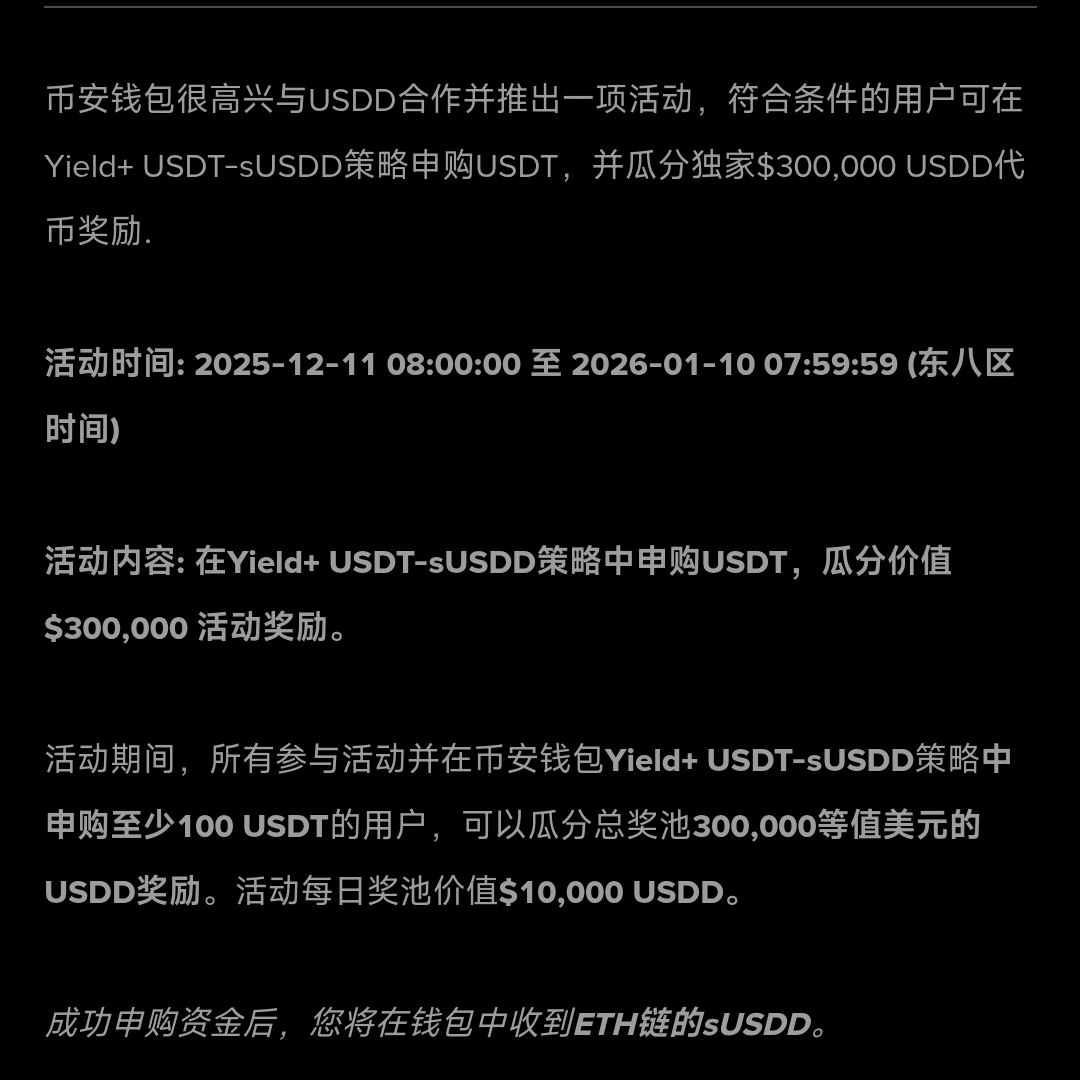
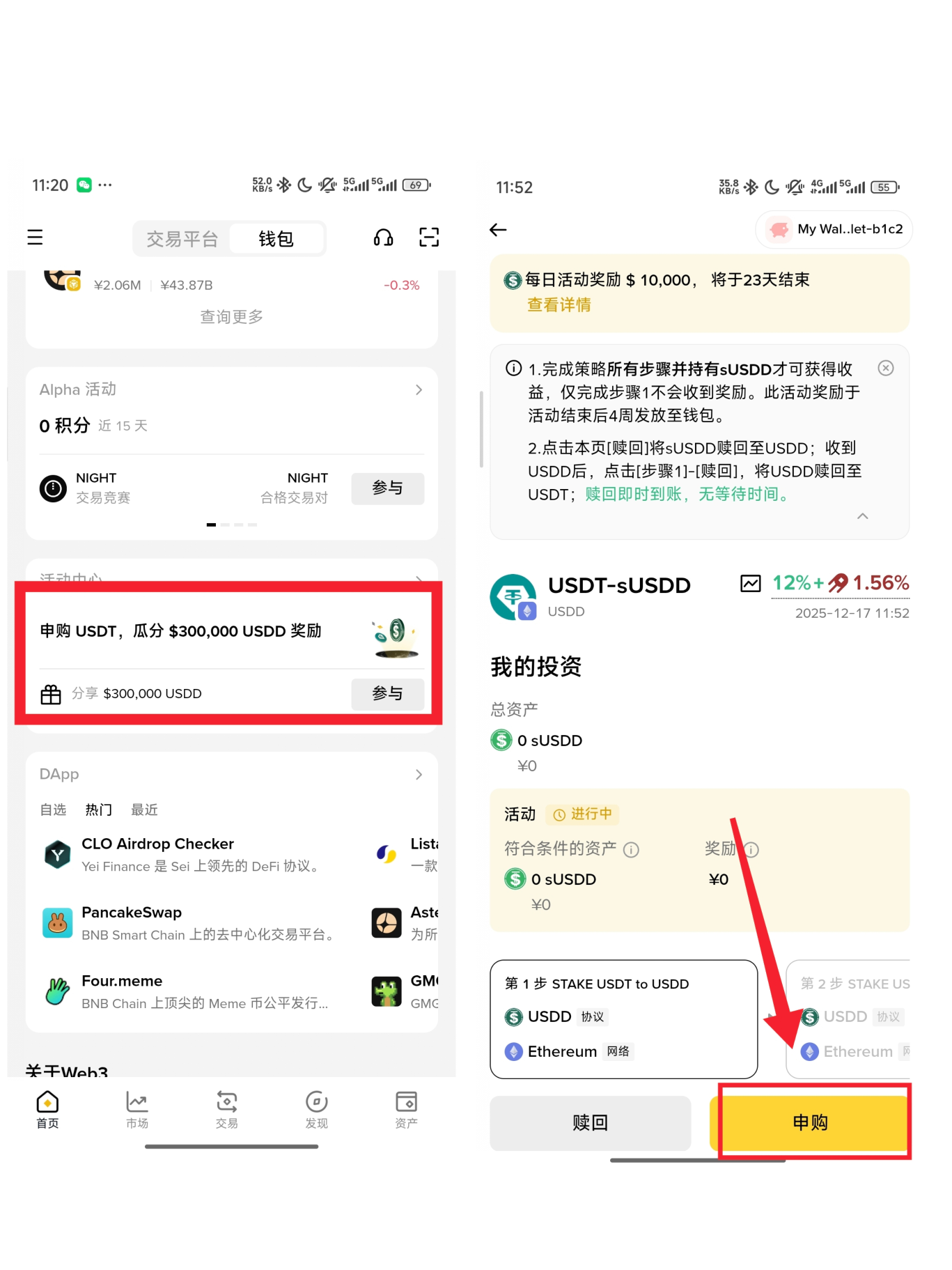
Specific steps:
Open the Binance wallet and scroll down to find the activity center.
Click on the USDD staking activity.
Enter the page to stake (minimum stake 100u).
Staking completed, the activity will automatically detect participation and distribute airdrops.
The USDD 2.0 promoted by Sun Yuchen has completed a comprehensive upgrade, fundamentally solving the shortcomings of the previous USDDOLD, achieving an overall innovation in mechanism design and governance structure, while enhancing security and ensuring returns. Its core improvements are mainly reflected in the following four aspects:
I. Stability Mechanism Upgrade: Transitioning from algorithmic adjustment to over-collateralization, enhancing anchor reliability.
Previously, USDDOLD adopted an algorithmic stablecoin model, relying on algorithms to adjust market supply and demand to maintain currency value stability, which could easily decouple during volatile market conditions, resulting in a relatively weak stability foundation. The USDD 2.0, officially launched in January 2025, has transformed into an over-collateralized decentralized stablecoin, requiring users to use high-quality assets such as TRX and USDT for over-collateralization to mint USDD, ensuring the collateral value is always higher than the face value of the generated tokens. Meanwhile, combined with a dedicated price stability module (PSM), it can achieve 1:1 instant lossless exchange between USDD and mainstream stablecoins, controlling price fluctuations within 0.5%, allowing it to maintain stable anchoring with the US dollar even under extreme market conditions, providing a more reliable environment for holding and mining.
II. Governance Model Transformation: Transitioning from centralized management to user autonomy, enhancing autonomy.
The issuance and full management of USDDOLD were previously solely handled by TRON DAO Reserve, where users could only conduct basic transactions and could not participate in governance, making asset security highly reliant on the credit of centralized institutions. USDD 2.0 fully implements decentralized principles, transferring governance rights entirely to the community, allowing any user to freely mint or burn USDD with compliant collateral assets. This token features on-chain native characteristics of immutability and non-freezability, with transfers confirmed within 3 seconds, significantly enhancing transaction flexibility and asset control, effectively avoiding risks from centralized institutional control.
III. Enhanced Information Transparency: Asset data is fully traceable on-chain, strengthening credibility.
The collateral asset information of USDDOLD was previously not disclosed completely, making it difficult for users to verify the actual reserve situation, affecting the establishment of system trust. USDD 2.0 has realized full-chain operation, with all collateral asset details and cash flow publicly available in real-time, facilitating global user supervision and verification. Additionally, the protocol has passed comprehensive audits by well-known security institutions such as ChainSecurity, confirming that its smart contract security level and asset repayment capability are among the best in the industry, with every asset movement being traceable, fundamentally safeguarding user rights and the system's risk resistance capability.
IV. Economic System Reconstruction: Transitioning from subsidy-driven to self-profitability, ensuring sustainable returns.
In the past, the profits of USDDOLD primarily came from external subsidies from TRON DAO, and the profit model lacked sustainability, with long-term returns lacking stable support. In June of this year, USDD 2.0 introduced the innovatively designed Smart Allocator, which allocates idle reserve assets to mature DeFi protocols such as Aave and JustLend through a fully on-chain, transparent, and auditable strategy to obtain continuous returns, thereby freeing itself from dependence on external subsidies and achieving self-profitability for the protocol. According to official data, the cumulative profit has now exceeded $7.2 million, providing a solid foundation for various high-yield mining activities, making user returns more sustainable.
